A new analysis of Hadrian’s Villa's concrete reveals how slowly forming calcite helped seal cracks, reinforce pores, and preserve ancient Roman infrastructure for nearly 2,000 years.
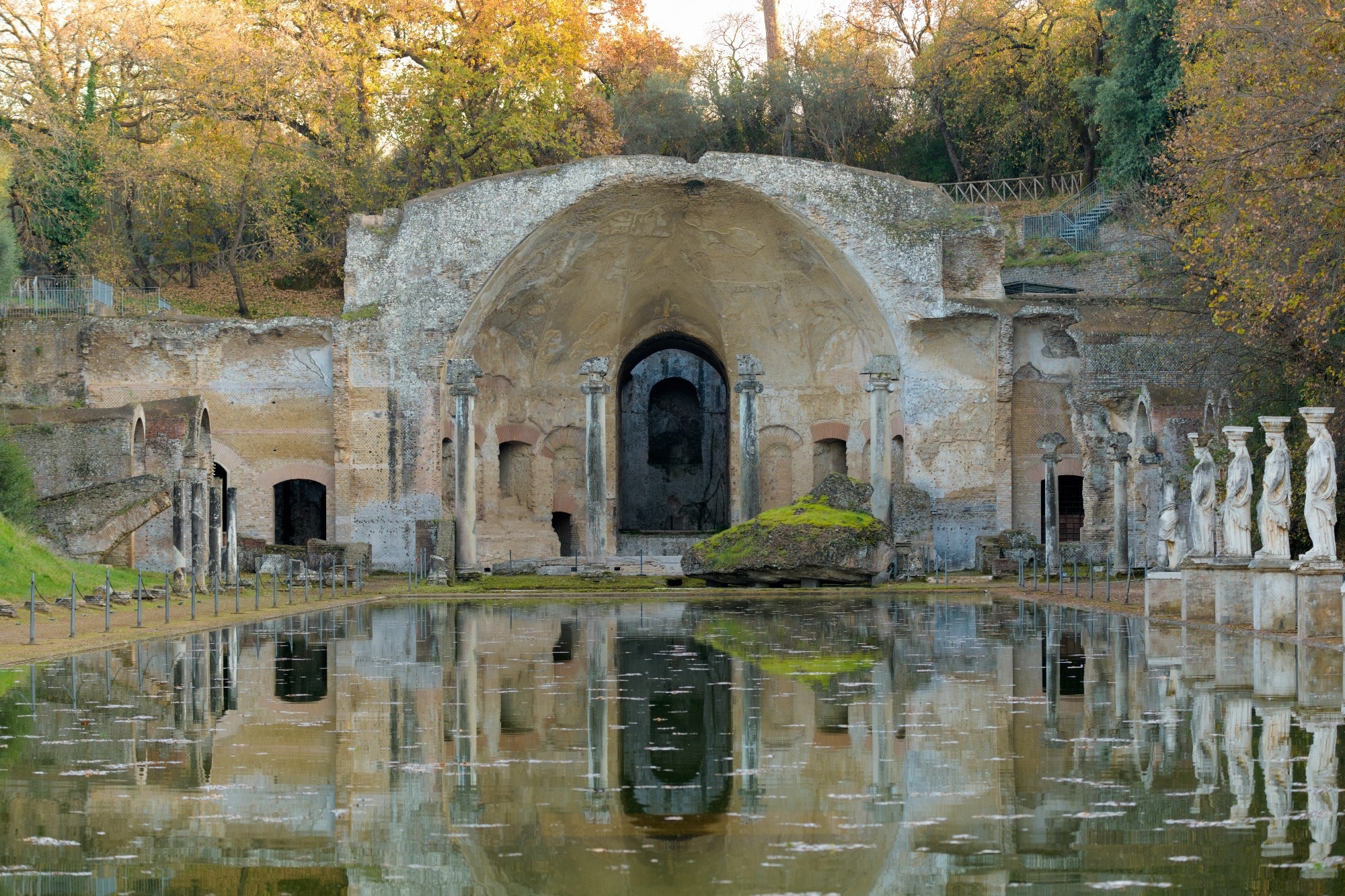
Hadrian’s Villa (Villa Adriana; Villa Hadriana) - The Canopus and Temple of Serapis - villa of emperor Hadrian near Tivoli outside Rome, Italy. Image Credit: Dima Moroz / Shutterstock. Paper: Mineralized carbonates contribute to the millennial durability of Roman concrete
A recent study published in the journal Science Advances reveals that long-term carbonate mineralization was a major, previously underappreciated contributor to the durability of this inland Roman concrete.
Researchers investigated concrete from Hadrian's Villa using advanced multiscale imaging and spectroscopic techniques to examine how carbonate minerals evolved over nearly two millennia. The findings provide new insight into the mineralogical evolution of this Roman concrete sample and could guide the development of more durable and sustainable cementitious materials.
Understanding the Long-Term Durability of Roman Concrete
Roman concrete remains one of the most durable construction materials ever produced, with many buildings, aqueducts, and harbors still serviceable after nearly two millennia, although the paper cautions against direct comparisons with modern reinforced concrete. Scientists have long credited this durability to the pozzolanic reaction between lime and volcanic ash. This reaction forms calcium-aluminum-silicate-hydrate (C-A-S-H), a binding gel that helps hold the material together.
Previous studies identified calcite as the dominant binding mineral in several ancient concretes, suggesting that long-term carbonation may have contributed more to durability. However, researchers have not fully understood how carbonate minerals evolved or how they strengthened the concrete over time. To investigate this question, the researchers analyzed concrete from a second-century AD latrine within Hadrian's Villa in Tivoli, Italy.
The team examined how lime-derived phases gradually transformed into calcite over centuries of natural carbonation, rather than focusing solely on hydration products. They also investigated how this mineralization influenced pore structure, crack healing, and the overall stability of the concrete. The findings provide a more complete picture of the durability of this Roman concrete in inland settings and offer valuable guidance for designing low-carbon cementitious materials with improved long-term performance.
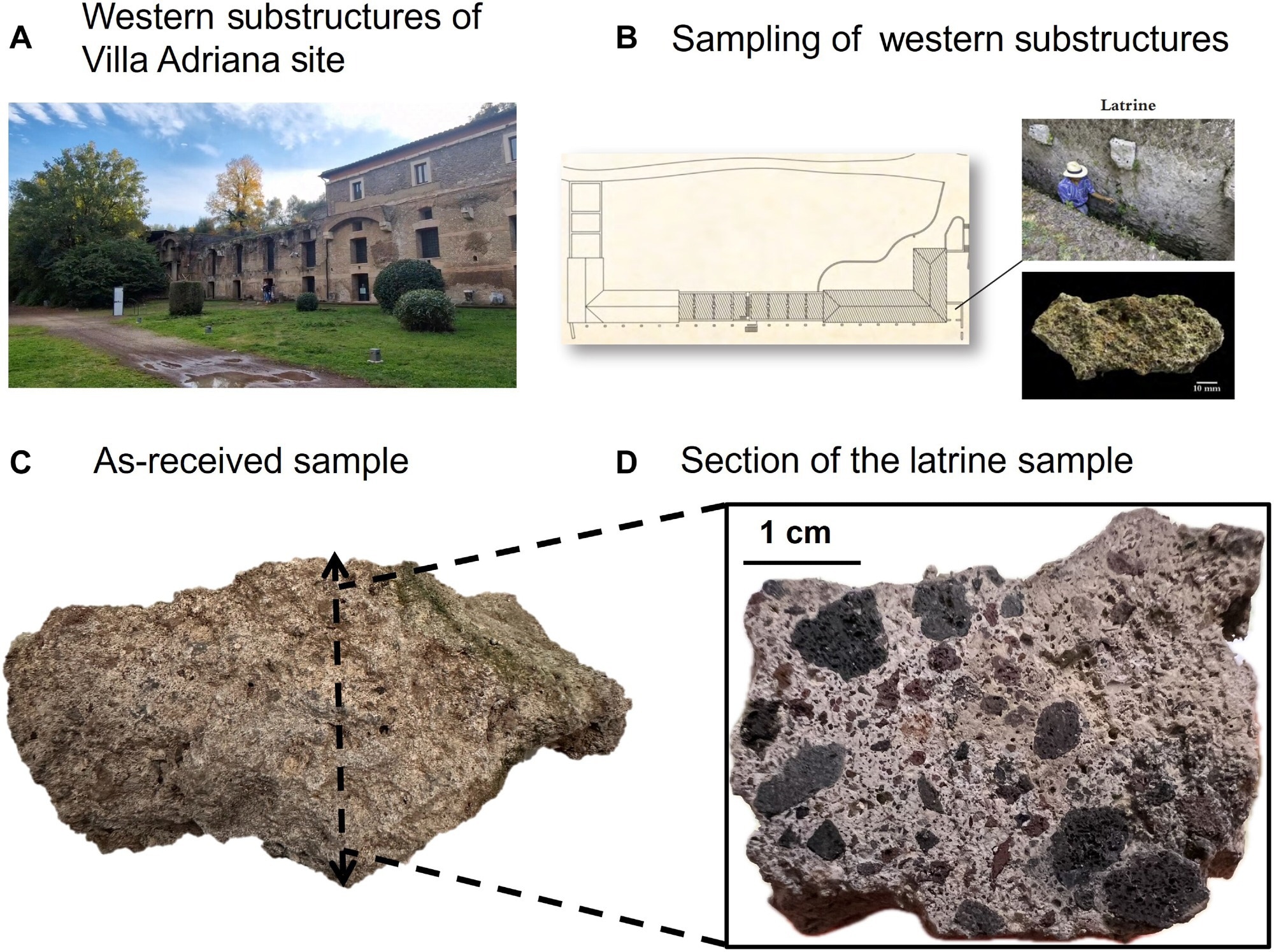
Villa Adriana (Tivoli, Italy, 2nd century AD by the Roman emperor Hadrian) is a world heritage site (UNESCO, 1999).
(A) Photograph and (B) map of the sampling region (Canopus western substructure) in Hadrian’s Villa. (C) Actual sample. (D) Section of the as-received sample. (A) Photo courtesy of Istituto Villa Adriana e Villa d’Este.
Investigating Roman Concrete Across Multiple Scales
The researchers combined several advanced analytical techniques to examine Roman concrete from the nanoscale to the bulk material. They selected a concrete sample from Hadrian's Villa that contained volcanic aggregates embedded within a lime-based binder. This well-preserved material provided an ideal opportunity to study the long-term evolution of ancient cementitious systems.
The team identified the mineral composition of both the aggregates and the binder. They combined powder X-ray diffraction (XRD), scanning electron microscopy with energy-dispersive X-ray spectroscopy (BSEM-EDX), Raman spectroscopy, transmission electron microscopy (TEM), and calcium L-edge X-ray absorption near-edge structure (XANES). Together, these techniques identified the mineral phases and confirmed the crystal structure of the carbonate binder.
Next, the researchers used synchrotron-based micro-computed tomography (μCT) and nano-computed tomography to visualise the concrete in three dimensions. These non-destructive imaging methods revealed the 3D morphology, connectivity, and porosity of aggregates, pores, reaction rims, and calcite-rich networks, while microscopy and spectroscopy confirmed the mineral identities. Combining these complementary techniques allowed the researchers to reconstruct the mineral evolution of Roman concrete over nearly two millennia. The integrated approach connected microscopic chemical changes with the material's remarkable structural longevity.
Carbonate Mineralization Strengthened the Concrete Over Time
The analyses showed that the studied Roman concrete from inland areas derives its durability from two complementary binding mechanisms. As expected, volcanic aggregates reacted with lime to form calcium-aluminum-silicate-hydrate (C-A-S-H) within the interfacial transition zone, the boundary where aggregate and binder meet. This cementitious phase strengthened the bond between the aggregates and the surrounding binder while reducing permeability. However, the researchers found that C-A-S-H accounted for only a relatively small portion of the overall binding system.
Calcite emerged as the dominant binding mineral, contributing to the concrete's long-term stability. Over centuries, residual lime reacted slowly with atmospheric carbon dioxide and moisture, producing extensive calcite cement throughout the binder matrix. The newly formed calcite-filled pores, fractures, and voids create an interconnected mineral network that reinforces the concrete rather than simply occupying space.
The researchers also identified several forms of preserved lime-derived particles. Some originated from partially burnt limestone, while others formed clusters of incompletely hydrated lime. Smaller particles hydrated more completely before gradually carbonating into calcite. Despite these differences, nearly all lime-derived phases had transformed into stable calcite, demonstrating the long-term evolution of the binder.
Three-dimensional imaging further revealed that the volcanic aggregates actively contributed to durability. They reacted with the surrounding binder, releasing aluminosilicate species that promoted local C-A-S-H formation. This chemical interaction strengthened the interfacial transition zone and improved bonding throughout the concrete.
Radiaxial fibrous calcite, a fan-like crystal form, grew outward from reaction rims and progressively filled nearby pores and microcracks. As the crystals continued to grow, they formed continuous mineral bridges that improved load transfer and reduced pathways for water and aggressive chemicals. This slow mineralization process refined the pore structure and may have progressively strengthened the concrete over time.
Inspiration for Future Low-Carbon Cementitious Materials
The study provides new insight into the exceptional durability of this inland Roman concrete. While pozzolanic reactions remain essential, the findings show that long-term carbonate mineralization also plays a critical role in preserving the material. As calcite gradually formed over centuries, it strengthened the concrete, refined the pore network, and naturally sealed microcracks. Together, these processes produced a binder that continued to evolve and improve long after construction.
The work also demonstrates the value of studying cementitious materials over extended timescales. The researchers note that Roman concrete should not be directly compared with modern reinforced concrete. Ancient structures contained no steel reinforcement and therefore avoided corrosion, which remains the primary durability challenge in today's infrastructure. They also caution that the slow, diffusion-limited carbonation observed over centuries to millennia should not be assumed to provide rapid climate benefits in modern infrastructure.
The study highlights how advanced imaging and spectroscopic techniques can reveal the long-term evolution of complex construction materials. These insights deepen our understanding of Roman concrete and also offer conceptual guidance for designing more resilient, sustainable, and durable cementitious materials for future infrastructure.
Disclaimer: The views expressed here are those of the author expressed in their private capacity and do not necessarily represent the views of AZoM.com Limited T/A AZoNetwork the owner and operator of this website. This disclaimer forms part of the Terms and conditions of use of this website.