An ultra-low-dose polymer network moves through moist cement pores and rebinds damaged surfaces, offering a potential pathway toward longer-lasting infrastructure.
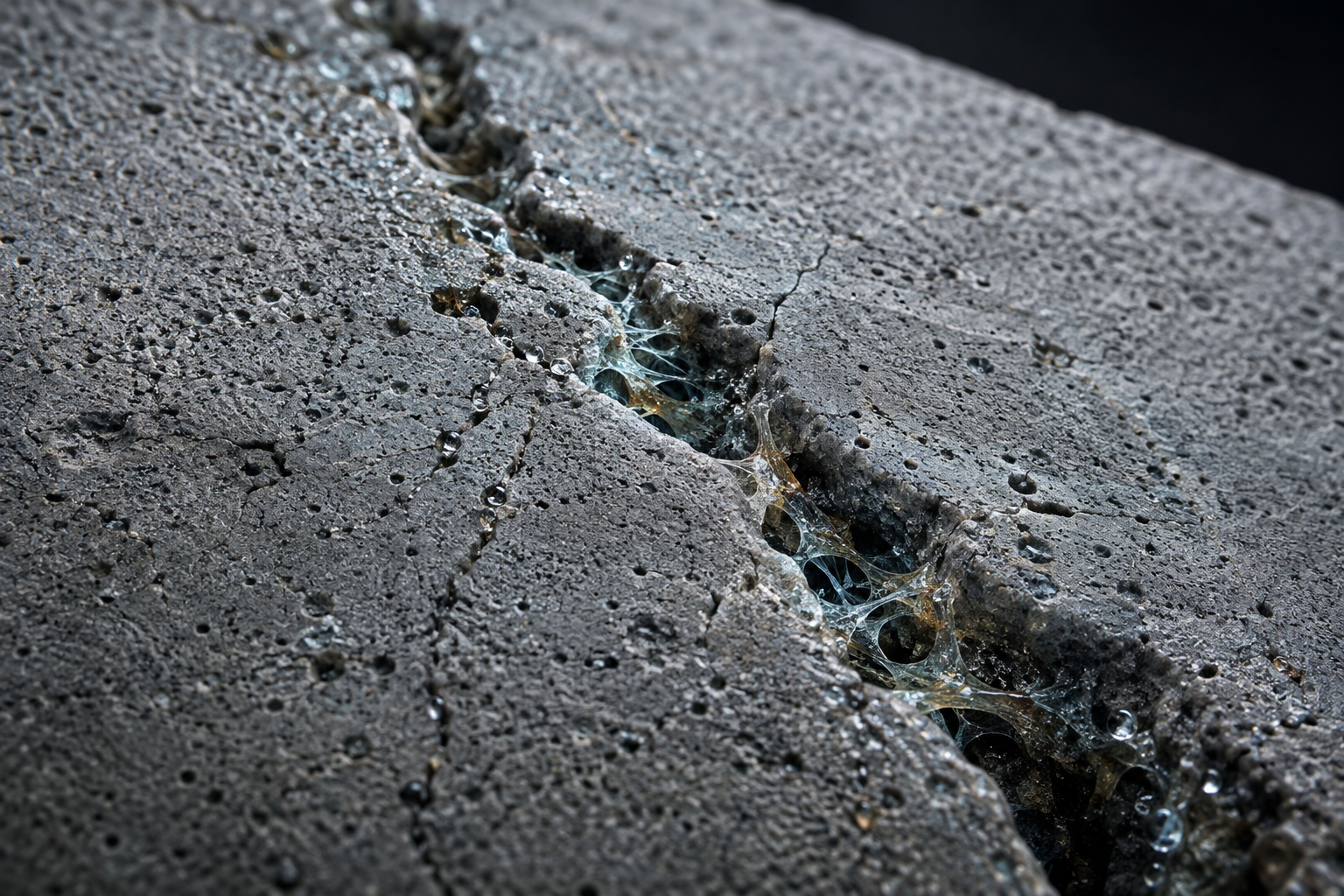
Paper: A molecular velcro self-healing cement. Image credit: AI-generated conceptual image created using ChatGPT/OpenAI
Global cement manufacturing accounts for approximately 8-9% of human-made carbon dioxide (CO2) emissions and about 2-3% of global energy consumption, highlighting the urgent need for longer-lasting building materials.
In a recent article in press in the journal Nature Communications, researchers developed a self-healing cement composite containing just 0.13 wt% polymer additive, eliminating the need for fragile microcapsules or complex embedded vascular networks. This polymer complex forms in situ during slurry preparation and disperses within the cement matrix, establishing dynamic electrostatic interactions and hydrogen bonds that enable compressive strength recovery across six damage-healing cycles under humid laboratory conditions. This potentially scalable approach could help extend the service life of concrete infrastructure if its performance is confirmed at larger scales, while potentially reducing the environmental impact of cement production.
Challenges in Conventional Concrete Healing
Conventional concrete has limited capacity for crack repair through autogenous healing, relying mainly on the delayed hydration of unreacted cement and the precipitation of calcium carbonate. Ancient Roman concrete exemplified the long-term potential of this process through embedded lime clasts that released reactive calcium when cracks formed. However, high lime-clast content creates weak zones, reducing the material’s initial mechanical strength and rendering autogenous healing ineffective once these minerals are depleted.
Modern self-healing concrete often incorporates healing agents through microcapsules or vascular networks. While effective, they are challenging to implement during construction, and microcapsules are single-use and cannot repair repeated cracks at the same location. High concentrations of microcapsules or blended polymers, typically above 1 wt% and reaching 10-55% by volume of solids in some formulations, can compromise concrete strength due to poor compatibility with the cement. These challenges highlight the need for a low-dose, self-healing system capable of repeated crack repair.
Composition and Characterization of the Hybrid Binder
To prepare the self-healing binder, researchers blended Type I/II Portland cement with silica fume in a 7:3 mass ratio and added a trace amount of a ternary polymer complex. This was synthesized in situ during slurry preparation using precursor solutions adjusted to a pH of 2.8 and containing poly(acrylic acid), poly(ethylene oxide), and branched poly(ethylenimine). During mixing, these polymers formed precipitated complexes that dispersed uniformly throughout the cement paste, with only minor effects on hydration and setting.
The material was characterized using various techniques. High-resolution X-ray computed tomography (XCT) visualized pore structure, polymer distribution, and crack healing in three dimensions. X-ray diffraction (XRD) monitored changes in crystalline phases during curing. Solid-state carbon-13 nuclear magnetic resonance spectroscopy was used to examine atomic-scale bonding, while classical molecular dynamics and density-functional-theory-based ab initio molecular dynamics simulations were performed to elucidate the underlying interactions.
To evaluate transport behavior, the study combined time-resolved confocal Raman microscopy with low-vacuum scanning electron microscopy (SEM) and energy-dispersive X-ray spectroscopy to assess polymer redistribution at freshly exposed fracture interfaces before and after humid exposure. Separate compression, direct tensile, and flexural tests were performed to measure mechanical recovery. Fresh-state properties were measured using rotational rheometry and Vicat needle penetration tests to determine yield stress and setting time.
Rapid Crack Repair and Strength Recovery
Microstructural analyses led the authors to propose that pore-pressure differences and capillary forces transported the polymer complex from nearby voids into newly formed cracks. The material showed polymer filling through an approximately 2 mm-deep fracture in the first XCT scan, obtained around four hours after damage, corresponding to an estimated healing rate of approximately 12 mm per day.
Confocal Raman microscopy showed two characteristic relaxation components, with a fast time constant of about 14 minutes and a slower equilibration time of 532 minutes. These findings were consistent with rapid initial polymer redistribution followed by slower interfacial rearrangement and stabilization. Semi-quantitative SEM and energy-dispersive X-ray analysis provided additional evidence of polymer enrichment through a 12% increase in normalized carbon peak area after humid exposure.
The autonomous component of crack repair was driven by dynamic electrostatic interactions and hydrogen bonding that function like molecular Velcro. Strong ionic bonds form between deprotonated carboxyl groups in poly(acrylic acid) and calcium ions within the calcium-silicate-hydrate matrix. Reversible hydrogen bonds are proposed to help reconnect the fractured surfaces, enabling repeated self-healing. Water-assisted continued hydration and calcium carbonate formation also contributed to crack filling, indicating that the overall process combined autonomous polymer healing with autogenous cement healing.
Mechanical testing indicated substantial recovery under severe post-peak damage, with loading continued until the material lost 20% of its peak strength. The polymer-modified cement recovered up to 62% of its original compressive strength after the first healing cycle and roughly 35-50% over the remaining five cycles, reaching 50% in the sixth cycle. Direct tensile recovery reached about 59% and flexural recovery around 50% after the first cycle. After repeated damage, tensile and flexural recovery plateaued at about 30% and 20%, respectively, over four cycles. The authors' literature review indicated that most previously reported systems lost effectiveness after a maximum of 3 cycles, although testing protocols varied considerably across studies.
Practical and Scaling Considerations
The ultra-low polymer dosage of just 0.13 wt% supports further investigation of this self-healing cement composite as a potentially scalable alternative to conventional microencapsulated systems. Rheological testing indicated only a slight increase in plastic viscosity and a modest 15-minute delay in final setting time (6.5 hours versus 6.25 hours for the control), suggesting limited effects on fresh-state workability and setting under the tested conditions.
This material may be relevant to surface and subsurface infrastructure exposed to repeated cracking, including wellbore and other cement-based structures. However, these applications were not directly tested. If future studies confirm reliable crack sealing, reduced permeability, and durability in concrete containing aggregates, the system could help limit fluid ingress, corrosion, and premature structural deterioration.
Directions for Sustainable Infrastructure
In summary, this study demonstrates that low-dose, multi-cycle self-healing cement composites can be achieved without high polymer loadings or mechanically encapsulated healing agents. By combining pressure- and capillary-assisted polymer transport with reversible molecular interactions, the binder enables rapid, repeatable crack repair while maintaining structural performance under moist laboratory conditions.
If this approach extends the service life of concrete infrastructure at larger scales, it could reduce repair demand and the associated consumption of cement, energy, and raw materials. Future work should focus on concrete-scale and field testing while assessing performance under dry or fluctuating humidity, freeze-thaw cycles, salt exposure, chemical attack, and other harsh environmental conditions. Permeability, corrosion protection, long-term mechanical durability, cost, and life-cycle emissions also require evaluation before commercial adoption.
Disclaimer: The views expressed here are those of the author expressed in their private capacity and do not necessarily represent the views of AZoM.com Limited T/A AZoNetwork the owner and operator of this website. This disclaimer forms part of the Terms and conditions of use of this website.