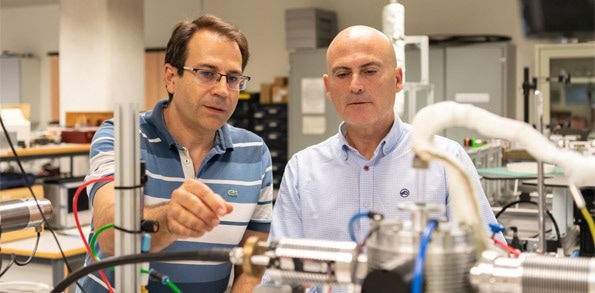
Image Credit: Universitat Politècnica de València
The research aims to produce green hydrogen with much higher efficiency by using redox cycles, a process in which the material absorbs and releases oxygen from water to stabilize its separation from oxygen. Since the discovered technique uses materials having redox characteristics that react to microwave radiation, green hydrogen may be produced from renewable electrical energy.
The fundamental mechanism of the redox chemical cycle is the transfer of electrons between atoms of different elements in the presence of an induced electromagnetic field, which permits the process to become electrified.
Microwaves offer distinct benefits when electrifying a redox process. These benefits include supplying electrical energy without the need for contacts and a significant drop in cycle temperature, from 1300 ºC to 400 ºC. These factors also simplify the process of obtaining H2 and maximize energy efficiency.
Main Novelty
The work's primary innovation is the thorough examination of the material characteristics that affect the process's performance. The foundation for material design has been established to customize the synthesis of hydrogen and oxygen and modify the material’s energized state based on the intended use. Furthermore, it has been shown that oxygen can be extracted using a quick, highly regulated pulsed technique.
The design of the cavities or chambers where we apply microwaves, as well as the control of the radiation process on these materials, is essential to take advantage of the unique benefits offered by microwave technology. This technology has been established in numerous industrial applications in recent years due to its rapid scalability and high energy efficiency.
Jose Manuel Catalá, Director, Institute of Information and Communications Technologies, Universitat Politècnica de València
As part of the research, a thorough investigation of the effects of various dopants added to the cerium oxide matrix material on hydrogen generation has been carried out to modify the material’s characteristics and its interaction with microwave radiation.
Subsequently, we have studied the hydrogen production capacity of this material and the mechanism that governs the process, which will facilitate the future design of materials.
José Manuel Serra, Director, Institute of Chemical Technology
The results of the study demonstrate the strength and stability of the materials created and employed for hydrogen augmentation.
Ministry of Science, Innovation, and Universities through European NextGenerationEU funds and Ramón y Cajal contracts and by the Generalitat Valenciana funded the project.
Journal Reference:
Domínguez-Saldaña, A., et. al. (2024) Enhanced Hydrogen Production in Microwave-Driven Water-Splitting Redox Cycles by Engineering Ceria Properties. Advanced Energy Materials. doi:10.1002/aenm.202401443