Researchers have demonstrated an 11-qubit atom processor in silicon, a significant step toward scalable, fault-tolerant quantum computing using industry-compatible materials.
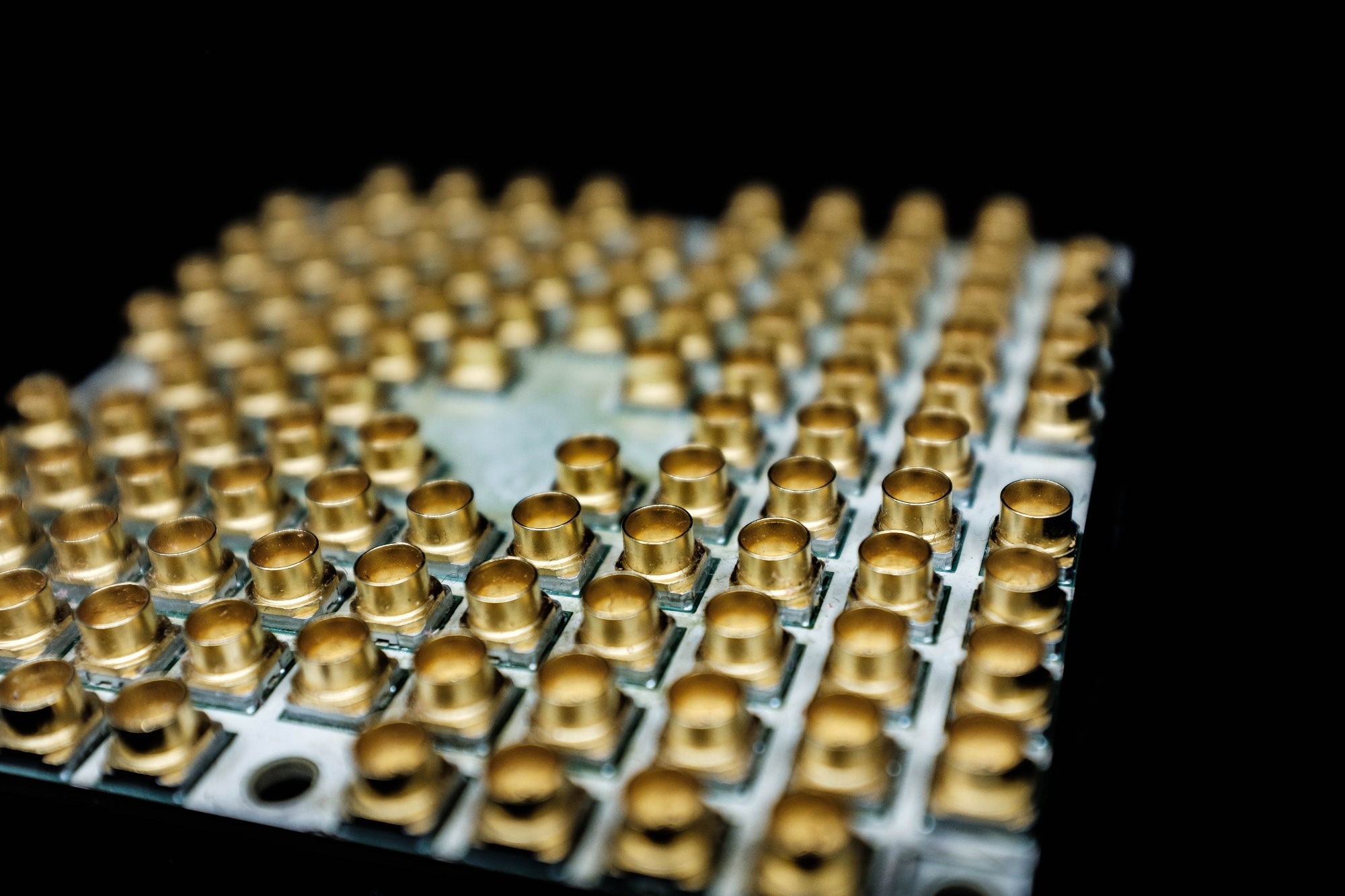 Study: An 11-qubit atom processor in silicon. Image Credit: Craig Raymond/Shutterstock.com
Reported in Nature, the device connects two multi-qubit nuclear-spin registers through a fast, exchange-based quantum link - a challenge that has long been a key obstacle to donor-based quantum systems.
The work advances silicon’s case as a serious contender for large-scale quantum computing by increasing qubit count and maintaining exceptionally high control fidelity while extending connectivity across registers.
Get all the details: Grab your PDF here!
The processor is fabricated using precision-placed phosphorus atoms embedded in isotopically purified silicon-28. Each phosphorus nucleus acts as a nuclear-spin data qubit, chosen for its long coherence time.
The system is divided into two registers: a four-phosphorus (4P) and a five-phosphorus (5P) register. Both are coupled to a shared electron spin. These electrons serve as ancilla qubits, enabling qubit control, readout, and entanglement.
Importantly, the two electrons are themselves exchange-coupled, creating a coherent quantum link between the registers.
This architecture is part of the donor-based “14|15” silicon-phosphorus platform, named for the elements’ positions in the periodic table.
Controlling 11 Qubits With High Precision
Operating at millikelvin temperatures, the processor uses electron spin resonance (ESR) and nuclear magnetic resonance (NMR) to initialize, manipulate, and read out individual qubits.
One of the paper’s key technical advances is a scalable calibration strategy.
Although the full system involves dozens of control frequencies, the researchers show that recalibration can scale linearly with the number of registers, allowing all relevant ESR transitions to be updated using only a small number of measurements.
This advance addresses a major practical challenge to scaling donor-based quantum hardware.
Performance: High Fidelity, Both Local and Non-Local
The processor achieved single-qubit and two-qubit gate fidelities above 99 %, with the critical electron-electron controlled-rotation (CROT) gate reaching 99.64 % fidelity.
The team demonstrated entanglement across the device by generating both Bell states and Greenberger-Horne-Zeilinger (GHZ) states:
- Local Bell states within a register reach fidelities as high as 99.5 %
- Non-local Bell states, spanning the two registers, achieve ~87 to 97 % fidelity, reflecting the longer gate sequences required
- GHZ states confirm genuine multi-qubit entanglement preserved for up to eight nuclear spins
Nuclear-spin coherence times range from milliseconds to hundreds of milliseconds, providing a strong foundation for complex quantum operations.
Rather than claiming immediate applications, the researchers frame their result as a foundational capability: high-fidelity operation across interconnected qubit registers in silicon.
This is an essential requirement for quantum error correction, modular quantum architectures, and eventually large-scale quantum processors.
The work shows that donor-based silicon systems can scale connectivity without sacrificing the performance needed for fault-tolerant operation.
The Next Hurdle for Quantum Computing
The authors are clear about the remaining challenges: Current gate operations assume that spectator qubits are initialized in known states, and future work will need to benchmark performance under more general conditions.
Further improvements will also rely on engineering hyperfine couplings, refining control pulses, and mitigating crosstalk as systems grow.
Still, by linking multi-qubit registers while maintaining state-of-the-art fidelities, the study indicates an advance for silicon-based quantum computing and strengthens the case for building quantum processors using the same material that underpins today’s classical electronics.
Journal Reference
Edlbauer, H., Wang, J., Huq, A.M.SE. et al. 2025. An 11-qubit atom processor in silicon. Nature 648, 569-575. DOI: 10.1038/s41586-025-09827-w
Disclaimer: The views expressed here are those of the author expressed in their private capacity and do not necessarily represent the views of AZoM.com Limited T/A AZoNetwork the owner and operator of this website. This disclaimer forms part of the Terms and conditions of use of this website.