New control achieved over perovskite solar cell crystallization with record efficiency and long-term stability.
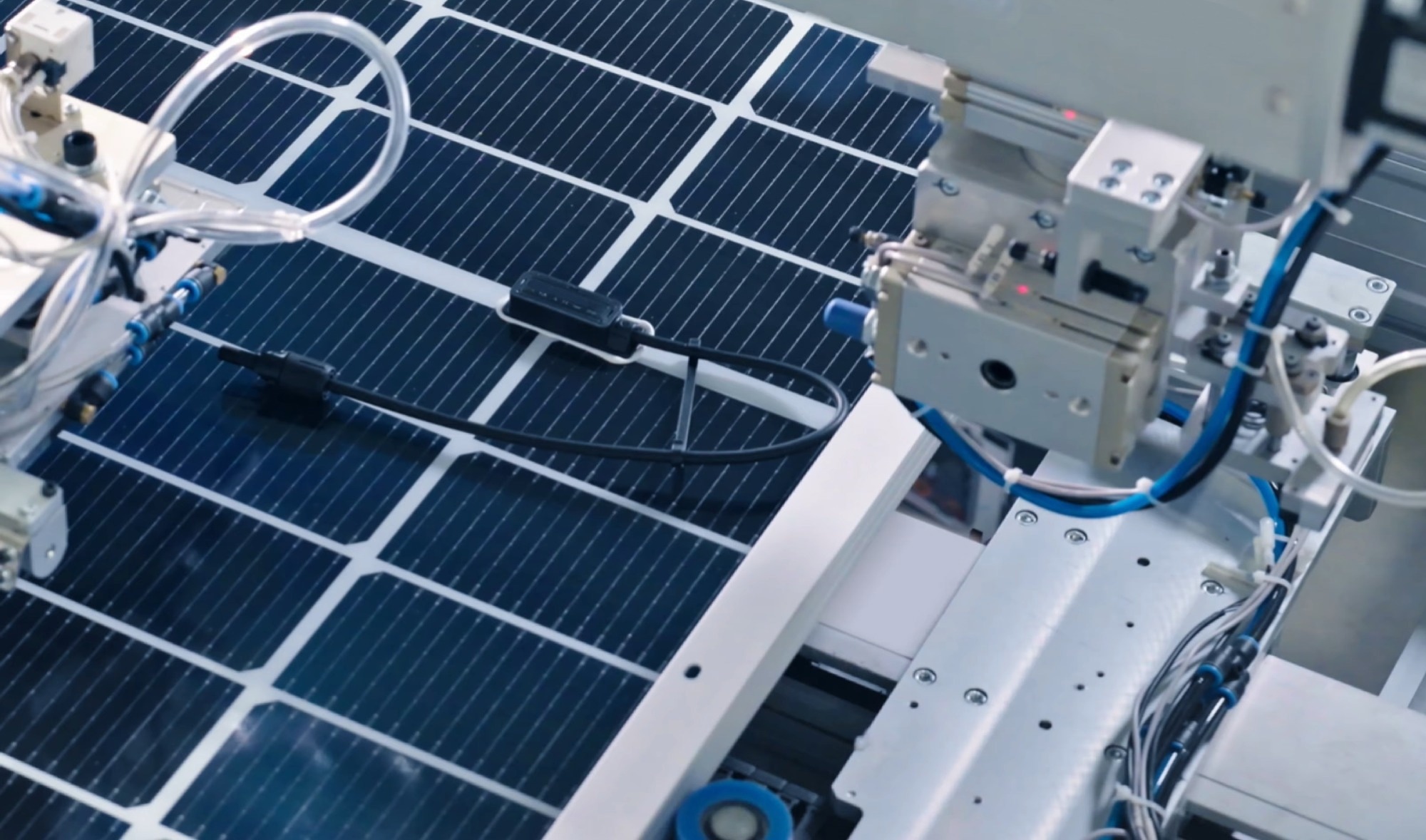
Study: Polarize the Solvent to Regulate the Intermediate Phase and Dynamic Crystallization of Perovskite Films. Image Credit: harhar38/Shutterstock.com
Researchers have identified a new way to control the crystallization of perovskite cells, achieving a record efficiency and long-term stability by subtly changing how the solvent behaves during film formation.
The approach, reported in Advanced Materials, uses highly polar fluorinated polymers to regulate solvent dynamics rather than directly binding to the perovskite itself, providing a new handle on one of the field’s most persistent challenges.
Get all the details: Grab your PDF here!
The performance of perovskite solar cells is largely determined during the first seconds of film formation, when solvent-precursor complexes form and collapse into the final crystal lattice.
In standard spin-coating processes, rapid solvent removal often drives uncontrolled nucleation, producing non-uniform grains and high defect densities.
Earlier solvent-engineering strategies focused on forming Lewis acid-base adducts between dimethyl sulfoxide (DMSO) and lead halides.
While effective for some compositions, these intermediates are either too fragile or too persistent in formamidinium-rich, mixed-cation perovskites - making crystallization difficult to control.
Polar Polymers Make the Difference
Instead of modifying the perovskite chemistry, the new study alters the solvent environment.
The researchers added polymers with increasing dipole moments to the antisolvent used during spin coating, culminating in a highly fluorinated polymer, poly(pentafluorostyrene) (PPFS).
These polymers interact strongly with DMSO through dipole–dipole interactions, increasing solvent polarity and slowing DMSO release from the wet film.
Measurements of solvent volatility, viscosity, and diffusion, validated by spectroscopy and calculations, confirmed that the polymer additives significantly prolong solvent retention without directly coordinating to the perovskite lattice.
Stabilizing the Fragile Intermediate Phase
In situ X-ray diffraction revealed that polar polymers dramatically extend the lifetime of a key MAI-PbI2-DMSO intermediate phase, even in formamidinium-rich, mixed FA/MA systems.
With PPFS, this intermediate persisted throughout spin coating and early annealing, rather than collapsing abruptly into the final perovskite structure.
Low-dose scanning transmission electron microscopy showed the intermediate consists of one-dimensional, ribbon-like structures made of face-sharing lead iodide octahedra.
This phase was observed to coexist with nascent perovskite during annealing, enabling a gradual and coherent transformation rather than burst nucleation.
Slower Growth Leads to Better Films
Optical spectroscopy during deposition confirmed delayed nucleation and moderated grain growth in polymer-modified films.
As a result, crystal formation became more uniform. Atomic force microscopy and conductive mapping showed larger grains, smoother surfaces, improved vertical connectivity, and fewer resistive grain boundaries.
Electrical and spectroscopic measurements indicated lower trap densities, reduced energetic disorder, and longer carrier lifetime, hallmarks of high-quality perovskite films.
When incorporated into inverted solar cell architectures, the optimized films delivered a champion power conversion efficiency of 26.4 % with an 86 % fill factor and negligible hysteresis. Non-radiative recombination was strongly suppressed.
The devices also showed exceptional durability, retaining 92 % of their initial efficiency after 1,000 hours of continuous illumination under maximum power point tracking.
The authors attribute this stability to both reduced defect densities and increased surface hydrophobicity introduced by the fluorinated polymer.
A Change In Crystallization Control
The study demonstrates that solvent polarization can be used to regulate intermediate phases and crystallization dynamics with high precision. While polymer concentration must be carefully optimized, the approach provides a general and scalable framework for improving perovskite film quality.
The authors suggest the concept could be extended to other perovskite compositions, solvent systems, and potentially to large-area coating techniques such as blade coating and slot-die printing.
More broadly, the work offers a transferable strategy for managing intermediate phases in a wide range of solution-processed semiconductors.
Journal Reference
Zhang, Z., et al. (2026). Polarize the Solvent to Regulate the Intermediate Phase and Dynamic Crystallization of Perovskite Films. Advanced Materials, e19793. DOI: 10.1002/ADMA.202519793
Disclaimer: The views expressed here are those of the author expressed in their private capacity and do not necessarily represent the views of AZoM.com Limited T/A AZoNetwork the owner and operator of this website. This disclaimer forms part of the Terms and conditions of use of this website.