By building ion-selective nanogels inside single nanopores, researchers show how nanoscale charge control could help turn salinity gradients into a more powerful source of renewable electricity.
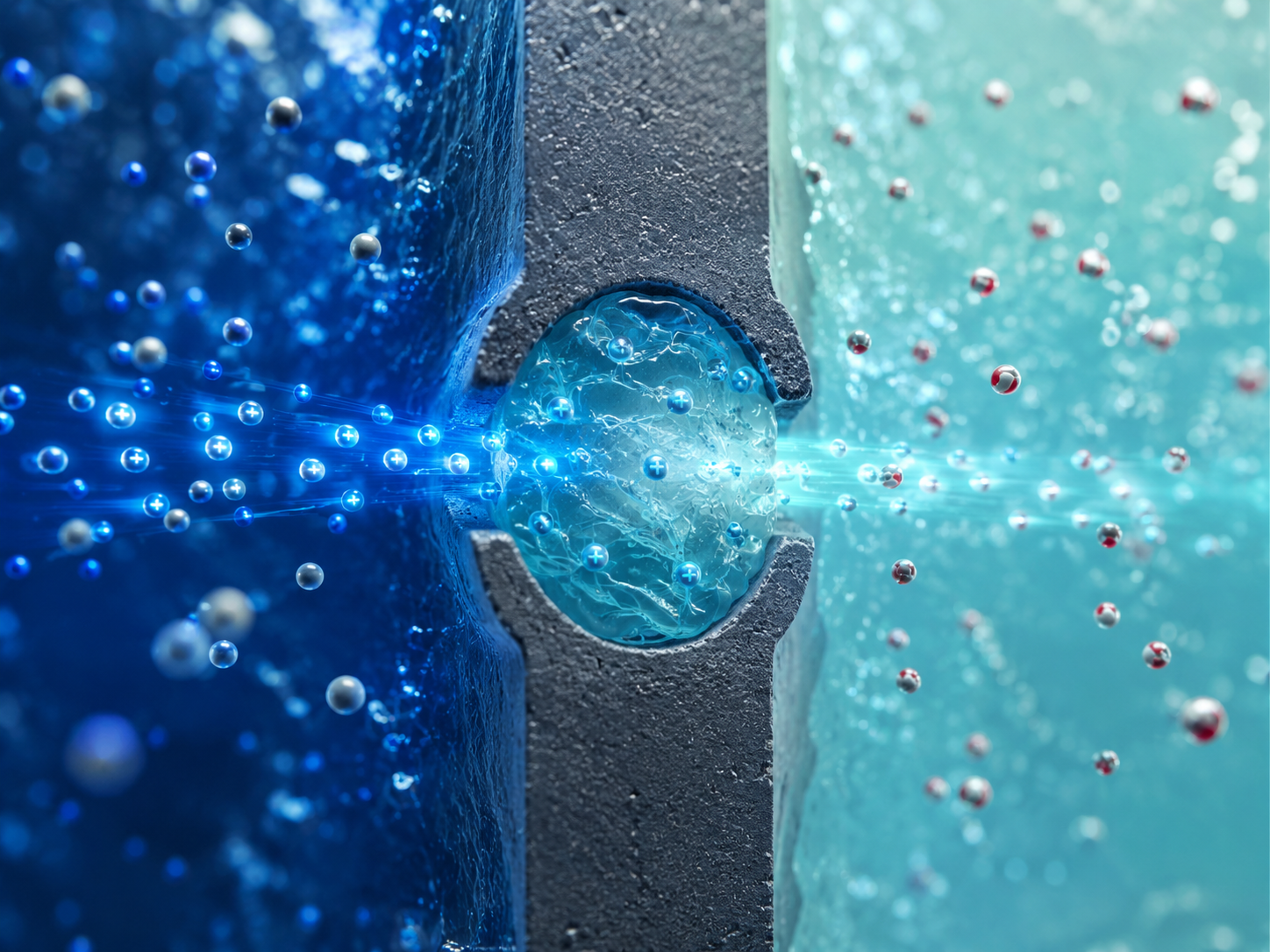
Paper: One-pore synthesis of ionic nanogel osmotic power generators. Image credit: AI-generated image created using ChatGPT/OpenAI
The growing demand for sustainable energy technologies has increased interest in blue energy, which generates electricity from salinity gradients. In a recent study published in the journal Communications Materials, researchers developed a high-performance osmotic power generator based on a single solid-state nanopore. Using a voltage-directed in-situ fabrication strategy, they synthesized an alginate-based ionic nanogel directly within a nanoscale pore, creating a structure that combines mechanical stability with efficient ion-selective transport.
This novel design enhances effective charge regulation and regulates ion transport at the nanoscale, addressing longstanding limitations of osmotic energy harvesting. The device achieved an impressive pore-area-normalized osmotic power density of 213 kW/m² under gate-voltage modulation, demonstrating promising energy conversion performance and providing a framework for future nanoscale blue-energy systems.
Harnessing Salinity Gradients for Energy Generation
Osmotic energy, often referred to as blue energy, is generated from the natural salinity gradient that exists where freshwater and seawater meet. When these solutions are separated by a semi-permeable membrane, selective ion transport creates an electrical current that can be harvested as renewable energy. However, large-scale deployment has been limited by material challenges in conventional membranes, including low surface charge density, high internal resistance, and insufficient mechanical stability, which reduce ion selectivity and overall energy conversion efficiency.
To address these limitations, researchers have focused on advanced nanofluidic materials and soft polymer networks, including ionic hydrogels. Their dense, charged internal structures enhance ion transport and selectivity, while nanoscale confinement improves charge regulation and fluid transport dynamics, paving the way for more efficient osmotic energy harvesting systems.
Fabrication of the Nanogel-Integrated Membrane
To create the energy-harvesting interface, researchers developed a hybrid nanostructured platform comprising a solid-state silicon nitride membrane with a single nanopore. This nanopore serves as a mechanically robust scaffold capable of withstanding continuous fluid flow and osmotic pressure. Instead of inserting a preformed polymer into the pore, the study employed an in situ synthesis strategy where an ionic nanogel was polymerized directly within the confined geometry. This process used sodium alginate and calcium chloride, with phosphate-buffered saline added in selected gels to introduce phosphate-containing species, enabling a seamless interface between the soft polymer network and the rigid inorganic framework.
Electrochemical measurements and real-time ionic current monitoring tracked gel growth and structural development, allowing precise control of the gelation process and the desired nanogel density within the pore. The resulting hybrid material combines the mechanical stability of silicon nitride with the tunable chemical properties of an ionic nanogel, creating a mechanically stable and highly controllable platform for osmotic energy harvesting.
Enhanced Ion Transport and Memristive Behavior
Electrochemical testing showed that the hybrid nanogel generator exhibits strong ion-selective transport properties. The confined ionic nanogel creates a dense, dynamic charge environment that promotes counterion mobility while suppressing co-ion transport, resulting in high permselectivity and enhanced voltage generation from salinity gradients.
A key finding was that phosphate-containing domains introduced additional negative charge into the alginate matrix, shifting the nanogel toward stronger cation-selective transport. This enhanced charge environment significantly improved ion transport efficiency and contributed to the device's high energy-harvesting performance.
The nanogel-filled nanopore also exhibited ionic memristive behavior, as evidenced by a characteristic pinched hysteresis loop during voltage sweeps. This response suggests that the internal ion distribution dynamically adapts to external electrical stimuli, enabling the system to retain information about previous conductive states.
As a result, the single-pore generator achieved a pore-area-normalized power density of 213 kW/m², exceeding the performance of several existing nanopore energy-harvesting platforms when compared using similar active-area normalization. In a 3600-pore array, the architecture produced 2393 W/m² when normalized to pore area, or 27 W/m² when normalized to the full membrane area, exceeding a commonly cited benchmark for osmotic power systems, although further validation under real-world salinity gradients and large-area operating conditions is needed. The device also showed long-term ion-transport measurements supporting persistence of phosphate-enabled selectivity under the tested conditions.
Future Prospects for Ionic Nanogel Applications
The development of ionic nanogel-embedded nanopores has significant implications that extend beyond osmotic energy harvesting. Their ability to generate electricity at the microscale makes them promising candidates for powering autonomous aquatic sensors and other self-sustaining low-power devices.
In addition to energy generation, the hybrid material exhibits memristor-like ionic behavior, allowing its conductance to change in response to previous electrical stimuli. This memory effect suggests potential relevance to iontronic and neuromorphic systems, combining adaptive information processing with ion-transport regulation.
Pathways to Enhanced Osmotic Energy Technologies
In summary, this study demonstrates that confining soft ionic materials within robust inorganic nanopores can significantly enhance ion transport control and osmotic energy conversion performance. Optimizing the interplay between internal membrane conductivity, ion selectivity, and external transport processes is critical for maximizing power generation. The findings establish a promising framework for designing high-performance nanofluidic materials capable of harvesting energy from salinity gradients.
Future work should focus on scaling this architecture from single nanopores to large-area multi-pore membranes while preserving the transport characteristics responsible for its exceptional performance. Successfully overcoming the challenges of concentration polarization, pore-spacing optimization, active-area scaling, and real-world salinity conditions could support progress toward practical osmotic technologies and the broader deployment of sustainable blue-energy infrastructure.
Download your PDF copy by clicking here.
Disclaimer: The views expressed here are those of the author expressed in their private capacity and do not necessarily represent the views of AZoM.com Limited T/A AZoNetwork the owner and operator of this website. This disclaimer forms part of the Terms and conditions of use of this website.
Source:
- Tsutsui, M., Arima, A., Garoli, D., Yoshinobu, B., & Kawai, T. (2026). One-pore synthesis of ionic nanogel osmotic power generators. Communications Materials. DOI: 10.1038/s43246-026-01242-6, https://www.nature.com/articles/s43246-026-01242-6