By redesigning the plasticizer as part of the end-of-life chemistry, researchers created a polymer system that links flexibility during use with an entirely different role after disposal.
Paper: Plastics to fertilizer: A polymer system based on isosorbide as a monomer, plasticizer, and fertilizer. AI-generated conceptual image created using ChatGPT/OpenAI
A recent study in the journal Scientific Reports investigates how an isosorbide-based polymer system can be chemically converted after use into fertilizer-compatible components. The researchers in Japan developed a poly(isosorbide carbonate) (PIC) system with a specially designed isosorbide-based plasticizer to improve flexibility and tune its mechanical properties. The findings demonstrate how polymer design can connect material performance with useful end-of-life applications.
Designing Plastics for Beneficial End-of-Life Use
Conventional plastics focus on durability and stability during use. Their end-of-life behavior often receives less attention during material design. Recycling and reducing plastic consumption remain important, but they do not necessarily focus on plastic waste for a useful second function. The researchers therefore explored a different approach. They designed a plastic that could provide useful material performance during use and later be chemically converted into fertilizer-compatible components.
The study builds on earlier findings that poly(isosorbide carbonate) (PIC) can undergo ammonolysis in aqueous ammonia. This reaction produces isosorbide (ISB) and urea. Both compounds have agricultural value, and previous research has linked their combination with improved plant growth. However, PIC has a major limitation. The polymer is hard and brittle, which restricts its use in flexible products. Conventional plasticizers can improve flexibility, but they are not necessarily designed to participate in the same fertilizer-compatible end-of-life conversion pathway.
The researchers addressed this challenge by developing ISB-based plasticizers with dual functions. These additives improve PIC’s flexibility and retain its ability to undergo ammonolysis. The study therefore connects polymer design, mechanical performance, chemical recycling, and agricultural use within one material system.
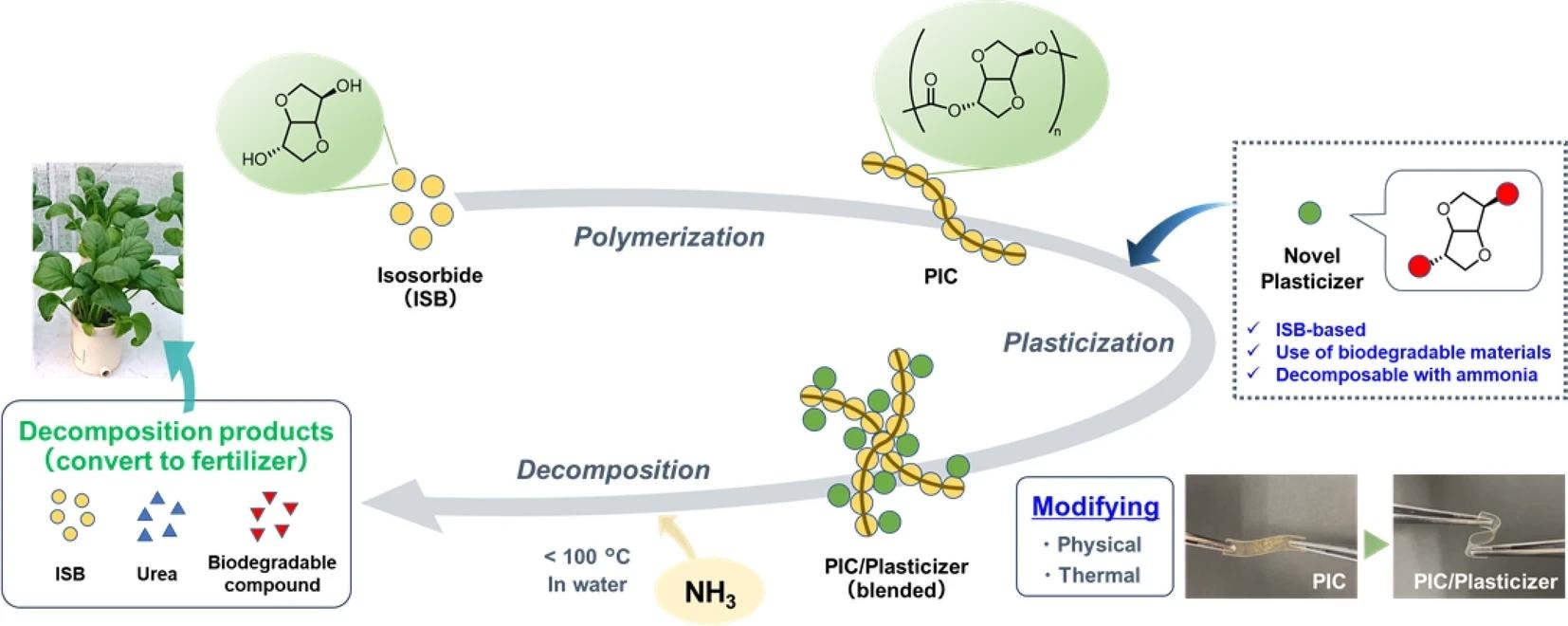
Schematic representation of the polymer system introduced in this work.
Developing Flexible PIC Through ISB-Based Plasticizers
The researchers first designed an ISB-based plasticizer called ISB-TEG. They used Hansen solubility parameters to assess compatibility between ISB-TEG and PIC. The calculated relative energy difference was 0.87, below the value of 1 associated with favorable compatibility.
The team synthesized ISB-TEG through a two-step process. They first converted ISB into an imidazole-based intermediate (ISB-CDI) using carbonyl diimidazole. They then added triethylene glycol to produce the carbonate-linked ISB-TEG structure. Nuclear magnetic resonance spectroscopy and mass spectrometry confirmed the chemical structure. The researchers blended PIC with varying amounts of ISB-TEG to prepare polymer films. They compared these materials with PIC containing dibutyl phthalate (DBP), a conventional plasticizer. Visual observations showed differences in compatibility between the two systems.
The team used differential scanning calorimetry to measure changes in the glass transition temperature. Tensile tests measured Young’s modulus, breaking stress, and elongation at break. The researchers also examined the material’s end-of-life behavior. They treated PIC/ISB-TEG samples with aqueous ammonia at 90°C for 24 hours. Gel-permeation chromatography measured molecular-weight changes, while proton nuclear magnetic resonance spectroscopy quantified the resulting products.
Finally, the researchers tested the plant-growth effects of the degradation products using Arabidopsis thaliana. They also prepared an oligomeric plasticizer, ISB-TEG2,300, and evaluated its degradation products using komatsuna grown in soil.
Plasticizer Improves Flexibility While Preserving Fertilizer Conversion
ISB-TEG showed strong compatibility with PIC. PIC blended with DBP produced an opaque appearance, indicating phase separation. In contrast, PIC/ISB-TEG produced visually uniform films across the tested compositions. The results support the use of Hansen solubility parameters as a useful tool for designing compatible plasticizers. Plain PIC had a glass-transition temperature of 161°C. Increasing the ISB-TEG content reduced this value to 123°C, 77°C, 66°C and 40°C for the 9/1, 8/2, 7/3 and 6/4 PIC/ISB-TEG compositions, respectively.
The material’s flexibility increased with increasing plasticizer content. Young’s modulus and breaking stress decreased, while elongation at break increased. The 6/4 blend reached 45.2% breaking elongation, compared with only 4.3% for neat PIC. The chemical end-of-life tests also confirmed that the modified polymer retained its ammonolysis pathway. After treatment with aqueous ammonia at 90°C for 24 hours, the solid PIC/ISB-TEG sample converted into a homogeneous aqueous solution. Its number-average molecular weight decreased from 17,600 to below 500.
NMR analysis confirmed the formation of ISB, urea, and triethylene glycol (TEG). Recovery reached 98.4% for ISB, 78.1% for urea, and 90.2% for TEG. The researchers attributed the lower urea recovery to partial hydrolysis and decarboxylation of carbonate groups. The degradation products promoted growth in Arabidopsis thaliana. However, the researchers cautioned that the experiment could not distinguish the individual contributions of ISB, TEG, and urea. Tests with komatsuna also showed significantly greater fresh weight and nitrogen uptake than the nitrogen-free control, with both outcomes comparable to commercial urea. This marked the first demonstration of cultivating an edible vegetable using fertilizer derived from a plasticizer-containing PIC system.
Towards Circular and Functional Plastics
The study presents a promising approach to sustainable polymer design by incorporating end-of-life considerations into the material design from the outset. The ISB-based plasticizer improves the flexibility of PIC while preserving its ability to undergo chemical conversion after use. This allows the material to serve as a functional plastic and later provide useful chemical products. Ammonolysis converts the PIC/ISB-TEG system into isosorbide (ISB), urea, and triethylene glycol (TEG).
The developed approach still faces challenges in mechanical performance, long-term stability, and plasticizer migration. Further work is also needed to assess the overall environmental and energy balance of the process, including energy consumption and handling of the aqueous products.
Future work should focus on improving material strength, optimizing plasticizer synthesis, and refining ammonolysis conditions. Further testing will also be needed to assess performance in practical plastic applications. Overall, the research demonstrates how polymer design can link plastic functionality to useful end-of-life outcomes, offering a potential route toward more sustainable end-of-life management of plastic materials.
Disclaimer: The views expressed here are those of the author expressed in their private capacity and do not necessarily represent the views of AZoM.com Limited T/A AZoNetwork the owner and operator of this website. This disclaimer forms part of the Terms and conditions of use of this website.
Source:
- Fujimata, S., Tokonami, Y., et al. (2026). Plastics to fertilizer: A polymer system based on isosorbide as a monomer, plasticizer, and fertilizer. Scientific Reports, 16(1), 23701. DOI: 10.1038/s41598-026-63638-1, https://www.nature.com/articles/s41598-026-63638-1