By screening nearly 92 million candidate compositions, researchers explored whether mixing familiar elements could produce unexpected neutron behavior in materials designed for demanding nuclear environments.
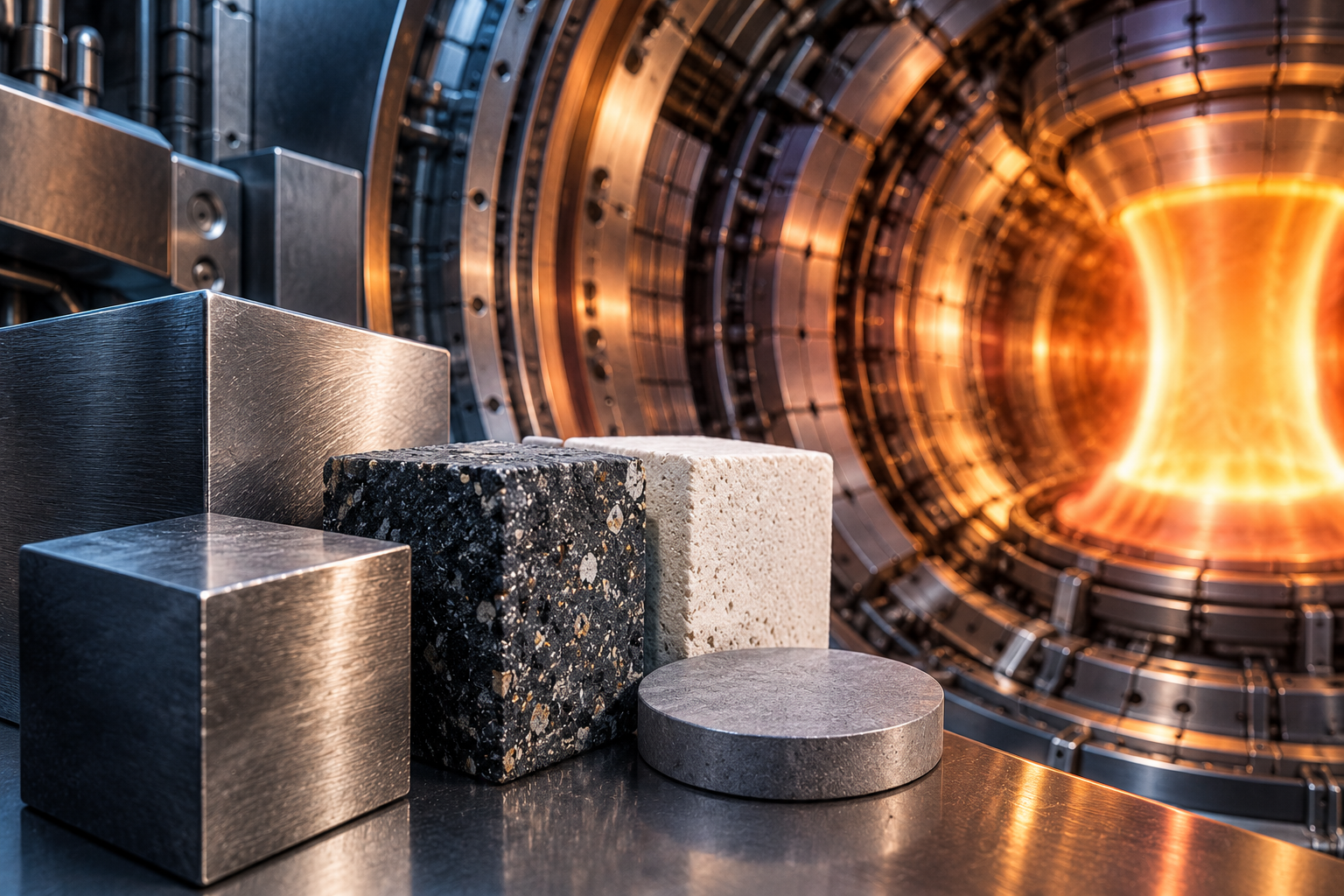
Paper: Neutronic Cocktail Effects in Compositionally Complex Materials. AI-generated conceptual image created using ChatGPT/OpenAI
A recent preprint submitted to the journal Materials Today Advances investigates how elemental mixing influences neutron transport in compositionally complex materials, including high-entropy alloys and high-entropy ceramics. Researchers at the University of New South Wales (UNSW), Australia, computationally examined how combinations of neutron scattering, absorption, and atomic density can produce neutronic cocktail effects that differ from the behavior of individual constituents. The calculations identify potential routes for designing nuclear shielding materials with improved neutron attenuation, lower costs, and reduced reliance on scarce or critical elements.
Understanding Neutron Transport in Complex Materials
Compositionally complex materials (CCMs) contain three or more principal elements, often in near-equiatomic proportions. Researchers have studied these materials for properties linked to lattice distortion, sluggish diffusion, entropic stabilization, and elemental interactions. However, their influence on neutron transport has received less attention.
The study examines whether elemental mixing can produce neutronic cocktail effects. These effects occur when a material’s neutron-attenuation behavior differs from that expected from its individual elements. The effect is particularly important in nuclear systems, where controlling neutron transport is essential for effective shielding and material design.
Fusion systems create demanding conditions because components such as first walls and shielding structures must withstand intense neutron fluxes. Strong neutron-attenuating elements can improve protection, but materials containing rhenium, osmium, or iridium can be costly and difficult to source. The researchers therefore investigated whether compositionally complex materials could potentially provide similar or improved neutron attenuation through elemental combinations.
The work addresses a gap in CCM research by connecting composition and neutron transport. It explores how scattering, absorption, and atomic density interact within mixed materials. The findings provide a basis for designing nuclear materials with tailored neutron-transport behavior.
Evaluating Neutron Transport in Complex Compositions
The researchers evaluated shielding performance using the case of protecting YBa2Cu3O7 (YBCO) in the central column of a spherical tokamak. To efficiently examine a large composition space, the team used a previously developed material performance index (M). The index combines information about the neutron source, shielding material, and protected target to estimate shielding performance.
This approach allowed the team to screen approximately 92 million compositionally complex materials. The dataset included equimolar combinations containing up to five elements selected from 62 non-radioactive metals. The team also examined high-entropy ceramics containing selected non-metallic elements. The team identified cocktail effects by comparing homogeneous CCMs with equivalent systems made from sequential bulk layers of their constituent elements or compounds.
Both systems had the same overall composition. This comparison allowed the researchers to determine whether mixing the elements changed neutron attenuation. The analysis used atomic-density estimates based on the rule of mixtures. Atomic densities for the individual constituents were obtained from the Materials Project and the Open Quantum Materials Database. Neutron cross-section data came from the TENDL-21 nuclear data library, while the fusion spectrum was based on an example DEMO first-wall flux. The analysis also considered material density, cost, and microstructure.
Scattering, Absorption and Density Drive Neutronic Cocktail Effects
The analysis identified two main neutronic cocktail effects. The first occurs when mixed elements have contrasting neutron-scattering and absorption properties. One element can scatter neutrons effectively but absorb them weakly. Another can absorb neutrons strongly but provide weaker scattering. When combined, the scattering process can redirect neutrons toward atoms with greater absorption capability.
The interaction can enhance neutron attenuation compared with the performance of separate layers containing the same elements. Importantly, this does not mean every mixture outperforms its best constituent. Mixing most often reduced performance relative to the corresponding pure elemental metal, although a small fraction of mixtures exceeded even the most attenuating constituent. The effect becomes stronger when the material has higher atomic density because neutrons encounter more atoms during transport.
The second mechanism involves a density cocktail effect. Mixing different materials does not always preserve the atomic density predicted by a simple rule-of-mixtures calculation. The screening itself used rule-of-mixtures estimates, while the authors examined how departures from those estimates would affect performance. The resulting density can therefore increase or decrease the concentration of elements that contribute strongly to neutron attenuation.
The screening identified beryllium, rhenium, osmium, and iridium among the strongest individual shielding candidates. In a small fraction of cases, mixtures performed better than even their most attenuating individual constituent. However, their high cost and supply limitations make material substitution important.
For the fusion-neutron spectrum considered, high-entropy ceramics generally provided stronger shielding than high-entropy alloys, a difference the researchers attributed to their higher atomic packing densities.
Hydrides performed particularly well because hydrogen combines strong neutron scattering with its small atomic size, which enables high atomic packing densities. Borides were the next strongest class, with their performance driven largely by the high atomic densities enabled by boron’s small atomic size. The researchers further examined tungsten-based shielding. Using representative raw-material price data, partial replacement of tungsten with nickel, copper, or iron could reduce raw-material costs by 36–56% while maintaining attenuation within ±1.8% of the reference material.
Engineering Materials for Improved Neutron Management
The study indicates that elemental mixing can affect neutron transport in ways that simple averaging cannot predict. Interactions between neutron scattering, absorption, and atomic density can create additional attenuation in carefully selected compositions. This finding adds a new design factor for compositionally complex nuclear materials. This could support shielding materials that achieve strong neutron attenuation with lower amounts of expensive or supply-constrained elements.
The findings could also guide the design of materials for higher neutron transmission. Understanding cocktail effects could therefore help researchers tailor neutron transport for different nuclear environments. The study indicates that cocktail effects can occur in single-phase and multiphase materials when the relevant structural length scale is smaller than the neutron mean free path. However, multiphase structures may reduce atomic packing efficiency and limit the benefits of mixing.
The authors identify non-equimolar compositions as an important next step. Because the present work is computational and theoretical, experimental validation and assessment of practical manufacturability would also be needed before proposed compositions could be considered for deployment. Overall, the study identifies neutronic cocktail effects as a potentially useful concept for nuclear materials design, opening opportunities for tailored neutron transport, improved shielding efficiency, lower material costs, and reduced reliance on critical elements.
Disclaimer: The views expressed here are those of the author expressed in their private capacity and do not necessarily represent the views of AZoM.com Limited T/A AZoNetwork the owner and operator of this website. This disclaimer forms part of the Terms and conditions of use of this website.