By changing which minerals remain in anthracite before activation, researchers created carbons with markedly different pore structures, adsorption behavior, and electrochemical characteristics.
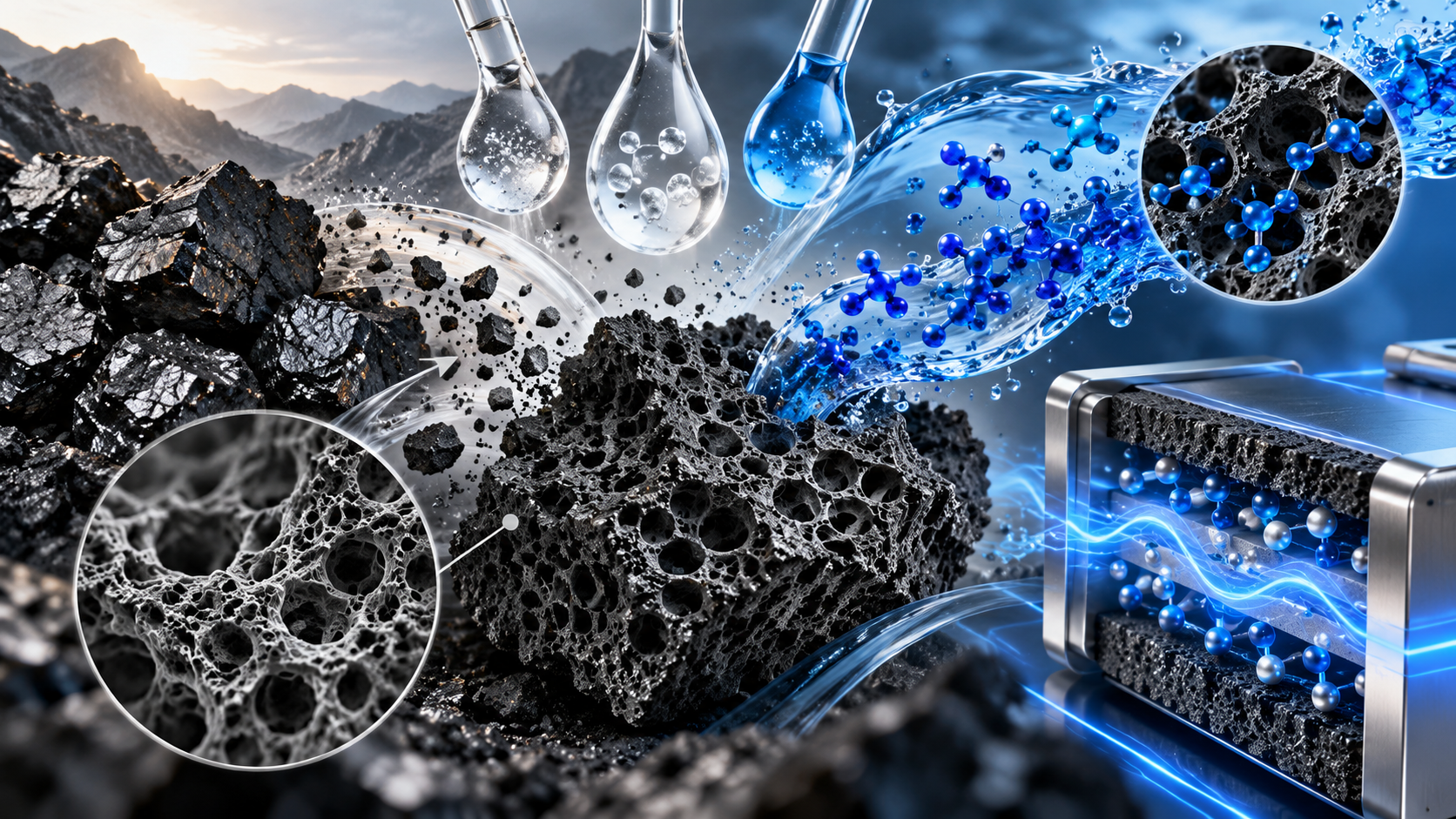
Paper: Residual minerals tune coal-derived porous carbon for adsorption and energy storage. AI-generated abstract conceptual image created using ChatGPT/OpenAI
A recent study, published as an Article in Press by Scientific Reports, examines how residual mineral species are associated with changes in the structure and performance of porous carbon derived from Taixi anthracite. The study compares hydrochloric acid (HCl), sodium hydroxide (NaOH), and combined NaOH–HCl deashing treatments before KOH activation.
The findings support a role for residual mineral species during carbon formation and show how precursor treatment can change the resulting porous carbon for methylene blue adsorption and supercapacitor applications.
Understanding the role of residual minerals
Porous carbon supports applications ranging from water treatment and gas adsorption to electrochemical energy storage. Its high surface area, tunable pore structure, and chemical stability make it attractive for these applications, but the required structural characteristics vary with the intended use. Micropores provide abundant sites for ion storage, while larger pores help molecular and ion transport.
Coal is an attractive precursor for large-scale porous-carbon production because of its abundance, low cost, and established industrial supply chain. Coal also contains naturally occurring mineral matter, which is commonly removed before activation to reduce ash content and improve carbon purity. Mineral matter may play a more active role in carbon formation than its classification as an impurity.
Residual calcium, iron, and magnesium species can influence gasification and local reactions during activation, while aluminosilicate phases may affect pore development through templating or by restricting access to parts of the carbon matrix. The study examines whether the type and amount of residual minerals influence the properties of coal-derived porous carbon.
Engineering porous carbon through selective deashing
The researchers selected Taixi anthracite as the carbon precursor and prepared four precursor states. They kept one portion of the coal untreated and designated it TX. They treated the other portions with HCl, NaOH, or sequential NaOH–HCl treatment, producing TX-S, TX-J, and TX-JS, respectively.
The researchers then activated all four precursors with KOH at a precursor-to-KOH mass ratio of 1:4, yielding TX-PC, TX-S-PC, TX-J-PC, and TX-JS-PC. The “-PC” suffix denotes the activated porous carbon product derived from each precursor. The chemical treatments resulted in markedly different ash contents. Untreated TX contained 3.06% ash.
The paper's main text gives an ash content of 2.06% for HCl-treated TX-S. NaOH treatment reduced it to 1.93%, and the combined treatment further decreased it to 0.31%. X-ray fluorescence analysis identified silicon as the dominant mineral element in the original coal, followed by aluminum, iron, calcium, and magnesium.
The two individual treatments altered the residual mineral composition in distinct ways. HCl removed more than 90% of most metallic elements but retained higher levels of aluminum- and silicon-related species, whereas NaOH removed aluminum and silicon while retaining more calcium, iron, and magnesium.
The researchers then characterized the resulting carbons using nitrogen adsorption, X-ray diffraction, Raman spectroscopy, scanning electron microscopy, Fourier-transform infrared spectroscopy, X-ray photoelectron spectroscopy, and Boehm titration. Thermogravimetric analysis provided information on thermal behavior, while methylene blue adsorption experiments assessed adsorption capacity and temperature dependence.
Residual mineral profiles are associated with pore structure and application performance
All four carbons developed highly porous structures dominated by micropores, with specific surface areas ranging from 2451 to 3101 m²/g and total pore volumes from about 1.3 to 1.76 cm³/g.
Changing the precursor deashing treatment produced clear differences in pore distribution. TX-S-PC, derived from the HCl-treated precursor, achieved the highest surface area of 3101 m²/g and the largest pore volume of 1.76 cm³/g. The NaOH-derived TX-J-PC had the highest micropore surface area fraction, at 72.1%.
The researchers propose that residual minerals may help explain these differences during KOH activation. Calcium-, iron-, and magnesium-containing species may alter local carbon reactivity, while mineral-derived phases could act as local templates for pore formation.
The authors did not directly establish the mineral transformations or reaction pathways during activation. Boehm titration measured 2.695 - 3.074 mmol/g of oxygen-containing groups, while FTIR showed that the main types of surface groups were similar across the four carbons.
These structural and chemical differences translated into contrasting application outcomes.
Methylene blue adsorption increased rapidly during the first 30 minutes and reached equilibrium after 60 minutes. The HCl-derived TX-S-PC achieved the highest equilibrium capacity at 1140.94 mg/g, while TX-PC reached equilibrium more rapidly. TX-JS-PC delivered 1108.78 mg/g and maintained comparatively consistent adsorption across the tested temperatures.
Adsorption fell as temperature rose from 30 to 50 °C; the authors described the process as exothermic and predominantly physical.
Electrochemical testing showed trade-offs between charge-storage capacity, ion transport, rate performance, and cycling stability. The NaOH-derived TX-J-PC provided the highest capacitance, 179.64 F/g at 0.1 A/g, while TX-PC supported faster charge and ion transport.
TX-S-PC instead showed the strongest cycling stability, retaining 78.99% of its capacitance after 20,000 cycles. The combined-treatment carbon, TX-JS-PC, had the highest rate retention at 82.31% when the current density rose to 10 A/g. The results show that surface area alone does not determine performance; pore accessibility, pore-size distribution, surface chemistry, ion transport, and stability must be considered together.
Toward application-specific coal-derived porous carbon
The study treats deashing as a materials-design choice that can change the structure and performance of coal-derived porous carbon. Each mineral-removal route created a characteristic precursor mineral profile and, in turn, porous carbons with varying combinations of pore structure, surface chemistry, adsorption behavior, ion transport, and electrochemical stability.
HCl treatment yielded TX-S-PC with highly developed porosity and the strongest long-term cycling stability. NaOH treatment yielded TX-J-PC with a micropore-rich structure and the highest low-current capacitance. Combined deashing gave TX-JS-PC the most temperature-stable methylene blue adsorption and the highest rate retention at high current density. These differences show why pore structure and surface chemistry need to match the intended application.
The authors note that the study focuses on a single anthracite precursor. The correlation analysis also covers only four porous carbons, so the reported correlations are based on a small dataset. Further research across different coal ranks and carbonaceous feedstocks, together with kinetic modeling and scale-up studies, could determine the extent to which the observed structure-performance relationships apply.
The work connects precursor mineral chemistry with porous carbon structure and end-use performance, providing researchers with a basis for selecting pretreatments for specific adsorption or energy-storage goals. The proposed reaction pathways still require direct verification.
Disclaimer: The views expressed here are those of the author expressed in their private capacity and do not necessarily represent the views of AZoM.com Limited T/A AZoNetwork the owner and operator of this website. This disclaimer forms part of the Terms and conditions of use of this website.
Source:
Zhang, Z., Luo, Y., et al. (2026). Residual minerals tune coal-derived porous carbon for adsorption and energy storage. Scientific Reports. DOI: 10.1038/s41598-026-73012-w. https://www.nature.com/articles/s41598-026-73012-w