By reshaping how water, zinc ions, and the electrode interface interact, the new hydrogel targets several failure mechanisms that have limited the durability of aqueous zinc batteries.
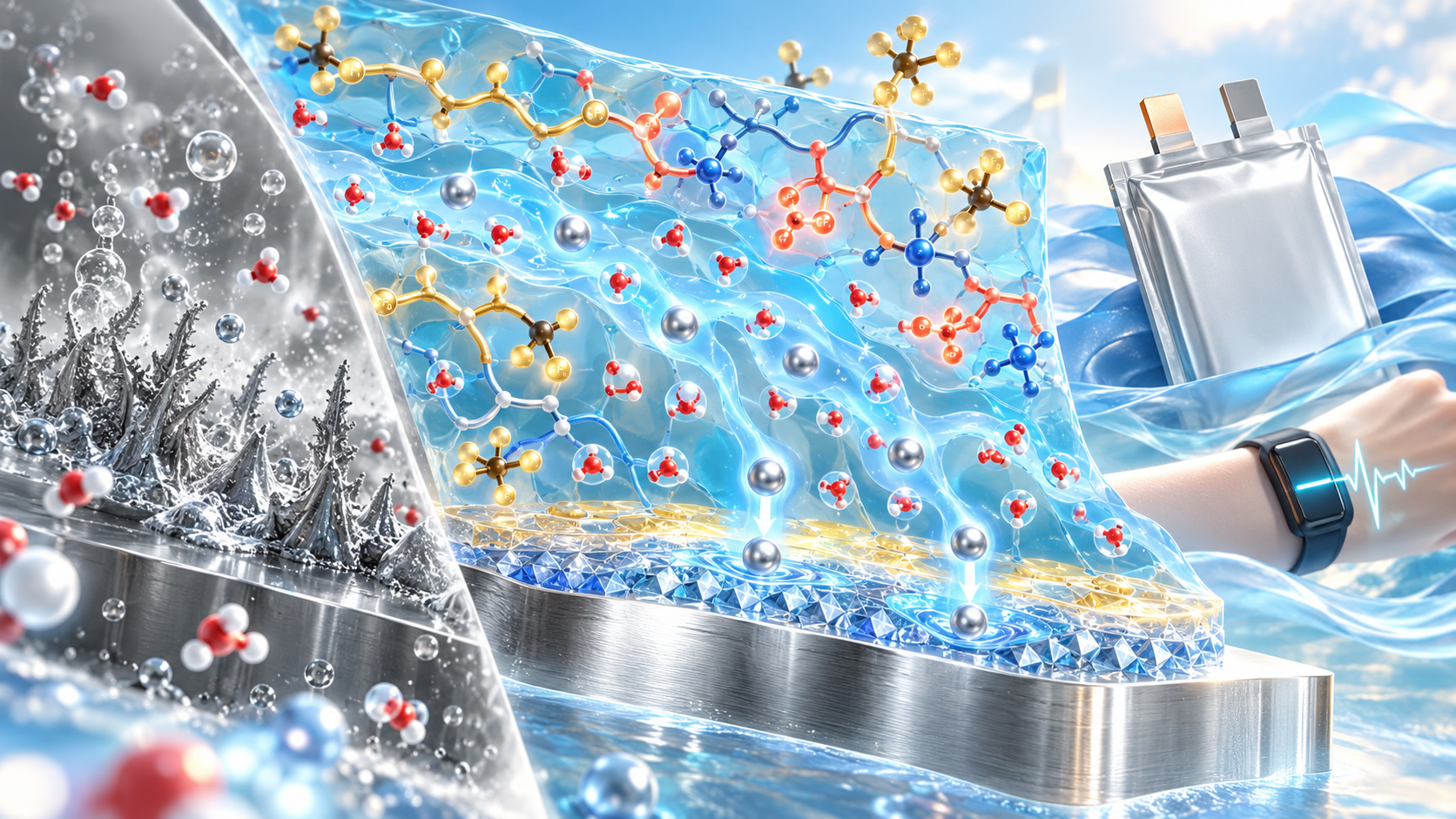
Paper: Molecularly engineered zwitterionic-fluorinated hydrogel electrolyte for durable Ah-level zinc-ion batteries. AI-generated abstract conceptual image created using ChatGPT/OpenAI
*Important notice: This news reports on an unedited version of an accepted paper and is awaiting final editing. Therefore, the paper should not be regarded as conclusive or treated as established information.
In a recent Nature Communications article, researchers developed a molecularly engineered zwitterionic–fluorinated hydrogel electrolyte that improves the stability, ion transport, and long-term performance of aqueous zinc-ion batteries.
Engineering water for zinc stability
Aqueous zinc-ion batteries are promising for large-scale energy storage because zinc is inexpensive, relatively safe, and has a high theoretical capacity. Their practical performance is constrained by the behavior of water at the electrode–electrolyte interface.
In conventional aqueous and hydrophilic hydrogel electrolytes, abundant free water can trigger hydrogen evolution, corrosion, unwanted side reactions, and unstable zinc deposition. Hydrogels can confine water while maintaining good ion transport, but conventional designs offer limited control over interfacial chemistry.
This study addresses the problem with a molecularly engineered hydrogel that combines hydrophobic fluorinated groups with zincophilic zwitterionic groups to regulate water structure, Zn2+ transport, and interphase formation.
Building the PAFS hydrogel architecture
The researchers developed a poly(acrylamide–trifluoroethyl acrylate–sulfobetaine methacrylate), or PAFS, hydrogel electrolyte. Acrylamide provided the hydrophilic polymer network, trifluoroethyl acrylate introduced hydrophobic fluorinated –CF3 groups, and sulfobetaine methacrylate supplied zwitterionic, zincophilic –SO3− and –N+(CH3)3 sites.
Sodium dodecyl sulfate helped stabilize the hydrophobic monomer in the aqueous precursor and acted as a physical crosslinker that supported gel formation.
The polymer network was formed through ultraviolet irradiation in a ZnSO4-based electrolyte. Conventional PAAm and PAF hydrogels were used as comparison materials. For Zn||MnO2 full-cell tests, the hydrogel contained 1 M ZnSO4 plus 0.2 M MnSO4. s41467-026-77562-5
The material was examined through structural, chemical, mechanical, and electrochemical characterization. Spectroscopic and scattering techniques were used to investigate polymer structure, functional groups, and water interactions. Ionic conductivity and Zn2+ transference were measured to assess ion movement. Mechanical testing evaluated tensile strength and adhesion to zinc.
The zinc interface was characterized using XPS, TOF-SIMS, TEM, and AFM to examine the composition, nanostructure, and mechanical properties of the solid electrolyte interphase.
XRD was used separately to characterize phase composition and showed reduced formation of the Zn4SO4(OH)6·5H2O byproduct. Zn||Zn, Zn||Cu and Zn||MnO2 cells were then tested, followed by pouch-cell demonstrations at approximately Ah scale.
Regulating Zn2+ transport and interfaces
The central design feature was the combination of hydrophobicity and zincophilicity within the same polymer network. Rather than allowing the hydrophobic component to hinder ion movement, the zwitterionic SBMA groups created continuous hydrophilic regions that supported Zn2+ transport.
The PAFS hydrogel achieved an ionic conductivity of 24.7 mS cm−1, compared with 13.3 mS cm−1 for PAAm and 10.3 mS cm−1 for PAF. Its Zn2+ transference number reached 0.76, substantially higher than the 0.50 measured for PAAm and 0.29 for PAF. The total ionic conductivity remained below 31.3 mS cm−1, the value measured for the 1 M ZnSO4 aqueous electrolyte.
The molecular structure also changed how water behaved inside the hydrogel. Fluorinated groups restricted water mobility, while hydrophilic and zwitterionic groups strengthened water-polymer interactions.
Measurements showed a higher fraction of strongly bound water and more restricted water mobility in PAFS, findings the authors interpret as evidence of lower water activity. Raman results also indicate that the material disrupts the free-water hydrogen-bond network while strengthening water–polymer interactions.
At the same time, the authors propose that confined water-rich regions help Zn2+ move through the hydrogel. Spectroscopy, electrochemical measurements, and molecular simulations support this mechanism, with the simulations showing faster Zn2+ diffusion in PAFS than in PAAm. The design combines restricted free-water behavior with efficient Zn2+ movement.
The hydrogel also showed improved mechanical properties. PAFS reached a tensile stress of 71.1 kPa, an elongation at break of 290.6%, and a toughness of 90.7 kJ m−3, outperforming the PAAm control. Its adhesion to zinc was 12.1 kPa compared with 2.7 kPa for PAAm.
The combination of covalent crosslinking, hydrophobic association, and reversible interactions helped the material maintain its network under mechanical stress.
A further finding was the formation of an organic–inorganic solid electrolyte interphase on zinc. XPS, TOF-SIMS, and TEM identified ZnS, ZnO, and ZnF2, along with an amorphous organic component.
This hybrid interphase combines the rigidity of inorganic phases with the toughness and adaptability of the organic component. Such a structure may resist dendrite growth while accommodating repeated volume changes during plating and stripping.
These molecular and interfacial effects were reflected in the electrode morphology and cycling performance. After cycling, zinc protected by PAFS showed an average surface roughness of only 37 nm, compared with 210 nm for the aqueous electrolyte.
Zn||Zn cells operated for more than 900 hours at 5 mA cm−2 and 5 mAh cm−2, while the PAAm control lasted approximately 240 hours. Zn||Cu cells maintained about 99.3% Coulombic efficiency over 500 cycles at 1 mA cm−2 and 0.5 mAh cm−2.
The electrolyte was also tested in complete batteries. Zn||MnO2 cells using PAFS retained 70% of their capacity after 1500 cycles at 1 A g−1. These coin cells used a MnO2 loading of 1 mg cm−2 and a large excess of zinc, with an N/P capacity ratio of 289.7, meaning the zinc electrode had far greater nominal capacity than the MnO2 cathode. The cycling result should not be read as a direct measure of a balanced practical cell.
An approximately 1 Ah Zn||MnO2 pouch cell operated for more than 40 cycles at 0.01 A g−1, with operation extending beyond 700 hours. Because the pouch cell was cycled at 0.01 A g−1, more than 700 hours corresponded to only around 40 cycles.
Capacity and Coulombic efficiency fluctuated during the final cycles, which the authors suggest may have resulted from gradual electrolyte loss and overcharging. A separate approximately 0.4 Ah pouch cell exceeded 70 cycles and 1000 hours with capacity retention above 80%.
A flexible cell using the same electrolyte also maintained stable discharge performance under bending, folding, and impact, and portable pouch cells using PAFS successfully powered a wearable electromyography system.
These results show that controlling polymer chemistry and interfacial structure can directly improve battery durability and mechanical reliability, while the pouch-cell tests remain laboratory demonstrations rather than evidence of commercial-level cycle life.
From molecular design to durable batteries
The study describes a materials-engineering approach in which hydrophobic fluorinated groups, zincophilic zwitterionic sites, and a polymer network perform complementary functions. The resulting PAFS hydrogel regulates water behavior, promotes Zn2+ transport, and forms an organic–inorganic interphase on zinc that balances rigidity and toughness.
These features suppress parasitic reactions and dendritic growth while enabling stable zinc deposition. The long coin-cell cycling life and Ah-level pouch-cell demonstration support further development of molecularly engineered hydrogel electrolytes for durable and mechanically resilient aqueous zinc batteries. Practical durability will require longer pouch-cell tests under more demanding operating conditions.