Solid Fat Content (SFC) is an important measurement for characterizing edible oils and fats used in the bakery, confectionery, and margarine industries, where a quick and convenient method is essential.
The melting profile (Solid Fat Content vs. Temperature) defines the specific application of an edible oil or fat, and therefore serves as a key quality control parameter for suppliers and end-users, as well as for product development purposes. Growing regulations aimed at reducing or eliminating trans fatty acids have revived interest in this method, as numerous traditional products will require reformulation.
Advantages of NMR
Although the traditional approach for measuring SFC is dilatometry, it is considered slow, imprecise, and cumbersome. For many years, however, Nuclear Magnetic Resonance (NMR) has been the preferred approach for determining SFC.
- NMR complies with all internationally accepted official Direct Methods for SFC measurement: ISO 8292-1, AOCS Cd 16b-93; and IUPAC 2.150
- NMR measurement time is short (typically 6 seconds), though sample conditioning is required
- The NMR method is non-destructive, allowing repeatability or additional measurements on the same sample
- NMR exhibits significant long-term stability and rarely requires recalibration.
Image Credit: AN NGUYEN /Shutterstock.com
The Direct Method
The Direct Method operates by measuring both the solid and liquid signals from the NMR Free Induction Decay (FID) of a sample. This is possible because signals from solids decay significantly faster than those from liquids.
In principle, measurements can be taken at two points on the FID (Figure 1): at point S0, representing the total solid plus liquid signal, and at another point, S70, which represents the liquid-only signal, after the solid signal has died away.
The Solid Fat percentage is calculated using the formula (S0 - S70)/S0 × 100. In practice, it is not possible to take a measurement at point S0, immediately after the 90°C radio frequency (RF) pulse.
The short, high-power RF pulse causes the sample probe to ‘ring’ for several microseconds, during which time measurements cannot be made. Instead, the initial measurement is taken immediately after this ringing period (or dead time), at point S11.
Since S11 does not represent the complete signal from the solid and liquid, a correction must be applied. This correction assumes a constant ratio (called the f-factor) between S0 and S11 due to loss of the solid signal during the first 11 μs of the decay.
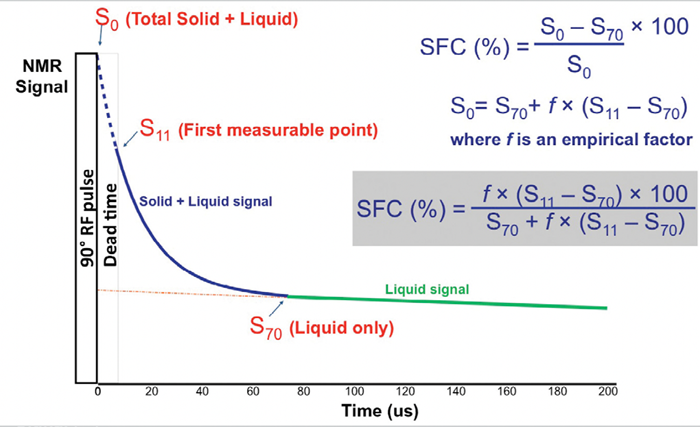
Figure 1. Schematic diagram showing how Solid Fat Content is derived from NMR measurements by the Direct Method. Image Credit: Oxford Instruments
Official procedures also exist for the Indirect Method, which measures only the liquid signal (an absolute measurement) and must therefore be referenced against the same sample when fully melted.
Consequently, the Indirect Method requires an additional temperature step and a temperature compensation sample, and all samples must remain within the probe’s measurement volume.
In contrast, the Direct Method is a ratio measurement that is not sensitive to sample loading and does not require a compensation sample or an additional temperature step. As such, the Direct Method is usually the preferred NMR technique for SFC determination.
Tempering
Before SFC determination, edible oil and fat samples must undergo tempering to stabilize their crystal structures. The tempering process involves placing samples in temperature-controlled blocks for predetermined time intervals.
After melting the samples at 100 °C, they are pre-conditioned at 60 °C and subsequently at 0 °C to remove their thermal history. Stabilizing fats such as cocoa butter require a different temperature regime. The samples are then stabilized at various target temperatures before NMR analysis.
This can be performed on the same sample in ‘Series’ or multiple aliquots of a sample in ‘Parallel’. The Parallel method is generally used as it is faster, though it requires a separate conditioning block for each temperature in addition to those for the preconditioning steps.
Image Credit: Food Impressions /Shutterstock.com
The number and value of temperature steps, as well as the time that the samples are at each temperature, are configured according to the official method followed, such as the International Organization for Standardization (ISO 8292- 1), the American Oil Chemists’ Society (AOCS Cd 16b-93), or the International Union of Pure and Applied Chemistry (IUPAC 2.150).
Additional details regarding these official procedures can be found on the respective organizations' websites. Oxford Instruments may also be contacted directly for guidance.

Figure 2. Graph showing melting profiles (Solid Fat Content vs. Temperature) of AOCS proficiency samples. Image Credit: Oxford Instruments
Calibration
The f-factor is calculated automatically by a software routine using known SFC samples. Artificial standards supplied by the NMR manufacturer represent about 0 %, 30 %, and 70 % SFC, with exact values assigned and certified by the producer.
Results
Figure 2 illustrates data obtained from three AOCS proficiency samples used to validate the instrument. The two most critical factors for achieving consistent results across laboratories, both independent of the instrument, are:
- F-factor determination
- Adhering to the same tempering protocol while following the method in every detail.
Summary
- Complies with official ISO, AOCS, and IUPAC standard methods
- Simple calibration using stable standards
- Simple, intuitive visual software suitable for inexperienced operators
The MQC+ SFC analyzer provides several benefits compared with other instruments on the market:
- Compliance with all official SFC Direct Methods
- Solid Fat Direct software guides users through the measurement process, recording sample identification and measurement temperatures
- Instructions available in English, French, German, Spanish, Chinese, and Japanese
- Solid Fat ProGen software provides users with flexibility in defining important NMR parameters, measurement temperatures, and techniques (Series, Parallel, or Individual measurements)
- Solid Fat Reporter software enables data review, plotting, and export to other programs; it also allows generation of melting profile curves
- A set of standards for instrument calibration (f-factor determination)
- Small benchtop footprint
- Minimal maintenance requirements.
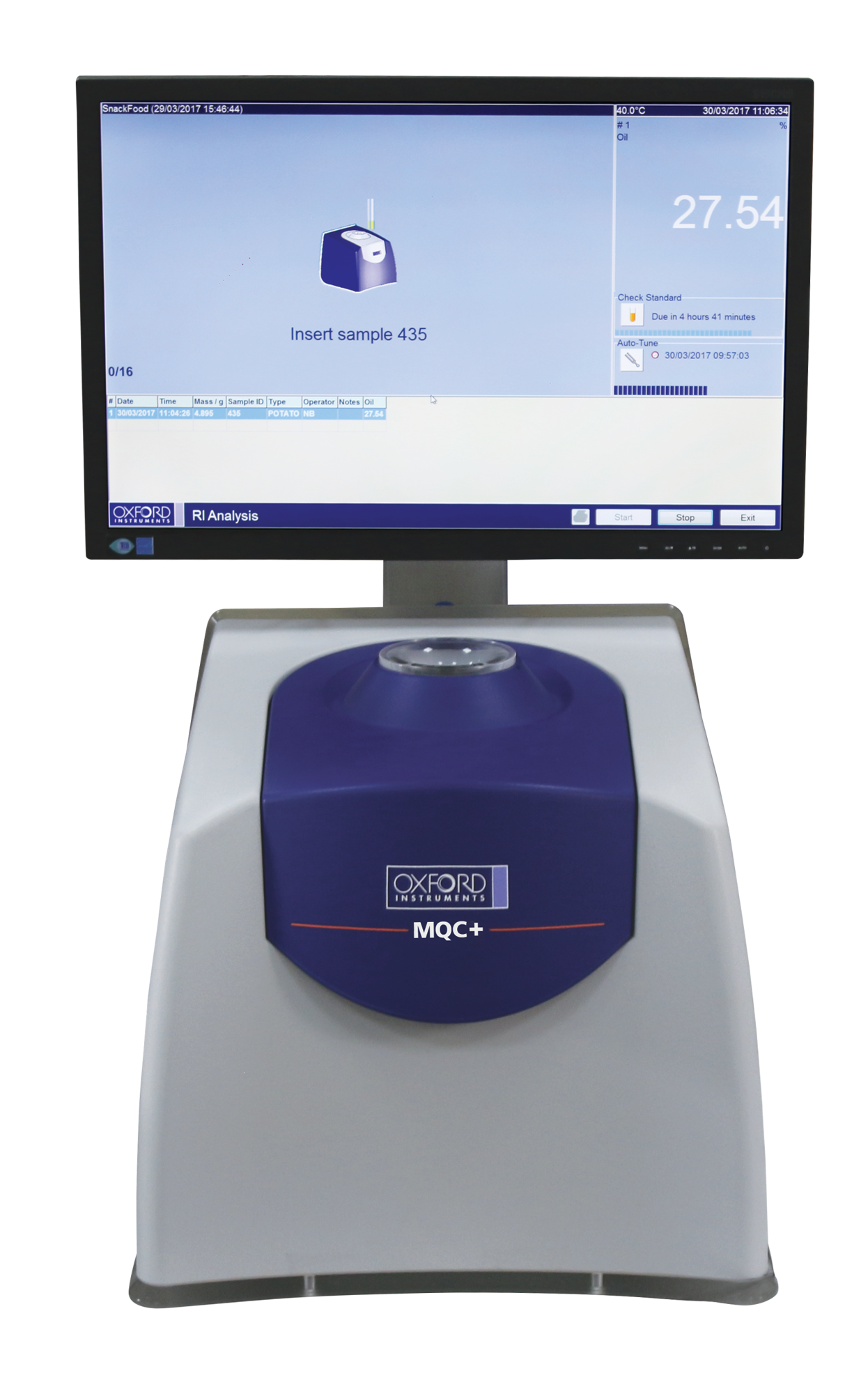
Image Credit: Oxford Instruments

This information has been sourced, reviewed, and adapted from materials provided by Oxford Instruments.
For more information on this source, please visit Oxford Instruments.