Carefully controlled grains, precipitates, and phase transformations allow selected entropy alloys to stretch beyond conventional limits, but scaling these laboratory achievements remains the next major challenge.
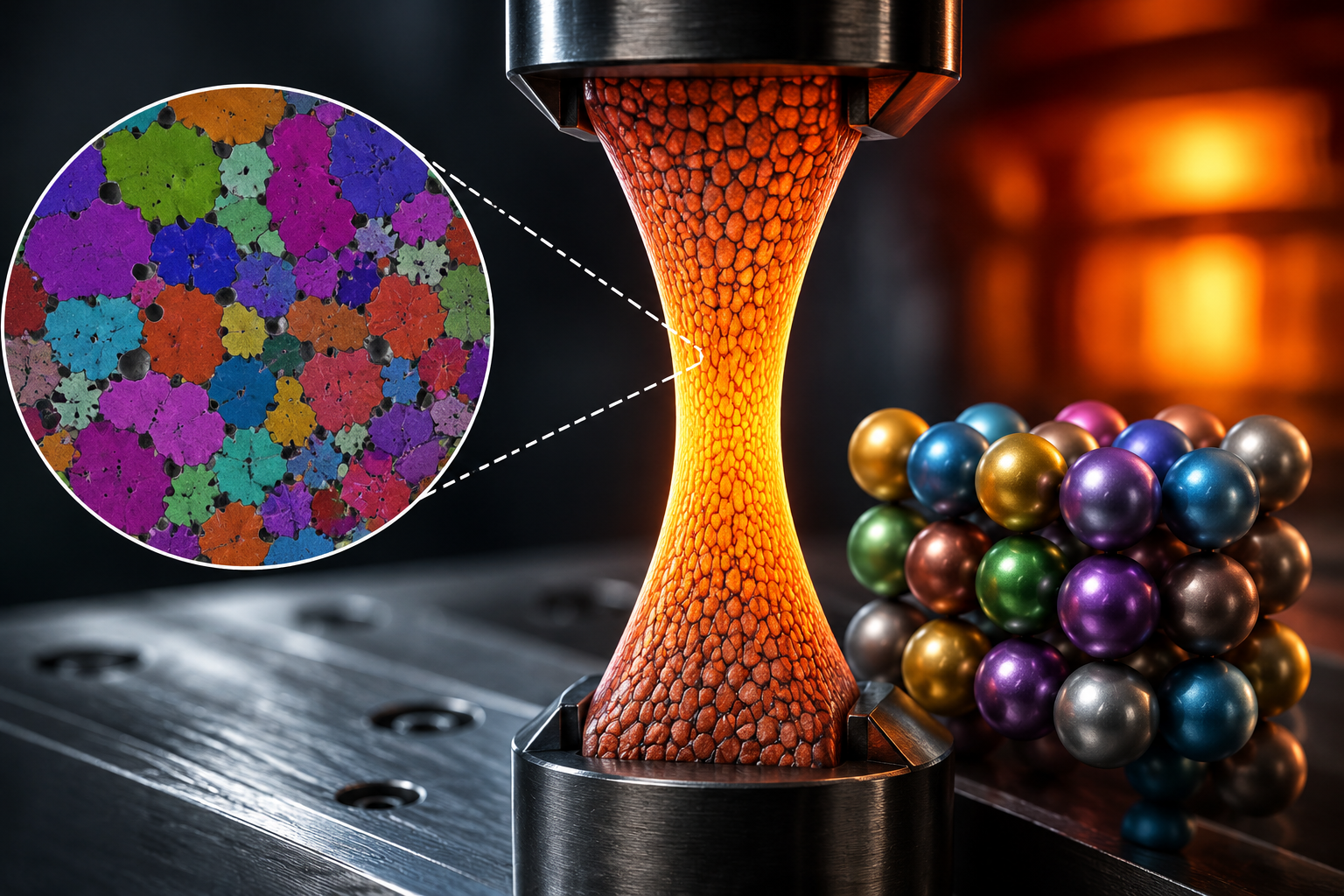
Paper: Unlocking superplasticity in medium and high-entropy alloys. Image credit: AI-generated image created using ChatGPT/OpenAI
A recent review published in the journal Communications Materials examines how medium- and high-entropy alloys (M/HEAs) can achieve exceptional superplasticity through carefully engineered and dynamically evolving microstructures. Superplasticity allows metals to stretch several times their original length at elevated temperatures without fracturing, making it valuable for manufacturing complex components. The review highlights how grain refinement, phase evolution, and thermomechanical processing work together to promote large plastic deformation.
Understanding Superplasticity in High-Entropy Alloys
Superplasticity enables metals to undergo extremely large deformation before failure. Superplastic forming uses this property to produce lightweight components with complex shapes while minimizing machining and material waste. The process depends largely on grain boundary sliding, in which neighboring grains slide past one another rather than accumulating excessive internal stress. To sustain this mechanism, the material must retain or continuously generate a fine, mostly equiaxed, and stable grain structure throughout deformation.
Medium- and high-entropy alloys have attracted considerable attention because they combine multiple principal elements, often, but not necessarily, in nearly equal proportions. This compositional strategy can produce unusual combinations of strength, ductility, fracture toughness, and thermal stability. Although researchers have extensively studied these mechanical properties, the superplastic behavior of these materials has received much less attention. Most previous reviews have focused on alloy design and mechanical performance rather than the mechanisms that enable large plastic deformation.
The review synthesizes recent research on superplastic M/HEAs and the influence of factors such as composition, processing, grain structure, and phase evolution on deformation behavior. The review provides practical insights for designing the next generation of superplastic alloys. However, the authors caution that superplasticity is not an intrinsic property of all M/HEAs and depends strongly on composition, processing history, microstructure, and testing conditions. Proposed HEA “core effects,” including sluggish diffusion and inherent thermal stability, are not universal, and constituent chemistry may be more important than the number of alloying elements.
Linking Processing to Microstructural Evolution
Experimental studies cover face-centered cubic (FCC), refractory body-centered cubic (BCC), and multiphase M/HEAs. The authors compile results from published studies on superplastic medium- and high-entropy alloys. They evaluate the processing methods that refine microstructure and improve superplasticity. The analysis also compares the high-temperature deformation behavior of different alloy systems.
Microstructural refinement plays a central role in achieving superplasticity. Conventional rolling and recrystallization reduce grain size, but severe plastic deformation techniques such as high-pressure torsion (HPT), equal-channel angular pressing (ECAP), and friction stir processing (FSP) produce much finer grains. These refined microstructures can promote grain boundary sliding and improve microstructural stability during deformation. Researchers can further optimize performance through controlled annealing and microalloying, which stabilize grain boundaries and promote the formation of beneficial secondary phases.
The authors also discuss theoretical models that explain superplastic deformation. Classical diffusion- and dislocation-based mechanisms remain important, but recent studies show that dynamic recrystallization, phase transformations, and evolving grain boundary chemistry also influence deformation. Together, these mechanisms determine how the microstructure evolves under high temperatures and mechanical loading.
Microstructural Evolution Drives Exceptional Ductility
The review shows that superplasticity can depend on continuous microstructural evolution rather than solely maintaining a static grain structure. In single-phase FCC alloys, such as the Cantor alloy, ultrafine grains promote grain boundary sliding during the early stages of deformation. In the unmodified Cantor alloy, however, grain coarsening and extensive cavitation limited elongation to about 320%. In Ti- or Al-modified Cantor-type alloys, deformation-induced BCC, ordered B2, and intermetallic σ precipitates can form and pin grain boundaries. This limits grain growth and helps maintain superplastic deformation.
The analysis highlights the advantages of multiphase alloys. Carefully designed multiphase materials can achieve greater superplastic performance than comparable single-phase alloys. Deformable FCC and B2 regions accommodate deformation, while harder precipitates stabilize the grain structure by restricting grain boundary movement. However, excessive precipitation of brittle intermetallic phases promotes crack formation and cavity growth, ultimately reducing elongation.
Some refractory M/HEAs follow a different deformation pathway. They may not require a uniformly ultrafine grain structure before deformation begins. Grain boundary sliding, dynamic recrystallization, dislocation motion, and creep then work together to accommodate large plastic strains. This behavior challenges the traditional view that superplasticity always requires an ultrafine starting microstructure. However, refractory alloys generally require substantially higher forming temperatures, making oxidation resistance and thermal stability important practical considerations.
The authors also discuss recent progress in high-strain-rate superplasticity, which is important for industrial manufacturing. Slow deformation rates and long processing times often limit the effectiveness of conventional superplastic forming. High-strain-rate superplasticity, generally defined as superplastic flow above 10-² s-¹, requires ultrafine grains to remain stable while stresses generated by grain boundary sliding are rapidly accommodated. Depending on the alloy, diffusion, dislocation activity, dynamic recrystallization, stress relaxation at phase interfaces, dynamic precipitation, and grain boundary pinning can all contribute. Some M/HEAs also achieve elongations above 1000% despite strain-rate sensitivity values of about 0.3-0.4, which are below the value near 0.5 associated with ideal grain boundary sliding. The authors therefore caution that this coefficient alone cannot identify the dominant deformation mechanism. These advances could shorten manufacturing times while retaining the excellent formability needed for complex engineering components.
Advancing the Design of Superplastic Structural Materials
This review highlights the importance of microstructural engineering in developing superplastic medium- and high-entropy alloys. The authors show that controlled precipitation, dynamic recrystallization, and grain boundary evolution can sustain grain boundary sliding during deformation. This approach provides greater flexibility for designing alloys with superior formability and mechanical properties.
The authors identify several challenges that limit large-scale applications. Many laboratory studies rely on severe plastic deformation techniques that are difficult to scale for industrial manufacturing. Moreover, many elongations were recorded from miniature specimens cut from HPT-processed materials, indicating intrinsic superplastic potential rather than engineering-scale formability. High alloy costs, oxidation during forming, recyclability, processing reproducibility, and long-term microstructural stability also remain concerns. Future research should focus on commercially viable processing methods such as rolling, friction stir processing, powder metallurgy, and additive manufacturing. These techniques could produce similarly refined microstructures while supporting large-scale production.
The authors further emphasize the need to combine advanced experiments with computational modeling. Tools such as Calculation of Phase Diagrams (CALPHAD), phase-field modeling, crystal plasticity, atomistic simulations, and machine learning can improve predictions of phase stability, grain evolution, deformation, diffusion, and defect behavior. Combining these methods with in situ characterization techniques could clarify the real-time interactions among grain boundary sliding, diffusion, dislocations, phase transformations, and cavitation. Integrating these approaches could accelerate alloy development and help researchers identify promising compositions before experimental validation.
Overall, the review positions selected medium- and high-entropy alloys as promising candidates for superplastic structural materials. It provides practical insights into how alloy composition, microstructure, and processing conditions influence deformation. These findings could guide the development of stronger, more formable alloys for aerospace, automotive, and energy applications, while enabling faster, more efficient manufacturing processes.
Disclaimer: The views expressed here are those of the author expressed in their private capacity and do not necessarily represent the views of AZoM.com Limited T/A AZoNetwork the owner and operator of this website. This disclaimer forms part of the Terms and conditions of use of this website.