A chain-ring structure gives inorganic glass an unusual combination of extreme flexibility and broad infrared transmission, pointing toward compact lenses that can change focus on demand.
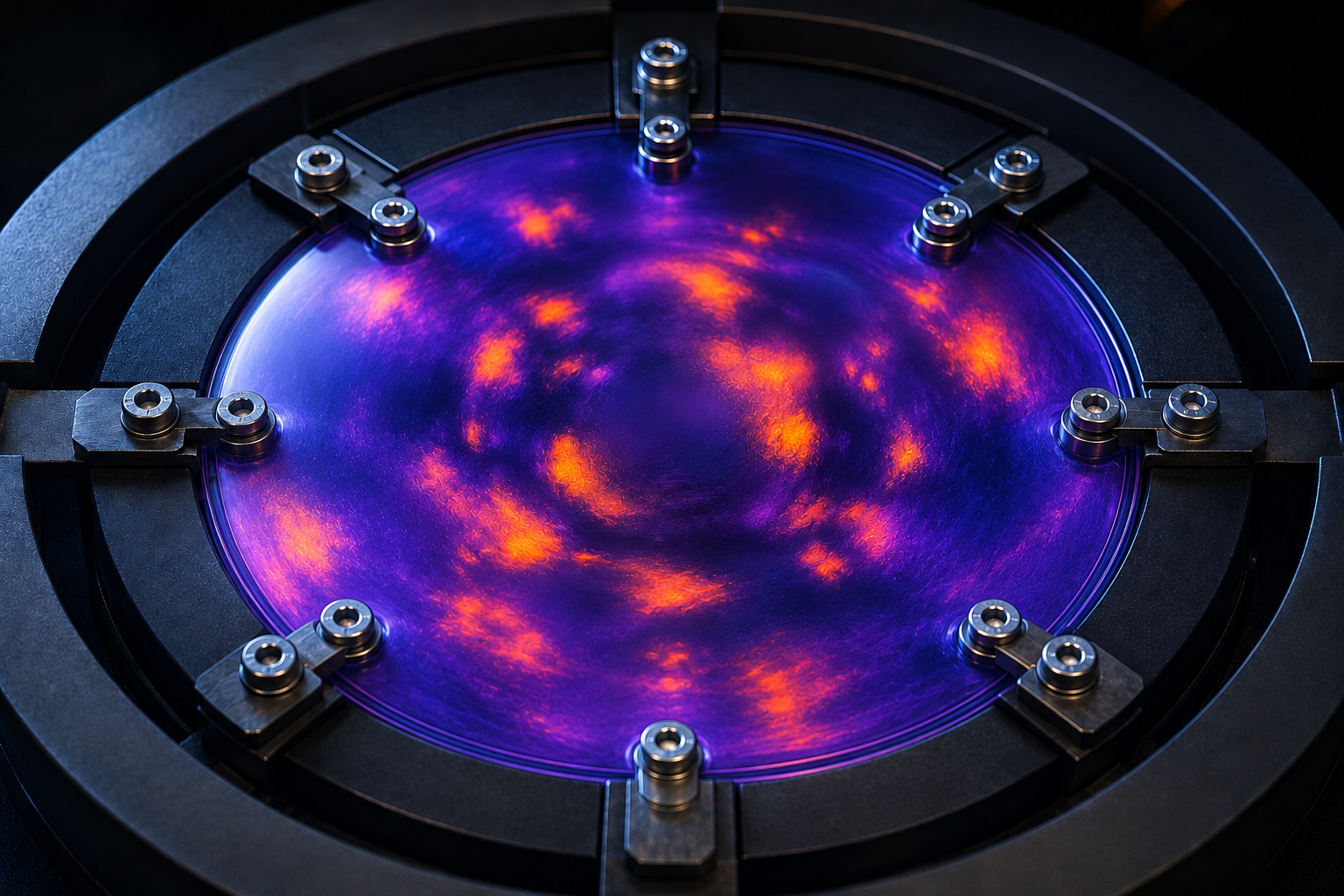
Paper: An infrared-transparent flexible glass for adaptive optics. Image credit: AI-generated image created using ChatGPT/OpenAI
Researchers have developed an ultra-flexible inorganic glass that combines broad infrared transparency with exceptional mechanical flexibility, addressing a longstanding challenge in optical materials science. Their study, published in the journal Light: Science & Applications, introduced a sulfur-selenium chalcogenide glass (S60Se40) with a measured transmission window extending from approximately 0.62 μm to a long-wavelength cutoff near 21 μm while showing extreme stretchability, high strain recovery, room-temperature self-healing, and shape-memory behavior.
The material has an ultralow Young's modulus of approximately 0.0037 GPa, withstood a maximum tensile strain of 647%, meaning it elongated by approximately 647% relative to its starting length, achieved an approximately 80% strain recovery ratio across tensile strains from 25% to 400%, and can self-heal after being cut. By overcoming the traditional trade-off between optical performance and mechanical flexibility, this glass opens new possibilities for adaptive optics, reconfigurable photonics, flexible thermal imaging, and other infrared optical systems.
The Challenge of Flexible Infrared Materials
Developing optical materials that combine mechanical flexibility with broad mid- and long-wave infrared transparency has long been a significant challenge. Conventional infrared materials, including germanium and zinc selenide, achieve excellent infrared transmission through rigid atomic networks of heavy elements. However, these strong atomic bonds make the materials stiff and brittle, with Young's moduli on the order of 100 GPa.
In contrast, organic polymers such as polydimethylsiloxane and polyurethane are soft and highly stretchable due to their flexible molecular chains. However, their light-element chemical bonds can strongly absorb infrared radiation, and the polymers compared in the paper had cutoff wavelengths ranging from approximately 2.2 to 6.5 μm. As a result, developing a material that combines infrared transparency with rubber-like flexibility has remained a goal in optical materials research.
Dual-Network Synthesis and Structural Design
To overcome the trade-off between infrared transparency and flexibility, researchers synthesized S60Se40 binary chalcogenide glass via vacuum-melt quenching. High-purity sulfur and selenium were sealed in evacuated quartz tubes, heated to 673 K for 48 hours, and rapidly water-quenched to produce a cylindrical glass ingot. The resulting glass was then sectioned into 2 mm-thick wafers and polished to optical quality. Separate lens samples were later produced by remelting the glass under nitrogen and casting it into molds.
The material's exceptional mechanical properties arise from a dual-network architecture. Covalent polymeric chains provide a load-bearing structural backbone, while physically cross-linked eight-membered sulfur-selenium rings act as junctions that rearrange under mechanical stress. This mechanism dissipates strain energy and redistributes internal forces while the covalent chains resist fracture and largely preserve the material's structural integrity, enabling high stretchability and self-recovery.
To investigate these mechanisms, the study combined molecular dynamics simulations with mechanical testing, including tensile, compression, and three-point bending experiments. Structural changes during deformation were characterized using in situ Raman spectroscopy, while ultraviolet-visible-near-infrared spectrophotometry and Fourier-transform infrared spectroscopy were used to characterize optical transmission.
![Schematic comparison of material design and the resultant properties: a stiff IR-transparent glasses with rigid three-dimensional covalent networks; b soft polymers with dynamically cross-linked chains; c S60Se40-based DN chalcogenide glass, which integrates physically cross-linked S8−ySey rings with polymeric [Se, S]n chains. Representative transmission spectra and stress-strain curves illustrate how the DN architecture achieves both a broad IR transmission window and a compliant, hyperelastic mechanical response](https://www.azom.com/images/news/ImageForNews_65667_17857154651802718.jpg)
Schematic comparison of material design and the resultant properties: a stiff IR-transparent glasses with rigid three-dimensional covalent networks; b soft polymers with dynamically cross-linked chains; c S60Se40-based DN chalcogenide glass, which integrates physically cross-linked S8−ySey rings with polymeric [Se, S]n chains. Representative transmission spectra and stress-strain curves illustrate how the DN architecture achieves both a broad IR transmission window and a compliant, hyperelastic mechanical response
Performance: Mechanical Resilience and Self-Healing
The S60Se40 chalcogenide glass successfully combined polymer-like mechanical flexibility with glass-like infrared transparency. It demonstrated a broad optical transmission window from 0.62 to 21 μm, thereby covering major atmospheric infrared bands used for thermal imaging, optical sensing, and infrared communications. Mechanically, the glass showed a Young's modulus of 0.0037 GPa and withstood a maximum tensile strain of 647%, while tolerating over 50% compressive strain and more than 15% bending strain without fracture.
The glass exhibited a strain recovery of about 80% across tensile strains from 25% to 400%. In a separate cyclic test, it maintained near-constant transmission with minimal hysteresis at 850 nm, 1,550 nm, and 10.6 μm during 200 stretching cycles between 0% and 15% strain. These properties arise from its dual-network structure, in which long sulfur-selenium polymer chains provide mechanical strength. At the same time, flexible eight-membered rings rearrange under stress to dissipate energy and prevent fracture.
Furthermore, the material demonstrated autonomous room-temperature self-healing. Due to dynamic sulfur-selenium bond exchange above its glass transition temperature of approximately 13.5 °C, severed samples can rejoin within three minutes without external heating. After three minutes, the healed material withstood tensile strain of up to 151% and recovered 81.8% of its original fracture stress. It also regained sufficient mechanical strength to support an approximately 500 g weight.
Advancements in Tunable Optical Devices
The combination of flexibility and a high refractive index enables this chalcogenide glass to be fabricated into compact, mechanically tunable optical devices. To demonstrate its practical potential, researchers developed transmissive deformable lenses with embedded peripheral metallic anchors connected to an electronic actuator system.
Applying multi-axis mechanical tension allowed for precise, real-time control of the lens surface curvature and focal length, achieving a tuning range of 5.62 mm, corresponding to an 11.8% change from the initial focal length. The high refractive index of the glass provides greater optical power modulation than conventional flexible polymers. In imaging demonstrations, the lenses performed real-time focal switching and depth-of-field adjustment, while measurements at 850 nm showed strain-dependent changes in Zernike aberration terms, which are mathematical measures used to describe wavefront distortions. Focal lengths at 2, 5, and 10 μm were extrapolated from lens curvature and refractive-index data rather than measured directly at each infrared wavelength. Images became blurred as the focal plane shifted under strain, but image quality was restored after strain release.
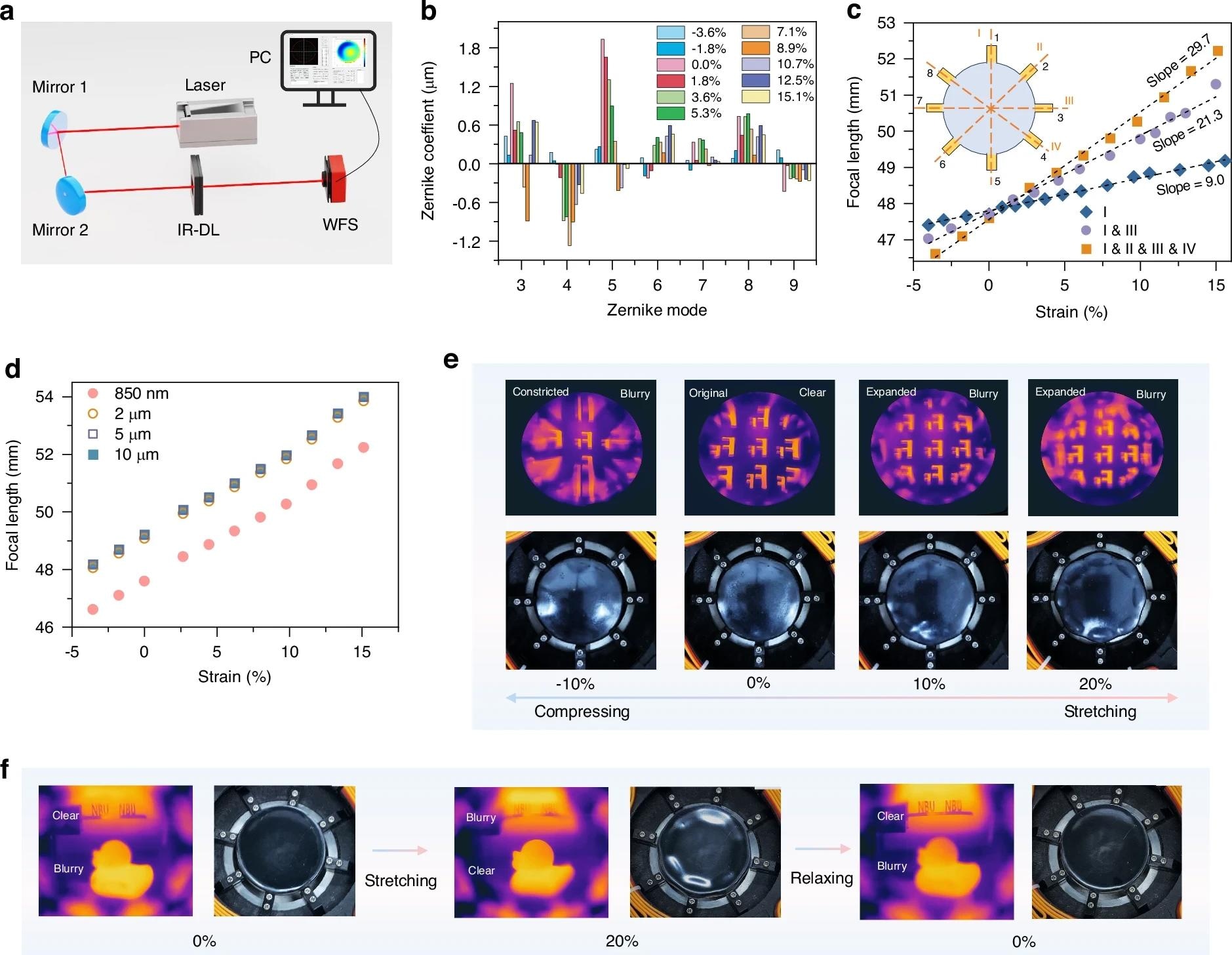
a Schematic of the transmitted wavefront characterization setup for an IR-DL using a custom optical bench equipped with a wavefront sensor (WFS). A collimated 850 nm laser beam passes through the IR-DL and is collected by the WFS (8 mm aperture, 1 ms exposure, 7 Hz acquisition rate). Wavefront aberrations were characterized by fitting the first 65 Zernike terms, excluding tilt components. The defocus coefficient was measured with a precision of ±0.05 µm (λ · 12−1). b Evolution of Zernike coefficients under simultaneous quadra-axial strain (axes I–IV). c Focal length tuning under vectored actuation: uniaxial (I), biaxial (I + III), and quadra-axial (I–IV). Defocus was nulled at each strain by WFS displacement. Inset: Actuator numbering and axes. d Focal length tuning range under quadra-axial strain at 850 nm. Focal lengths derived from lens curvature and refractive index f = R/(n − 1), where R is the radius of curvature and n the refractive index) were extrapolated to wavelengths of 2, 5, and 10 µm. e Visible-light and thermal IR images of a plano-convex IR-DL under relaxed, compressive, and tensile states, showing deformation-dependent imaging evolution. f Real-time focal switching and depth selectivity demonstrated with a plano-concave IR-DL: the distant “NBU” object is sharply imaged in the relaxed state; focus shifts to the nearer “Duck” object under stretching; and original focus recovers upon strain release
Future Applications in Photonic Technologies
The findings show that inorganic glass can achieve polymer-like flexibility while retaining broad infrared transparency and the optical characteristics of bulk glass under ambient laboratory conditions. This design combines mechanical compliance with optical functionality, potentially enabling compact, transmissive optical components that could reduce reliance on some bulky reflective systems in infrared applications.
Overall, the self-healing and adaptable chalcogenide glass provides a versatile platform for next-generation photonic technologies. Applications include adaptive optics for space laser communications, thermal imaging, bioimaging, industrial metrology, and reconfigurable infrared optical systems. However, the research remains a laboratory-scale material and proof-of-concept lens demonstration. Although infrared transmission remained stable after one year of storage in air, long-term mechanical fatigue, repeated self-healing, durability under humidity, temperature cycling, outdoor exposure, manufacturing scalability, and performance in installed adaptive-optics systems were not established.
Disclaimer: The views expressed here are those of the author expressed in their private capacity and do not necessarily represent the views of AZoM.com Limited T/A AZoNetwork the owner and operator of this website. This disclaimer forms part of the Terms and conditions of use of this website.