A solvent-exchange strategy clears away interfacial water and rapidly assembles a recyclable supramolecular adhesive capable of strong, long-lasting underwater bonding.
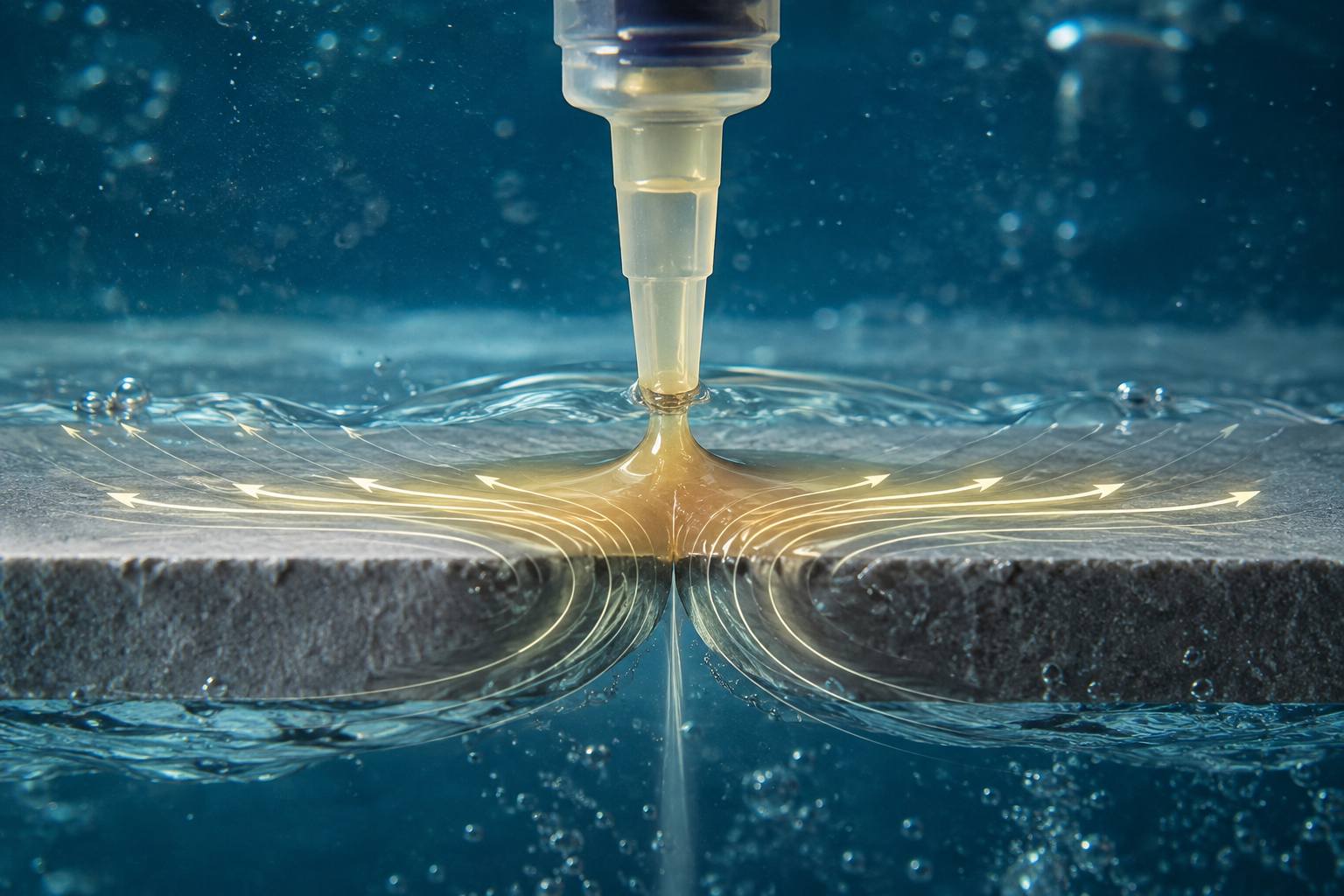
Image credit: AI-generated conceptual image of Marangoni flow created using ChatGPT/OpenAI, Study: Macroscopic assembly of supramolecular coacervates for underwater adhesion.
Achieving strong, rapid underwater adhesion has long been a significant challenge in materials science due to surface hydration layers that prevent most adhesives from bonding effectively. In a recent study published in Nature Communications, researchers developed a novel supramolecular ionic liquid adhesive, BP16TPB, achieving an underwater lap-shear strength of approximately 1.1 MPa within just 10 seconds. This adhesive uses solvent-exchange-driven self-assembly, combined with Marangoni flow, to displace surface water and quickly form a robust, water-resistant network.
Addressing the Challenge of Hydration Layers
Effective underwater adhesives face challenges posed by hydration layers that form on submerged surfaces. Water molecules adsorb onto solid surfaces, forming a liquid film that prevents adhesives from making direct contact with the substrate, resulting in weak bonding. Conventional underwater adhesives often achieve limited strength due to this issue.
Existing adhesive systems have practical limitations: catechol-based adhesives cure slowly through oxidative cross-linking, vinyl-based adhesives require light for polymerization, isocyanate adhesives release carbon dioxide bubbles when reacting with water, and epoxy resins cure slowly due to competing interactions with water. Moreover, some formulations contain per- and polyfluoroalkyl substances (PFAS), raising environmental concerns. These factors highlight the need for fast-curing, recyclable underwater adhesives that overcome some of the limitations of conventional formulations while efficiently displacing water and forming strong, durable bonds.
Structural Composition and Characterization of BP16TPB
Researchers synthesized BP16TPB and three reference compounds to evaluate the individual molecular components. BP16TPB consists of hydrogen-bonded aromatic bis-urea cations, flexible sixteen-carbon alkyl chains, and tetraphenylborate anions. Its properties were characterized using various techniques, including nuclear magnetic resonance (NMR) spectroscopy, Fourier-transform infrared (FT-IR) spectroscopy, X-ray photoelectron spectroscopy (XPS), small-angle X-ray scattering (SAXS), differential scanning calorimetry (DSC), thermogravimetric analysis (TGA), ultraviolet-visible spectroscopy, X-ray diffraction, and rheological measurements.
The adhesive precursor was prepared by dissolving BP16TPB in dimethyl sulfoxide (DMSO) at about 0.2 g/mL, thereby forming pre-assembled supramolecular oligomers via dynamic non-covalent interactions. Molecular assembly was analyzed using two-dimensional (2D) correlation spectroscopy (2DCOS), diffusion-ordered spectroscopy (DOSY), and rotating-frame Overhauser effect spectroscopy (ROESY). Furthermore, during underwater application, in situ attenuated total reflectance infrared (ATR-IR) and Raman spectroscopy monitored solvent exchange and self-assembly in real time.
The study also modeled the adhesive mechanism using computational methods. COMSOL Multiphysics simulations modeled Marangoni-driven wetting and fluid flow during underwater spreading, while the LAMMPS software suite was utilized to conduct molecular dynamics simulations and analyze interfacial adhesion energies and hydrogen-bonding networks.
Mechanisms of Interfacial Dynamics and Performance
The exchange of DMSO with water created a strong surface-tension gradient, generating Marangoni flow. This flow displaced the hydration layer, allowing the adhesive to wet the submerged substrate. DMSO progressively diffused into the surrounding water, with substantial solvent exchange occurring during the first 25 minutes, while BP16TPB underwent liquid-liquid phase separation, transforming from loosely assembled oligomers into dense supramolecular coacervates.
In situ Raman spectroscopy revealed a time-dependent molecular reorganization. Hydrophobic alkyl chains initially concentrated at the water-facing surface, but after about 20 minutes, the imidazolium cations and tetraphenylborate anions became more prominent at the surface as the alkyl chains shifted inward. This molecular reorganization, together with hydrogen bonding, π-π stacking, hydrophobic interactions, and electrostatic interactions, contributed to the formation of a cohesive network. Mechanical testing demonstrated that the adhesive achieved an underwater lap-shear strength of 1.1 MPa on ceramic substrates within 10 seconds, increasing to 1.3 MPa after 5 minutes. Strong adhesion was also observed on copper (1.1 MPa), epoxy resin (0.7 MPa), and polyamide (0.5 MPa), while maintaining performance in acidic, alkaline, and saline environments.
Remarkably, the material retained more than 0.8 MPa of adhesion strength after 250 days of immersion in water and, in a separate static hanging-weight test, supported a 2 kg load underwater for over 3 years without failure. Because the adhesive is held together by reversible non-covalent interactions, it is recyclable and shows no observable loss of adhesion performance across eight tested dissolution and reassembly cycles.
Applications in Marine and Industrial Settings
The rapid underwater solidification, high mechanical strength, and environmental stability of this supramolecular adhesive suggest potential for underwater repair and maintenance. This solution can be applied directly with a syringe to submerged surfaces, including glass, ceramic, copper, polyamide, and epoxy resin. These properties could make it useful for applications such as sealing leaking pipelines and repairing submerged marine structures.
The adhesive performs reliably in acidic, alkaline, and saline environments, suggesting its potential for long-term underwater or marine applications. It could potentially be used to attach environmental monitoring sensors and oceanographic instruments to submerged structures. Additionally, because the material does not rely on PFAS-based adhesive chemistry, it shows promise for applications such as attaching tracking devices or repairing damaged shells of aquatic organisms, although biological safety and biocompatibility were not evaluated in the study.
Conclusion and Future Directions
In summary, this study presents a new strategy for underwater adhesion by combining Marangoni-driven fluid transport with supramolecular self-assembly. The resulting adhesive rapidly removes surface water, forms strong underwater bonds, and provides a recyclable, non-covalent alternative to adhesives that depend on irreversible covalent cross-linking.
Future work should focus on extending this solvent-exchange assembly strategy to new supramolecular and ionic liquid systems for demanding aquatic environments. The underlying design principles could also support the development of other environmentally responsive smart materials and solvent-induced macroscopic supramolecular assemblies.
Disclaimer: The views expressed here are those of the author expressed in their private capacity and do not necessarily represent the views of AZoM.com Limited T/A AZoNetwork the owner and operator of this website. This disclaimer forms part of the Terms and conditions of use of this website.