As China dominates critical mineral processing and global powers scramble to secure supplies, researchers warn that technological uncertainty, environmental costs, and weak governance could determine whether mineral wealth drives sustainable development or deepens conflict and dependency.
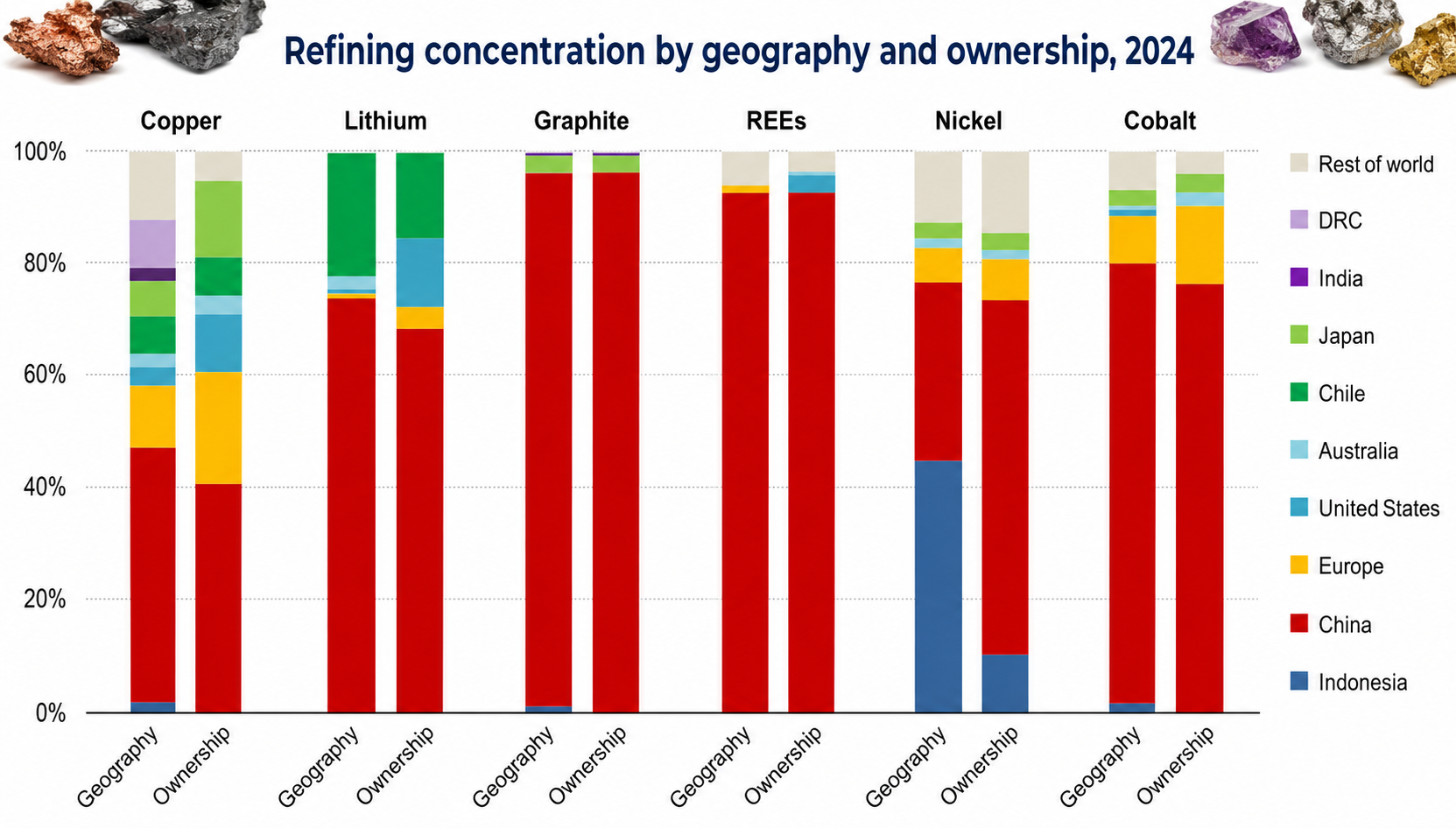
China dominates critical mineral mining by geography and ownership. Source: RystadEnergy. Paper: The scramble for critical minerals
In a recent research article published in the Oxford Review of Economic Policy, authors Christopher Adam, Rabah Arezki, and Frederick van der Ploeg examine and synthesize research on the economic, geopolitical, and environmental implications of the global competition to secure critical minerals essential for the energy transition and digital transformation.
Critical Minerals Landscape
The global economy is experiencing a rapid transition towards cleaner energy, digital technologies, and artificial intelligence (AI), all of which critically depend on specific raw materials known as critical minerals.
These minerals, such as lithium, cobalt, nickel, and rare earth elements, are considered critical because they are essential to modern technologies while also facing supply-chain risks. They are important inputs for batteries, semiconductors, defense technologies, and renewable energy technologies. Unlike traditional fossil fuels, critical minerals underpin low-carbon growth and advanced technology sectors.
This growing reliance has triggered a new resource scramble primarily driven by major economic powers including the United States (US), China, and the European Union (EU). The mining of these minerals occurs predominantly in developing countries, although major producers also include economies such as Australia, while most processing capacity is concentrated in China, creating complex supply-chain vulnerabilities.
Given the rising geopolitical tensions and technological uncertainties surrounding these materials, examining their production, supply chains, and associated economic, social, and environmental consequences is critical for informed policy-making.
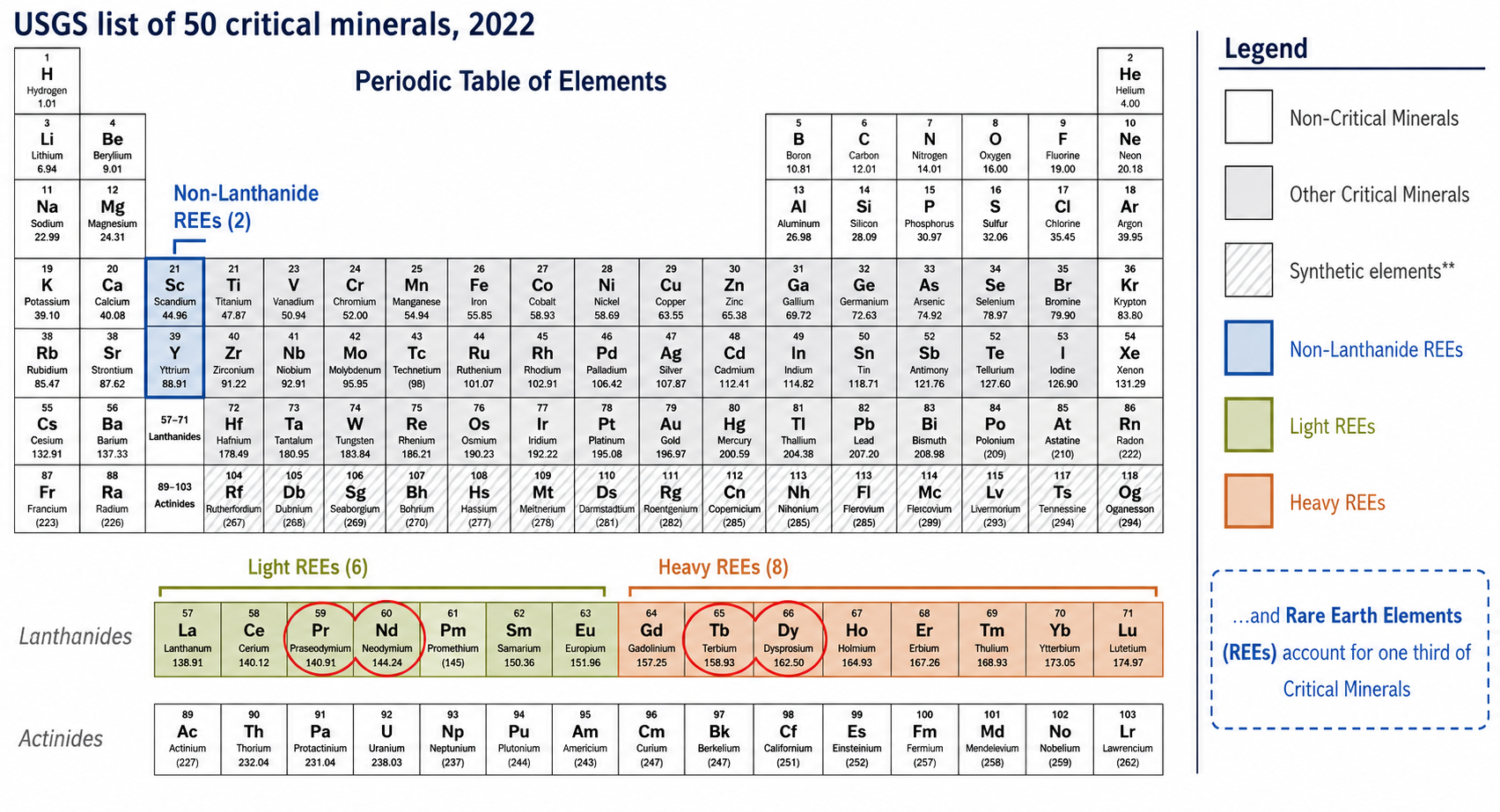
Critical minerals comprise more than half of the 94 naturally occurring elements. Notes: ∗Promethium (PM) is excluded from the critical minerals list due to extreme scarcity ( < 600 grams in Earth’s crust), instability, and minimal industrial applications. ∗∗Synthetic elements do not occur naturally on Earth and must be created in laboratories or nuclear reactors. Sources : RystadEnergy research and analysis; US Geological Survey, April 2025.
Mining and Processing Analysis
The authors synthesize multidisciplinary research from across the special issue, integrating geological, engineering, economic, and geopolitical perspectives to examine the supply and demand dynamics of critical minerals. Among the studies they discuss is research that uses satellite imaging and artificial intelligence to improve the accuracy of mine detection worldwide, revealing that global mining activity may be substantially undercounted.
The research reviewed in the paper contrasts conventional mining methods relying on ore excavation with emerging sources such as saline geofluids, highlighting their differing geographic distributions and implications for supply security.
Economic frameworks typically used to analyze fossil fuel markets are considered alongside engineering approaches including life-cycle assessments and material flow analyses, capturing substitution possibilities and technological evolution.
The paper also examines examples of downstream mineral development in countries such as China, Indonesia, and Botswana, analyzing their industrial policies and regulatory reforms. Additionally, geoeconomic tensions are evaluated by examining the disparities between mining locations in developing countries and processing hubs dominated by China.
Geoeconomics and Socio-environmental Impacts
Critical minerals mining is highly concentrated geographically, with countries like the Democratic Republic of Congo (DRC), Australia, Chile, and Indonesia occupying important positions in the production of particular minerals.
The production of raw minerals is generally located in developing economies, while the downstream refining and processing are largely dominated by China, which accounts for roughly 60–80% of global processed output across key minerals such as copper, lithium, cobalt, nickel, and rare earths.
This spatial imbalance exposes industrialized economies to supply risks and heightens geopolitical competition. Investor and government strategies show growing efforts to diversify supply chains, with the US and EU pursuing partnerships and contracts to secure access to minerals in Africa, Latin America, and Central Asia.
Technological evolution plays a vital role in demand dynamics. For instance, lithium-ion batteries currently dominate electric vehicle markets, but alternative battery chemistries like sodium-based cells are in development, introducing substitution possibilities that complicate long-term demand forecasting. This technological uncertainty, coupled with geopolitical factors, increases the risk of supply chain disruptions, technological obsolescence, investment losses, and price volatility in the critical minerals markets.
The paper highlights how weak governance in resource-rich developing countries can contribute to the persistence of poverty, conflict, and environmental degradation, despite abundant mineral wealth. The DRC exemplifies this “resource curse,” where mineral revenue has yet to translate into broad economic gains due to corruption, rebel conflicts, and inadequate institutions.
Environmental impacts from mining, such as deforestation, biodiversity loss, water pollution, greenhouse gas emissions, persistent mineral contamination, and labor abuses including child labor, are substantial and often exacerbated by limited enforcement of social and environmental regulations.
Successful downstream mineral processing is limited but instructive. China’s state-directed industrial policies, combined with tax reforms and investments in technology, have positioned it as the global leader in processing capacity.
Indonesia effectively banned raw nickel ore exports in 2020 to promote domestic processing, supported by Chinese investment in integrated industrial parks. Botswana’s experience with diamond cutting and polishing, although more modest, highlights challenges such as cost disadvantages and limited scale economies that resource-rich developing economies face in value addition. However, the authors caution that protectionism and directed industrial policies can also provoke trade retaliation and reduce global economic welfare.
Policy Challenges and Prospects
Critical minerals are vital to the future of the green energy and digital transitions, but their supply chains are marked by geographic concentration, geopolitical tensions, and technological uncertainties. The dominance of China in mineral processing contrasts with developing countries’ roles as primary producers, intensifying risks to supply security and economic development.
While demand is set to rise significantly, rapid technological shifts and substitution possibilities complicate long-term forecasts. The authors emphasize that these uncertainties extend beyond quantifiable market risks to fundamental uncertainty over future technologies, geopolitics, regulation, and the pace of the energy transition. Sustainable benefits for mineral-producing economies hinge on strengthening governance, promoting local value addition, and designing effective contracts to share risks fairly.
Addressing environmental and social challenges linked to mining is also critical. Navigating this complex landscape requires coordinated policies that balance economic security, technological innovation, and equitable development to ensure critical minerals become a driver of sustainable progress rather than conflict and degradation. The authors also highlight long-term and contingent contracts as potential ways to improve risk-sharing between governments and mining companies, while warning that poorly designed arrangements could encourage accelerated extraction, price volatility, and environmental damage.