PicoQuant, a world leading company in photoluminescence instrumentation, announces the launch of Solira, a new microscope for time-resolved photoluminescence (TRPL) measurements and advanced materials characterization. Combining methods such as TRPL, TRPL imaging, carrier diffusion mapping, and correlation measurements within one configurable system, Solira enables the investigation of semiconductors, perovskites, nanomaterials, LEDs, quantum emitters, and other advanced material systems. Solira will be presented to the public for the first time at the E-MRS Spring Meeting 2026 in Strasbourg, France, from May 25-29, 2026, at booths 67/68.
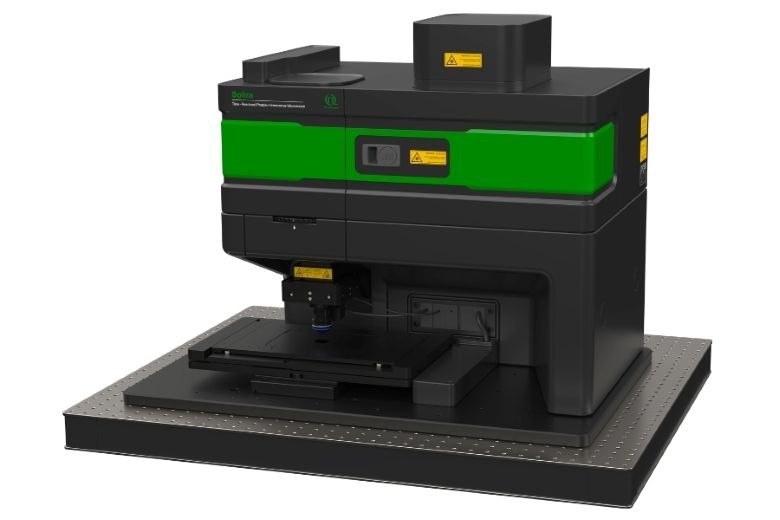 Solira is PicoQuant's new modular upright microscope for time-resolved photoluminescence measurements across semiconductors, nanomaterials, optoelectronic devices, and other advanced material systems. Image Credit: PicoQuant
Modern materials research increasingly requires the combination of spatial, temporal, and spectral information across different sample types and experimental conditions. Solira addresses these challenges through flexible excitation and detection configurations combined with high sensitivity for weak emission signals and fast photophysical processes. Configurations with up to 8 laser channels covering excitation wavelengths from 355 nm to 1064 nm support measurements across diverse material systems, while flexible detector configurations with spectral sensitivity from 400 nm to 1550 nm enable reliable characterization of demanding samples. PicoQuant's proven time tagging and TCSPC electronics provide picosecond timing precision for studying charge carrier dynamics, recombination pathways, excited-state behavior, and single-emitter properties.
By combining flexibility across methods and materials with highly sensitive detection and precise timing, Solira expands PicoQuant's portfolio of advanced instrumentation for time-resolved spectroscopy and microscopy. From semiconductor characterization and perovskite research to nanomaterials and quantum photonics, Solira supports researchers investigating complex photophysical processes across modern material systems.