Platinum is often used as a catalyst to speed up industrial electrochemical reactions, such as those involved in wastewater treatment and in fuel cells for power generation. Typically, platinum nanoparticles are electrically deposited onto ultra-thin carbon materials to drive these reactions.
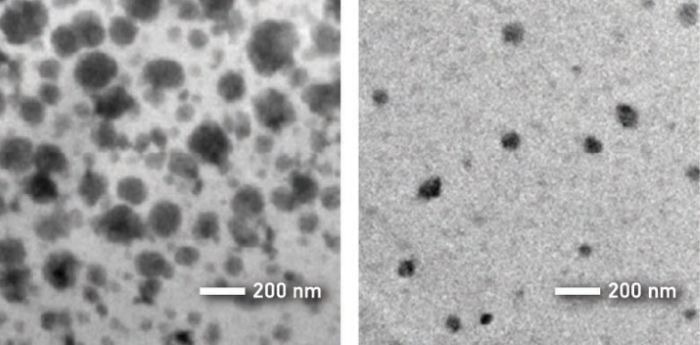 Copper nanoparticles were more evenly distributed when electrically deposited on ultra-thin graphene carbon sheets (left). But when the graphene sheets had nitrogen atoms embedded, the copper particles deposited in specific spots around those atoms. Image Credit: ACS Nano 2024, 18, 29, 19220–19231
Platinum, however, is an expensive precious metal. Copper is a promising alternative, but the processes involved in how it is deposited are not well understood.
Now, Nanyang Technological University, Singapore (NTU Singapore) scientists – led by Dr Tan Shu Fen from the University’s Maritime Energy and Sustainable Development Centre of Excellence and Prof Lam Yeng Ming from the School of Materials Science and Engineering – have uncovered fresh insights into these processes, which could lead to the development of cheaper copper substitutes.
The researchers used various techniques to study copper deposition, including transmission electron microscopy, X-ray photoelectron spectroscopy and modelling. They found that the speed at which a voltage is applied, known as the “scan rate”, affects how copper particles are deposited.
The faster the scan rate, the more uneven and larger the copper clumps deposited. A slower scan rate means a more even distribution of the copper particles in smaller clumps, which increases the available surface area for copper to catalyse more reactions.
When nitrogen atoms are added to the carbon materials, copper gets deposited around these atoms, which could be helpful when chemical reactions are needed in specific spots. However, nitrogen doping could lower the setup’s electrical conductivity, reducing its ability to drive certain reactions, such as breaking down nitrate pollutants in wastewater treatment.