This week, at the 2026 IEEE / JSAP symposium on VLSI Technology & Circuits, imec, a world-leading research and innovation hub in advanced semiconductor technologies, presents two advances in ferroelectric memory research, targeting both ferroelectric capacitors and ferroelectric field-effect transistors as emerging candidates to enable low-voltage operation and high-density integration.
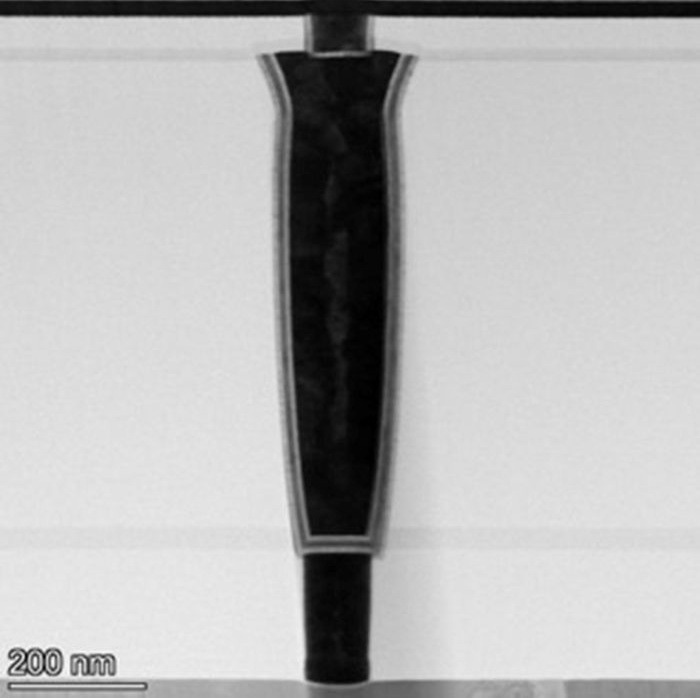 Image Credit: imec
Ferroelectric memory is drawing increasing attention as AI workloads place unprecedented pressure on memory systems to deliver more capacity, higher bandwidth, and better energy efficiency at sustainable cost. As conventional memory technologies such as DRAM and SRAM become harder to scale, ferroelectric approaches are emerging as promising candidates because they can combine low-voltage operation with pathways to denser 3D integration. Against that backdrop, imec is presenting two complementary advances: low-voltage ferroelectric capacitors that could support future DRAM-like memory, and vertically stacked FeFETs that point toward compact, high-density memory architectures for next-generation AI systems.
Ferroelectric capacitors are shown to enable low-voltage (∼1.3 V) operation through ferroelectric layer scaling while maintaining high remnant polarization (> 40 μC/cm2) and endurance (≥ 1013 cycles), key requirements for DRAM-like memory applications. In a separate demonstration, imec takes a step toward high-density 3D ferroelectric memory with vertically stacked IGZO-based ferroelectric field-effect transistors (FeFETs). The work presents the first functional demonstration of a five-word-line vertical stack of FeFET memory cells, increasing storage density by stacking devices on top of each other. By introducing a dual-gate configuration with a back-gate, imec improves erase efficiency, a key challenge for FeFET technology. This innovation in architecture highlights the potential of oxide semiconductor-based FeFETs for future high-density memory applications.
It is imec’s multidisciplinary approach that brings the presented device concepts together through shared materials, integration strategies, and a common vision of enabling scalable 3D ferroelectric memory. Both approaches rely on similar ferroelectric material stacks, where insights gained from interfacial engineering and scaling in capacitors directly apply to the optimization of FeFET devices. At the same time, the advanced 3D integration techniques demonstrated for FeFET stacking provide pathways for implementing high-density 3D ferroelectric capacitor arrays. Both memory building blocks, ferroelectric capacitors and FeFETs, offer distinct advantages, with insights from each guiding further optimization of the other.
These advances come at a critical moment for the semiconductor industry. As memory technologies such as DRAM and SRAM approach their scaling limits, and AI-driven workloads require exponentially larger memory capacity, the need for new memory concepts becomes increasingly necessary. The demonstrated low-voltage operation of ferroelectric capacitors supports energy-efficient memory concepts, while vertically stacked FeFETs open the door to compact, high-density storage suitable for embedded and next-generation computing architectures. Collectively, these innovations offer complementary pathways to address performance and cost challenges in future data-centric systems.
“This work shows how imec’s multidisciplinary expertise, from materials science to advanced 3D integration, enables us to tackle some of the most pressing challenges in memory technology,” said Attilio Belmonte, program director at imec. Maarten Rosmeulen, program director at imec, continues, “We are exploring multiple paths toward the memory solutions that will be required to sustain the rapid growth of AI and data-intensive applications.”
Looking ahead, imec will continue to refine both device concepts while addressing remaining challenges such as endurance and erase performance in FeFETs and further voltage scaling and reliability optimization in ferroelectric capacitors. Future work will focus on system-level evaluation of these technologies, the development of fully integrated 3D memory architectures, and improving key performance metrics to bring these concepts closer to practical implementation. While still at the research stage, these results mark important steps toward next-generation memory technologies that could redefine how data is stored and accessed in the AI era.