Microgravity as a Research Environment
How is Microgravity Being Used in Materials Research?
Commercial Developments
Future Possibilities with Microgravity
Reference and Further Readings
Orbital platforms and space-based research missions are enabling new insights into materials science by removing the effects of gravity.
 Image Credit: Artsiom P/Shutterstock.com
Earth's gravitational field affects everything in materials science research. It drives convection currents in solutions, causes denser particles to sediment out of suspensions, forces immiscible phases to separate by density, and deforms soft or liquid samples before measurement can take place.
These pervasive effects interfere with the fundamental thermophysical behaviors of materials, making it difficult to isolate and study their intrinsic properties.
Using microgravity in space could transform materials science.
Saving this article for later? Download a PDF here.
Microgravity as a Research Environment
Microgravity, the state of near-weightlessness where objects appear to be in continuous free fall, removes the effects of gravity.
This environment suppresses buoyancy-driven convection and prevents sedimentation. In doing so, it allows particles, solutes, and molecules to move primarily through diffusion.
When in this environment, materials can form more uniform, defect-free structures, and phase transitions can be observed under near-ideal conditions, revealing intrinsic behaviors that are otherwise masked by gravity.
The International Space Station (ISS), among others, can provide research projects with sustained access to microgravity, enabling experiments over hours to days that are impossible on Earth.
This allows researchers to study material behaviors under near-ideal conditions, providing insights that could advance the development of advanced materials and manufacturing processes.1
How is Microgravity Being Used in Materials Research?
Pharmaceuticals and Protein Crystallography
Protein crystallization is a key aspect of structure-based drug development, as high-resolution crystal structures determine the accuracy of molecular geometry data used in drug design.
On Earth, convective currents in crystallization solutions unevenly transport protein molecules, deposit impurities at crystal surfaces, and produce small, disordered crystals with limited diffraction quality.
In microgravity, diffusion-dominated transport allows proteins to assemble slowly and orderly into well-formed crystal lattices, yielding larger, more uniform crystals with substantially higher X-ray diffraction resolution.
Merck demonstrated this advantage by growing highly uniform crystalline suspensions of the monoclonal antibody Keytruda® aboard the ISS, identifying a path to reformulate from intravenous infusion to subcutaneous injection. This could reduce drug and storage costs by approximately 90 % while increasing patient accessibility.2
Molecular-Level Materials Research
Another useful impact of microgravity research is the ability to study materials at the atomic and molecular levels without interference from gravity-driven transport phenomena.
An investigation by the European Space Agency into colloidal suspensions found that particle behavior in microgravity differed markedly from that on Earth, revealing previously unobserved aggregation patterns, diffusion-driven rearrangements, and structural ordering.
These results provided insights into glass transitions, nucleation, and gelation, supporting the design of advanced nanomaterials, soft matter systems, and complex fluids where particle-level dynamics are critical for optimizing material properties.
Advance Materials Development
Microgravity and space environments have also advanced the discovery and development of novel materials. In space, materials are exposed to extreme temperatures, radiation, and other factors absent on Earth, enabling the formation of structures with unique properties.
For example, researchers at NASA’s Glenn Research Center developed “superblack” by growing carbon nanotubes in microgravity, producing a surface that absorbs 99 % of incident light. This material is now used in high-sensitivity imaging systems, including space telescopes, where maximal light absorption is critical.
Separately, a carbon nanotube-epoxy composite developed and tested at Glenn Research Center achieved a specific strength 10x that of steel at a fraction of its mass. By enabling structural materials with exceptional strength-to-weight ratios, microgravity processing and testing may find uses well beyond space, including in engineering on Earth.3,4
Controlled Nanoparticle Assembly
Nanomaterial assembly in microgravity provides a precise environment to study the transport and interfacial mechanisms that govern nanoparticle organization.
Experiments aboard the ISS have demonstrated that, without buoyancy-driven or thermal convection, nanoparticles manipulated by optical forces migrate toward surfaces, nucleate bubbles, and are transported to the three-phase contact line by Marangoni flows.
The absence of gravitational detachment allows bubbles to grow larger, increasing nanoparticle collection and producing denser, more ordered deposits.
Similarly, a JAXA-ANSTO study on oppositely charged colloidal clusters showed that eliminating sedimentation and convection enables diffusion-driven aggregation, yielding undisturbed, highly ordered nanostructures.
These findings provide fundamental insights into nanoscale assembly and guide the development of nanomaterials for photonics, optical communications, sensing, and precision-engineered functional materials.5,6
Semiconductors Solidification
Under terrestrial conditions, semiconductor solidification is limited by convection, container stresses, and interfacial instabilities, which degrade crystal quality. In microgravity, diffusion-dominated transport improves dopant uniformity, enables detached solidification, and reduces dislocations and grain boundaries.
Skylab experiments demonstrated detached solidification, in which crystals separated from the ampoule walls via a moving meniscus, eliminating mechanical contact, minimizing thermal stresses, and nearly eradicating defects, resulting in high-quality semiconductor crystals.
Subsequent ISS studies have shown that microgravity also produces more uniform thin films with fewer interfacial defects, directly benefiting the fabrication of advanced microprocessors and optoelectronic devices.6
Commercial Developments
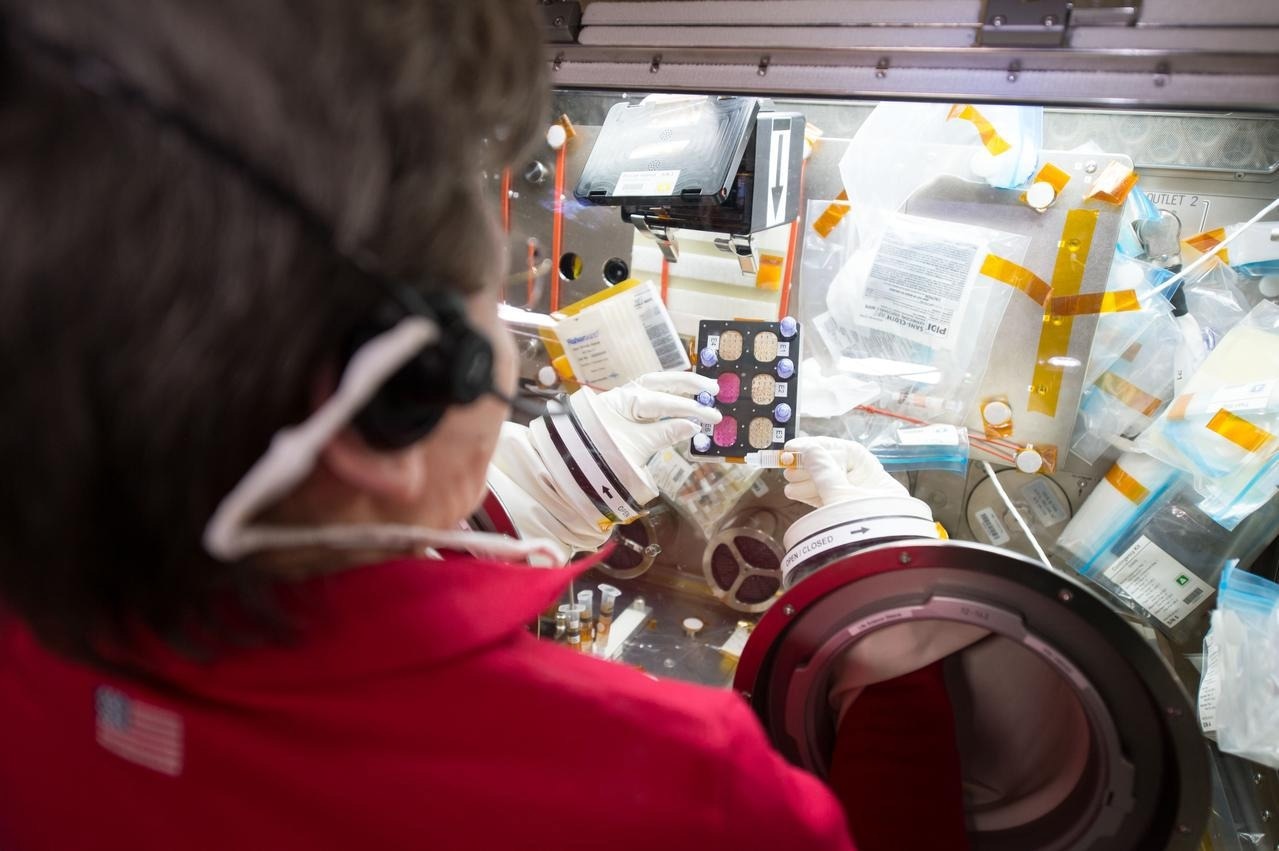 Image Credit: Jack Fischer /NASA Media Library
Redwire: Space Materials Research Instruments
Redwire is an aerospace manufacturer and space infrastructure technology company focused on enabling microgravity research. In collaboration with the European Space Agency, it has developed advanced instruments to study materials science and fluid behavior in microgravity.
Its Non-Equilibrium Fluctuations during Diffusion in Complex Liquids (Neuf-Dix) instrument helps investigate diffusion and mixing in multi-component liquids, where gravity-driven separation is replaced by diffusion-controlled behavior, with applications in drug transport and industrial mixing.
Complementing this, the Transparent Alloys (TAC) facility enables visualization of solidification in model systems that mimic metallic alloys, supporting detailed analysis of eutectic growth, metastable phases, and microstructural transitions.
These capabilities provide high-fidelity insights into fundamental transport and solidification processes, supporting the optimization of materials design and manufacturing on Earth.7
Space Forge: Orbital Semiconductor Manufacturing
Space Forge has established the National Microgravity Research Center (NMRC) as part of a £13 million program supported by the UK Space Agency, creating a key facility for advancing microgravity-enabled semiconductor manufacturing.
NMRC provides access to advanced semiconductor processing and characterization tools, as well as collaborative research networks, serving as the ground-based component of Space Forge’s hybrid manufacturing model, in which materials grown in microgravity are returned for scaling and integration.
This development builds on the successful launch of ForgeStar-1 in June 2025, which demonstrated plasma generation in orbit for gas-phase crystal growth. It also supports ongoing work on radiation-hard, wide bandgap materials such as silicon carbide, gallium nitride, and gallium oxide.
The facility represents a significant step toward integrating space-based manufacturing with terrestrial semiconductor production, enabling scalable development of advanced electronic materials for future high-performance applications.8
BioOrbit: Space Pharmaceutical Manufacturing
BioOrbit is developing hardware for large-scale crystallization of monoclonal antibody therapeutics in space to reformulate intravenous cancer drugs into subcutaneous injections suitable for self-administration.
Traditional intravenous delivery requires extended infusions, increasing costs and patient inconvenience, while small volumes and high viscosity limit subcutaneous administration.
Protein crystallization addresses these issues by producing crystalline suspensions with lower viscosity, but achieving consistent crystal size, uniformity, and purity on Earth is difficult due to environmental disturbances.
BioOrbit seeks to exploit microgravity to produce large, highly uniform protein crystals, taking advantage of the stable space environment to enable high-concentration, injectable formulations.
This strategy is projected to reduce drug delivery and storage costs by approximately 90 %, decrease pharmaceutical waste by 62 %, and increase patient throughput by 75 % by replacing four- to six-hour hospital infusions with home-administered injections.9
Read the latest space news here!
Future Possibilities with Microgravity
Microgravity research and orbital manufacturing provide unprecedented opportunities to advance materials science. However, access to the space stations remains costly and competitive, with limited experiment volumes and delays in sample return that can risk post-flight degradation.
Continued expansion of orbital infrastructure, declining launch costs, and standardized experimental platforms are expected to enhance access and throughput, bridging the gap between research and commercial production.
These advances promise not only to improve terrestrial manufacturing processes but also to support the direct production of high-value materials in space, creating new opportunities for technological innovation and industrial applications across multiple sectors.
Reference and Further Readings
- Yu, J., Zhang, W., Yang, S., Zhang, Y., Hui, X., Zhong, H., Yan, M., & Yu, Y. (2025). Recent advances and future prospects of Space Materials Science. Review of Materials Research, 1(2), 100065. DOI:10.1016/j.revmat.2025.100065, https://doi.org/10.1016/j.revmat.2025.100065
- McPherson, A., & DeLucas, L. J. (2015). Microgravity protein crystallization. Npj Microgravity, 1(1). DOI:10.1038/npjmgrav.2015.10, https://www.nature.com/articles/npjmicrograv201510
- RobAdlard. (2023). Materials science in microgravity: Unlocking new frontiers in innovation. https://www.innovationnewsnetwork.com/materials-science-microgravity-unlocking-new-frontiers-innovation/31491/
- NASA. (2026). Nanostructured Super-Black Optical Materials. https://techport.nasa.gov/projects/16148
- ANSTO Staff. (2025). Advanced materials research in microgravity earns NASA recognition. Australian Nuclear Science and Technology Organisation. https://www.ansto.gov.au/news/advanced-materials-research-microgravity-earns-nasa-recognition
- NASA. (2025). A Researcher’s Guide to: Microgravity Materials Research. https://www.nasa.gov/science-research/for-researchers/a-researchers-guide-to-microgravity-materials-research/
- Redwire. (2024). Redwire Developing Microgravity Research Instruments to Study Materials Science and Fluid Behavior for Earth-Based Applications. https://rdw.com/newsroom/redwire-developing-microgravity-research-instruments-to-advance-materials-science-and-fluid-behavior-for-earth-based-applications/
- UK Space Agency. (2026). National Microgravity Research Centre opens in Swansea. GOV.UK. https://www.gov.uk/government/news/national-microgravity-research-centre-opens-in-swansea
- BioOrbit. (2026). BioOrbit: The Hospital to home via space. https://www.bioorbit.space/
Disclaimer: The views expressed here are those of the author expressed in their private capacity and do not necessarily represent the views of AZoM.com Limited T/A AZoNetwork the owner and operator of this website. This disclaimer forms part of the Terms and conditions of use of this website.