A sulfur-rich coating and spinel-like surface layer worked together to limit oxygen-driven degradation and improve lithium transport in long-cycling solid-state cells.
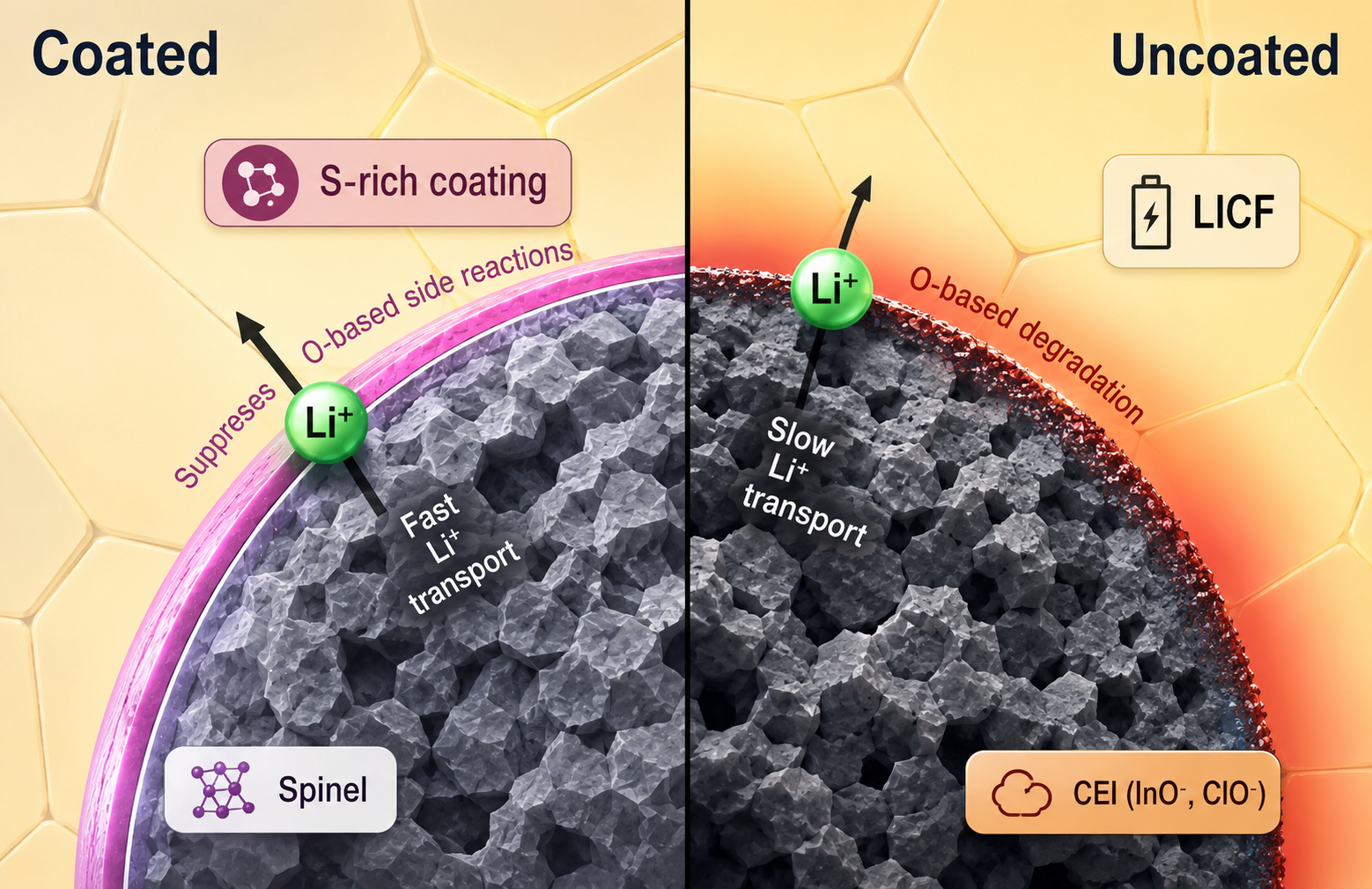
Schematic illustration of the thiourea-derived coating strategy. The thiourea-derived coating suppresses oxygen-related interfacial degradation and facilitates Li+ transport through the surface spinel layer, resulting in improved cycling stability and rate capability of the LRMO positive electrode. Image adapted from fig 5. Jin, F., Zhao, W., et al. (2026). Thiourea-derived coating enabled a lithium-rich manganese oxide positive electrode in solid-state batteries. Nature Communications. DOI: 10.1038/s41467-026-75215-1 using ChatGPT/OpenAI
A recent study published in the journal Nature Communications demonstrates how thiourea-derived surface engineering can improve the performance of lithium-rich manganese oxide cathodes in laboratory-scale solid-state half-cells. The researchers developed an ultrathin sulfur-rich surface coating together with a spinel-like surface layer and investigated their effects using advanced electrochemical measurements, multiscale characterization techniques, and computational modeling. The findings show that the engineered surface suppresses interfacial degradation, enhances lithium-ion transport, and markedly improves cycling stability in LRMO-based solid-state cells.
Overcoming Stability Challenges in Lithium-Rich Cathodes
Lithium-rich manganese oxide (LRMO) cathodes are promising materials for next-generation solid-state batteries because their combined transition-metal and oxygen redox chemistry can deliver specific capacities above 250 mAh g−1. Their high capacity stems from the combined participation of transition-metal ions and lattice oxygen in charge compensation. This additional oxygen redox reaction enables higher specific capacities and the potential for increased energy density compared with conventional cathode materials. As a result, LRMO has emerged as a strong candidate for high-energy solid-state batteries.
Despite these advantages, LRMO still faces several challenges that limit its practical use. Charging to high voltages activates oxygen redox but also generates highly reactive oxygen species. The resulting degradation lowers the initial Coulombic efficiency, slows lithium-ion transport, and gradually reduces both voltage and capacity during repeated cycling. The relatively low electronic conductivity of the Li2MnO3 component further limits electrochemical performance.
Researchers have explored several surface modification strategies to improve LRMO stability, including lithium phosphate, lithium tungstate, and sulfite-based coatings. These approaches improved selected aspects of oxygen-redox reversibility, interfacial stability, or cycling performance, but persistent limitations remained. A surface treatment that could combine interfacial protection, structural stabilization, and rapid lithium-ion transport was therefore still needed.
Researchers developed a thiourea-based surface-engineering strategy for LRMO particles. The treatment forms an ultrathin sulfur-rich coating together with a spinel-like surface layer beneath it. The study demonstrates how carefully designed surface chemistry can simultaneously improve structural stability and electrochemical performance.
Engineering a Thiourea-Derived Surface Modification
The researchers modified commercially available LRMO particles by dispersing them in a thiourea solution, then drying and annealing them under controlled conditions. The authors proposed that thiourea-derived sulfur species reacted with the particle surface during heat treatment, forming sulfur-containing compounds while reconstructing the outermost crystal structure. The treatment modified only the near-surface region, leaving the bulk crystal structure largely unchanged.
The team then characterized the modified material using a range of advanced techniques. Synchrotron X-ray diffraction examined changes in crystal structure, while scanning electron microscopy and high-angle annular dark-field scanning transmission electron microscopy revealed the morphology of the surface layers. Electron energy-loss spectroscopy mapped an approximately 0.7 nm sulfur-rich coating and an underlying manganese-rich region. The spinel assignment was supported collectively by synchrotron X-ray diffraction, Raman spectroscopy, TEM lattice analysis, and elemental mapping. XPS further identified sulfate and sulfite species formed during the surface treatment.
The researchers assembled laboratory-scale Li-In solid-state half-cells using an LPSCl separator and an LICF halide catholyte to evaluate electrochemical performance. They measured charge-discharge behavior, rate capability, cycling stability, cyclic voltammetry, lithium-ion diffusion, and interfacial resistance. Together, these techniques linked battery performance directly to changes in surface chemistry, crystal structure, and interfacial reactions during cycling.
Surface Engineering Improves Cathode Stability and Performance
The surface treatment markedly improved battery performance. At 0.1 C between 2.5 and 4.6 V at 25 ± 2 °C, the modified cathode delivered an initial discharge capacity of 220.2 mAh g−1, compared with 138 mAh g−1 for the untreated material. Initial Coulombic efficiency increased from 75.46% to 84.83%, indicating fewer irreversible reactions during the first cycle. The modified cathode also showed better rate capability and retained about 97% of its initial capacity after 600 cycles at 1 C, showing strong long-term capacity retention. However, its midpoint potential retained 86.8% of its initial value after 500 cycles, showing that voltage fade was reduced rather than eliminated.
Microscopy revealed two distinct surface regions, while electrochemical and computational analyses indicated that they perform complementary functions. The outer sulfur-rich layer protected the cathode from oxygen-driven side reactions at the electrode-electrolyte interface. Beneath it, the manganese-rich spinel layer provided three-dimensional lithium-ion diffusion pathways that can bypass the restricted two-dimensional pathways in the layered bulk structure. Together, these layers improved both interfacial stability and ion transport.
Impedance analysis showed that the modified cathodes developed much lower interfacial resistance during charging, particularly at high states of charge, where interfacial degradation usually accelerates. Galvanostatic intermittent titration measurements also revealed higher lithium-ion diffusion coefficients, especially at high states of charge near the oxygen-redox region. These improvements enabled faster lithium transport while reducing energy losses during cycling.
XPS and ToF-SIMS analyses further showed that the sulfur-rich coating suppressed oxidation of the LICF halide catholyte after 200 cycles and reduced the formation of interfacial decomposition products. Density functional theory calculations supported these observations by showing that peroxide formation was less favorable in spinel LiMn2O4, with its most stable configuration 2.59 eV higher in energy than in LRMO. This result supported the proposed energetic barrier to oxygen migration and loss. Together, these results support the proposed explanation for how the surface treatment improves both structural stability and long-term battery performance.
Advancing High-Energy Solid-State Battery Materials
This study demonstrates, at the laboratory scale, how surface engineering can mitigate several long-standing challenges in lithium-rich cathodes. The researchers designed a multifunctional surface that combines chemical protection with faster lithium-ion transport. The sulfur-rich coating suppresses oxygen-driven degradation, while the spinel-like surface layer stabilizes the crystal structure and promotes rapid ion diffusion. Together, these modifications improve capacity, cycling stability, and electrochemical efficiency.
The findings also support a potentially scalable design strategy for next-generation cathode materials. Advanced characterization and computational modeling revealed how surface chemistry influences structural evolution and interfacial reactions during battery operation. These insights provide a clearer framework for designing stable, high-energy cathodes.
Although the coating strategy performed well in laboratory tests, further validation under practical operating conditions will be important. The researchers already evaluated a high areal loading of 15.28 mg cm−2; these cells delivered about 174 mAh g−1 at 0.1 C, below standard-loading performance, although they remained stable during extended cycling.
All electrochemical tests, including the high-loading evaluation, used small Li-In half-cells operated under 150 MPa pressure, and the authors identified evaluation in a practical pouch-cell architecture as future work. Further studies should assess full cells, lower-pressure operation, manufacturing reproducibility, and compatibility with different solid electrolytes.
Overall, this work provides laboratory-scale evidence that this strategy can improve lithium-rich cathodes, but it does not yet establish performance in commercial electric-vehicle or grid-storage batteries.
Disclaimer: The views expressed here are those of the author expressed in their private capacity and do not necessarily represent the views of AZoM.com Limited T/A AZoNetwork the owner and operator of this website. This disclaimer forms part of the Terms and conditions of use of this website.