Atomic-scale imaging reveals how subtle changes in crystal alignment reshape the pathways halide ions take across perovskite interfaces.
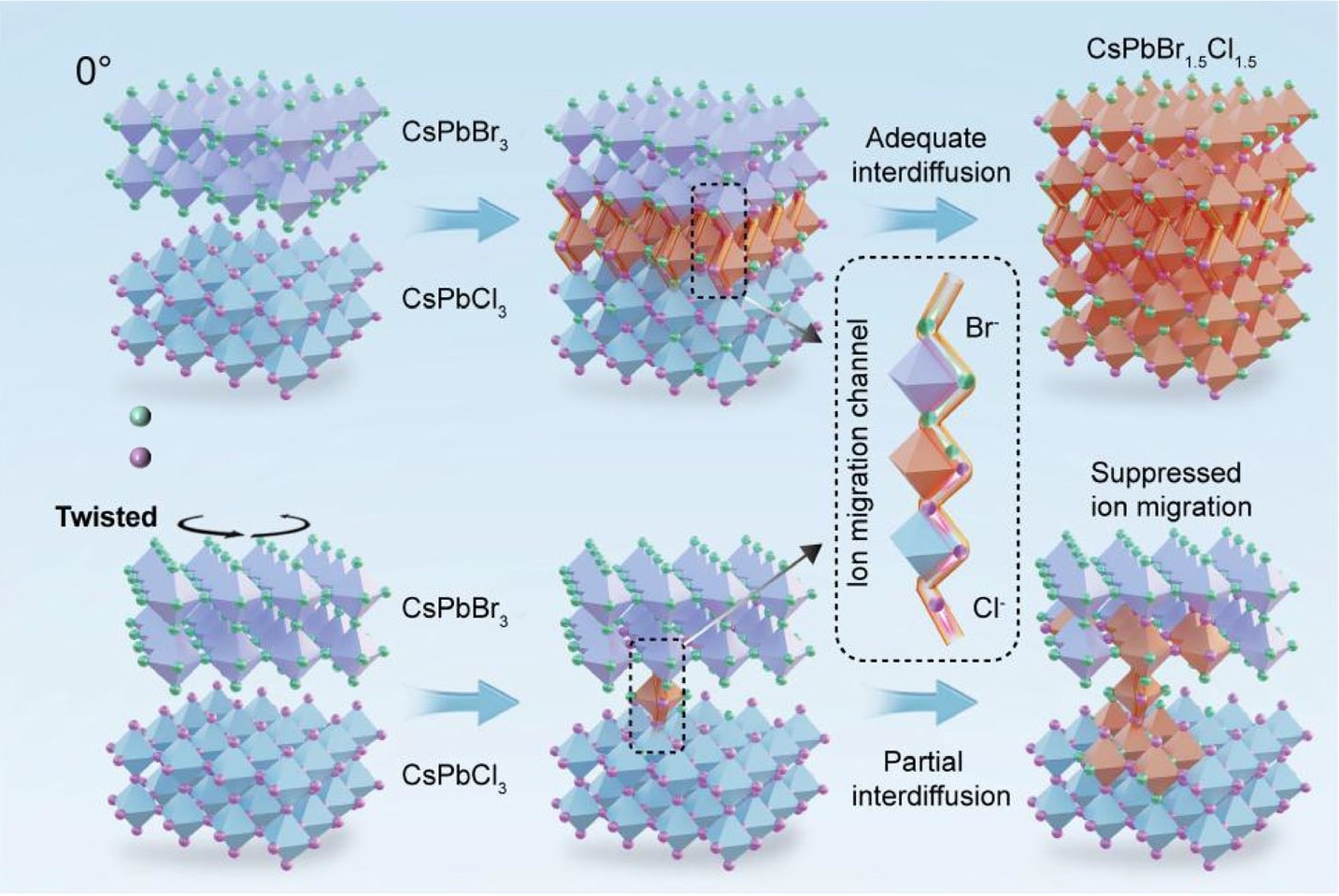
Twistionics to modulate ion migration in halide perovskites. a, b Schematic illustrations of ion migration dynamics in CsPbBr3-CsPbCl3 heterostructure with 0° and 28° twist angles. The enlarged section shows a schematic of the ion migration channel. The purple octahedra represent CsPbBr3, the light-blue octahedra represent CsPbCl3, and the orange octahedra represent the mixed-halide CsPbBr1.5Cl1.5 transition phase formed during interdiffusion. The green and purple atomic spheres represent Br and Cl atoms, respectively.
A recent study in the journal Nature Communications introduces a twist-angle engineering strategy for controlling ion migration in halide perovskite heterostructures. The researchers used CsPbBr3–CsPbCl3 heterostructures to directly observe halide-ion diffusion at the atomic scale. Researchers found that lattice alignment facilitates the formation of nanoscale diffusion channels, whereas introducing a twist angle limits channel formation; calculations indicated that twisting also weakens interfacial van der Waals interactions.
Using Interface Geometry to Control Perovskite Instability
Halide perovskites show strong potential for photovoltaic cells, light-emitting diodes, and photodetectors. Halide-ion migration changes local composition, triggers phase transitions, and degrades device performance. In mixed-halide perovskites, it can also cause phase segregation and alter the bandgap.
Researchers have studied ion migration using electrical measurements, photoluminescence, spectroscopy, microscopy, and computational modeling. These approaches have provided valuable information about diffusion rates and migration mechanisms. However, they generally cannot capture the dynamic formation of ionic pathways at the atomic scale. The formation and growth of interfacial diffusion channels therefore remained poorly understood.
The researchers addressed this gap by studying CsPbBr3–CsPbCl3 heterostructures with different twist angles. The study shows that crystallographic alignment can promote ion migration, while twisting the interface can disrupt the pathways required for cross-interface diffusion.
Building and Examining Twisted Perovskite Heterostructures
The researchers prepared single-crystalline CsPbBr3 and CsPbCl3 films using vapor-phase epitaxial growth. They transferred and stacked the films to form heterostructures with controlled twist angles of 0°, 15°, and 28°. This design allowed the team to compare ion-migration behavior at aligned and differently twisted interfaces.
They then used aberration-corrected scanning transmission electron microscopy (STEM) to examine the interface at high spatial resolution. Energy-dispersive X-ray spectroscopy (EDS) mapping tracked the redistribution of bromide (Br) and chloride (Cl) ions over time. The team also used in situ electron-beam irradiation to directly observe the formation and growth of diffusion channels. Thermal treatment at 150 °C accelerated interdiffusion, allowing the researchers to monitor the process over experimentally accessible timescales.
First-principles calculations examined the energy barriers associated with halide movement between the bulk material and the interfacial region. Molecular dynamics (MD) simulations compared ion diffusion in aligned and twisted heterostructures. The team also calculated van der Waals (vdW) interactions as a function of interfacial distance and twist angle.
Finally, the team fabricated CsPbBr3–CsPbCl3 photodetectors with twist angles of 0 ° and 28 °. Current–voltage measurements and photoluminescence spectroscopy allowed them to determine whether the reduced ion migration translated into improved device stability under accelerated thermal testing.
Twisting the Interface Suppresses Diffusion Channels
The experiments showed that halide ions do not migrate uniformly across the heterointerface. In the 0° structure, Br and Cl initially remained on their respective sides. After one hour, weak interdiffusion appeared in localized nanoscale channels. These channels expanded laterally as heating continued. After 24 hours, Br and Cl had become substantially mixed around the channels.
Channel formation was linked to the initial interfacial structure. The two perovskite crystals contained a narrow halide-rich gap where additional halide ions accumulated. First-principles calculations showed that halide migration from the bulk into this gap required less energy than migration across the gap or movement back into the bulk. As halides accumulated, perovskite nanobridges developed between the crystals. Cation migration helped compensate for local depletion of Cs and Pb, allowing the interface to fuse progressively.
Introducing twist angles of 15° and 28° suppressed the formation of diffusion channels and slowed halide-ion interdiffusion compared with the aligned 0° structure. The 0° heterostructure reached full compositional conversion in about 72 hours. The 28° structure required as long as 96 hours. The team estimated that the 28° twist reduced halide diffusion by approximately 25% and reduced the diffusion-channel ratio by more than 60% compared with the 0° structure.
Atomic-resolution STEM provided direct evidence for the mechanism. At 0°, diffusion channels formed preferentially where the CsPbBr3 and CsPbCl3 lattices aligned well. At 15°, channel formation occurred later. At 28°, the interface showed only limited atomic-layer growth even after 100 minutes of electron-beam irradiation, with no clear diffusion channels. Control experiments further indicated that lattice matching alone was insufficient and that chemical compatibility between adjoining materials was also required for mutual halide interdiffusion.
MD simulations supported these findings, showing rapid interdiffusion in the aligned structure but only limited ion movement at 28°. The calculations showed that van der Waals (vdW) interactions contribute to nanobridge formation when the interfacial gap becomes sufficiently narrow. Twisting disrupts atomic registry and is calculated to weaken the interfacial vdW coupling. These results demonstrate that twist engineering can translate atomic-scale interface control into improved device stability.
Towards Geometric Control of Ionic Transport
The study establishes twist angle as a new design parameter for controlling ionic transport in halide perovskites. The combined STEM observations and computational results show that lattice alignment and interfacial van der Waals (vdW) interactions strongly influence the formation of diffusion channels and the rate of halide-ion migration across the heterointerface.
The 28° configuration effectively disrupts interfacial atomic registry and is predicted to weaken vdW coupling. This reduces the formation of diffusion channels and slows cross-interface halide migration, helping preserve the structural and electrical properties of perovskite heterostructures during thermal treatment. The authors propose that the strategy could also be applicable to 2D/2D, 2D/3D, and 3D/3D perovskite heterostructures.
The authors also suggest that this concept could extend beyond halide perovskites to materials and devices such as lithium-ion batteries, memory devices, and catalytic systems. Unlike approaches based on compositional changes or diffusion-blocking interlayers, twist engineering offers a geometric route to regulate ion transport without altering the constituent materials. Overall, the study demonstrates how crystallographic orientation can provide a new route to control atomic-scale ionic transport and improve the stability of functional materials.
Disclaimer: The views expressed here are those of the author expressed in their private capacity and do not necessarily represent the views of AZoM.com Limited T/A AZoNetwork the owner and operator of this website. This disclaimer forms part of the Terms and conditions of use of this website.
Source:
Yin, S., Zhang, S., Gao, W., et al. (2026). Twistionics in halide perovskites. Nature Communications. DOI: 10.1038/s41467-026-77126-7, https://www.nature.com/articles/s41467-026-77126-7