Two specialized cells designed for true powder rheology open the door to a deeper, more precise understanding of powder behavior, capturing the details traditional methods often miss.
A diverse array of specialized powder measurement techniques is available, encompassing not only rapid tests but also detailed assessments for both quality control and research and development.
The MCR Rheometer's powder shear cell is particularly suited for analyzing the flow characteristics of consolidated powders and their time-dependent properties. Supplementary accessories enable complete control of temperature and humidity.
The powder flow cell offers a scientific and versatile approach to powder characterization, supporting a wide range of testing techniques.
It allows powder behavior to be evaluated under different processing conditions, making it easier to simulate, fine-tune, and optimize performance in applications such as manufacturing.
Shear Cell
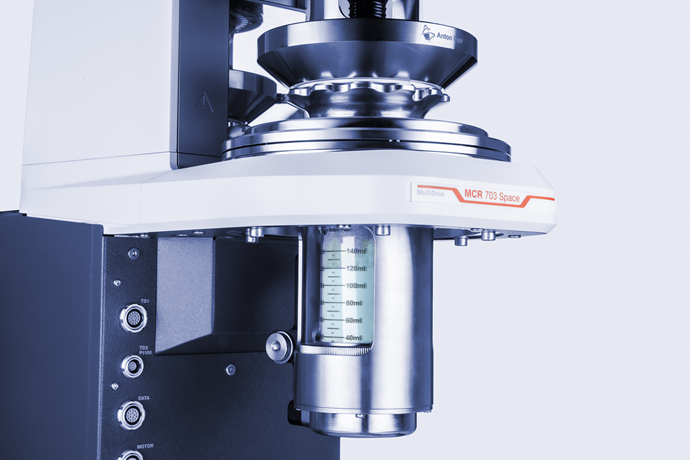
Image Credit: Anton Paar GmbH
- Appropriate for measurements ranging from -170 °C to +980 °C (and can be combined with humidity control).
- Characterization of powders under varying loads from low to high and their time-dependent behavior.
- Tests for shear, compressibility, and wall friction.
Flow Cell
- Characterization of fine powders to foams under processing conditions
- Ideal for examining the fluidization behavior of a powder in a dust-free setting
- Exceptional reproducibility for research and development, as well as quality control
Key Features
Two Cells to Cover all the Needs
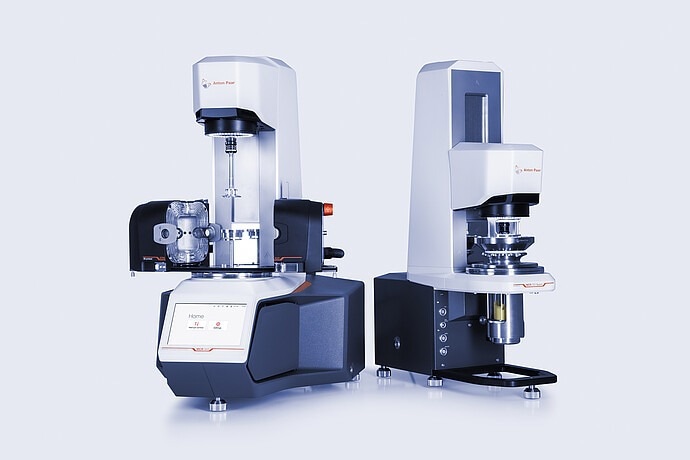
Image Credit: Anton Paar GmbH
The comprehensive powder rheology apparatus, which includes both the powder shear cell and the powder flow cell, provides all the necessary options for characterizing powders and granular materials. The integration of a rheometer with a system designed to assess powder behavior ensures optimal sensitivity.
Versatile Powder Characterization with the Powder Flow Cell
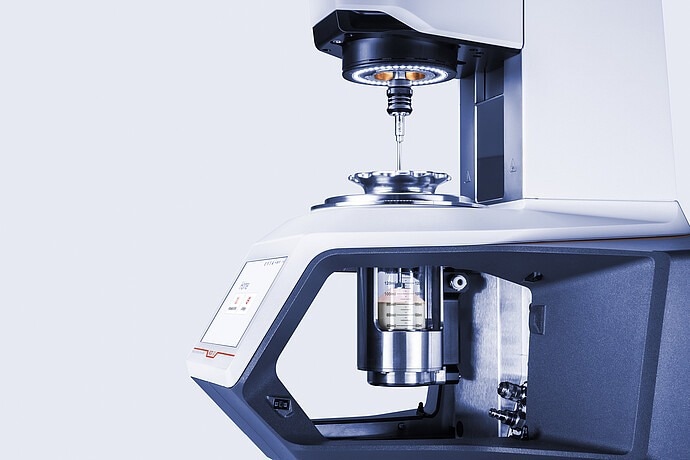
Image Credit: Anton Paar GmbH
The powder flow cell is suitable for comprehensive powder characterization and as a quality control instrument owing to its exceptional versatility. It facilitates rapid testing while utilizing the accuracy of Anton Paar’s MCR rheometers.
Employ one of the numerous measurement techniques offered – including basic flowability energy, cohesion strength, pressure drop, or deaeration time – to assess the powder throughout processing, handling, and storage.
Envelope density can be measured using the powder flow cell with a specific measuring geometry and displacement powder.
The Only Powder Shear Cell with Temperature and Humidity Control
Regulate the temperature and monitor its effects on the powders. MCR rheometers can be fitted with heating chambers that span an extensive temperature range from -170 °C to +980 °C.
Humidity, which has a significant impact on powder behavior during storage, handling, and processing, can be managed within 5 % RH to 95 % RH using a specialized humidity kit. Temperature and humidity control can be provided for the powder flow cell upon request as a tailored solution.
Powerful Software for Incomparable Control
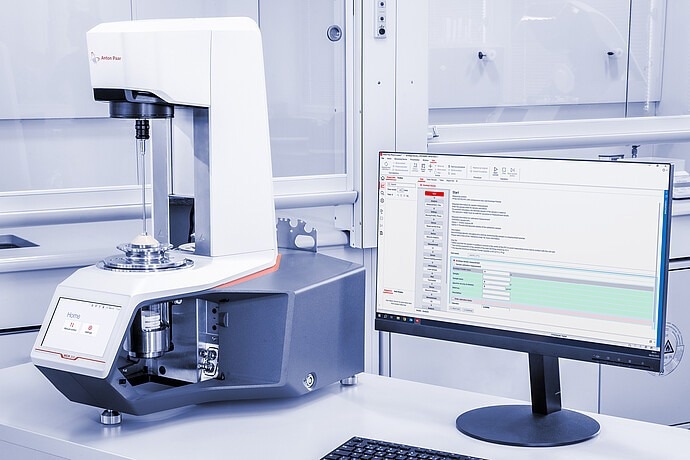
Image Credit: Anton Paar GmbH
The user-friendly interface of the rheometer software enables fully automated powder rheometry measurements with just two clicks, while providing comprehensive control over all measurement parameters.
Each measurement can be customized to meet the specific requirements. The system adheres to quality management standards, including 21 CFR Part 11, which is essential for the pharmaceutical sector.
Patented Dust Protection for the Powder Flow Cell
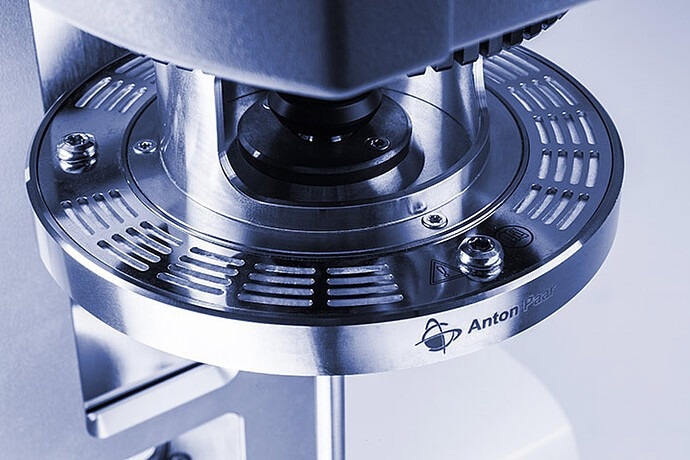
Image Credit: Anton Paar GmbH
The distinctive, patented dust-protection system (EP 3067684) facilitates the clean, secure handling of samples. A quadruple sealing concept safeguards both the operator and the instrument from fine, potentially dangerous powder, even when the powder is fully fluidized.
The air-seal technology of the powder flow cell is designed to be dustproof and to operate without friction on the measurement axis, thereby preserving the exceptional accuracy and resolution of the MCR rheometer down to 10 nNm.
Designed for Sensitivity and Reproducibility
Anticipate consistent powder rheometry measurements utilizing both the powder shear cell and the powder flow cell. The sensitivity of the MCR aids in distinguishing between even closely resembling powders and identifying minor variations within the samples.
The configuration of the powder shear cell comprises a sample preparation bench designed to guarantee uniformity, thereby considerably minimizing operator impact and enhancing reproducibility. The powder flow cell is equipped with automated sample preparation modes, ensuring unparalleled reproducibility of up to 0.5 %.
Specifications
Source: Anton Paar GmbH
| |
Powder shear cell |
PFC 30 |
PFC 20 |
PFC 10 |
| Sample volume |
4.3 mL and 18.9 mL |
60 mL to 120 mL |
21 mL |
| Torque range |
0.2 nNm to 300 mNm |
0.2 nNm to 300 mNm |
Normal
stress |
While shearing: up to 30 kPa
While compacting: up to 110 kPa
(sample- and cell-dependent) |
22 kPa |
- |
Temperature
option |
-20 °C to +180 °C with CTD 180 HR
-150 °C to +450 °C with CTD 450 TDR
-170 °C to +600 °C with CTD 600 MDR
Customized up to +980 °C |
-15 °C to +80 °C Possible on request |
-20 °C to +180 °C with CTD 180 HR
-150 °C to +450 °C with CTD 450 TDR
-170 °C to + 600 °C with CTD 600 MDR |
Humidity
option |
5 % RH to 95 % RH |
Customizable on request |
5 % RH to 95 % RH |
| Measurement systems compatible |
Included in the setup:
- Small shear system (4.3 mL)
- Large shear system (18.9 mL)
- Wall friction system with exchangeable discs
|
- Two-blade stirrer
- Helical two-blade stirrer
- Warren Springs geometry
- Powder preparation set with exchangeable discs
- Cylinder systems
- Envelope density set
|
Included in the setup:
- Small helical two-blade stirrer
|
Measurement
method |
For low-load to high-load conditions
- Shear measurements
- Time consolidation
- Wall friction and adhesion
- Compressibility (bulk density, Carr index, Hausner ratio)
|
For fluidized, aerated, and low-load conditions
- Pressure Drop
- Air retention
- Cohesion strength
- Segregation
- Permeability
- Fluidized bed viscosity
- all PFC 20 methods
|
For non-fluidized, aerated, and low-load conditions
- Compressibility (bulk density, Carr index, Hausner ratio)
- Wall friction and adhesion
- Warren Spring cohesion and caking
- Tensile strength
- Basic flowability energy (BFE)
- Specific energy (SE)
- Envelope density
|
For non-fluidized, aerated conditions
- Basic flowability energy (BFE)
- Specific energy (SE)
|
Dust
protection |
Not necessary |
Patented dust protection hood (US10031067) for 100 % filtration of particles d ≥ 5 µm; 90-95 % for 5 µm ≥ d > 1 µm |
- |
- |
| Fluidization option |
Not necessary |
Choice of three mass flow controllers for volumetric flow from 0.05 L/min up to 80 L/min. |
- |
- |
| Accessories |
Included in the setup:
- Sample preparation/time consolidation bench
- Weight base for small and large shear cell
- Weights for small and large shear cell (up to 12 kPa in 1 kPa step)
|
Included in the setup:
- Uncoated glass measuring tube
- (Optional: FTO-coated glass/steel tube)
|
- |