Edinburgh Analytical’s benchtop double-beam UV-Vis spectrophotometer is designed for analytical, research, and pharmaceutical applications in a compact footprint.
Key Features
- Fast scanning: Up to 6000 nm/minute to aid sample analysis throughput
- Optional Visacle® software: For easy PC control
- Touchscreen interface: Intuitive menus and functions for ease of use for standalone control
- Automatic accessory recognition: When connected to the DB30
- Variable bandpass options: 0.5, 1.0, 1.5, 2.0, or 4.0 nm over the range 190–1100 nm
- Multiple data storage options: USB, SD card, and internal data storage for convenient retrieval of methods and results
The DB30 is a high-performance UV-Vis spectrophotometer, built with a dual-beam optical system. It records precise and reliable absorbance and transmission measurements across a broad wavelength range, making it an essential tool for analytical tasks that demand the highest levels of accuracy and consistency.
Designed for flexibility and ease of use, the instrument supports a range of measurement formats, including traditional cuvettes, solid samples, and flow-cell setups. Its advanced optical architecture ensures excellent control over stray light, great baseline stability, and precise wavelength and photometric accuracy.
Users can operate the system using an integrated touchscreen or connect it to a PC using Visacle® software. Visacle offers secure data and method management, with an optional upgrade available for CFR Part 11 compliance, supporting data integrity in regulated environments.
Measurement Examples
Core Features
The DB30 covers the ultraviolet spectrum down to 190 nm, with an absorbance range higher than 3.
This allows for the measurement of samples with high UV absorption, such as the spectra of edible oils illustrated below.
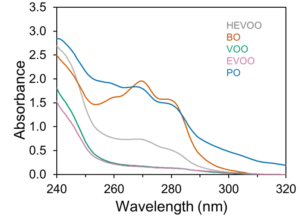
Figure 1. UV absorption spectra of heat-treated extra-virgin olive oil, blended oil, virgin olive oil, extra-virgin olive oil, and pomace oil, measured using a standard DB30 dual spectrophotometer. Image Credit: Edinburgh Analytical
Particle Size
The DB30 NanoSize package comprises the DB30 primary apparatus, SpectroLink™ technology, and NanoCuvette™ S.
Particle-size determination has become economically accessible through the NanoSize package, with analytical computations performed via SpectroWork™ using advanced machine learning algorithms.
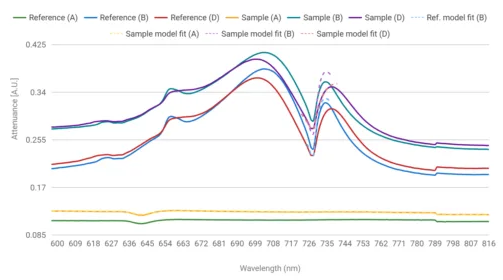
Figure 1. Particle size analysis with the DB30 NanoSize Package. The particle size is calculated from the spectral features in the absorption spectrum. Image Credit: Edinburgh Analytical
Refractive Index
The DB30 NanoIndex package comprises the DB30 primary instrument, SpectroLink™ technology, and NanoCuvette™ One apparatus.
The refractive index of sugar solutions can be readily determined with the NanoIndex package, with subsequent analytical computations performed in SpectroWork™ using advanced machine learning algorithms.
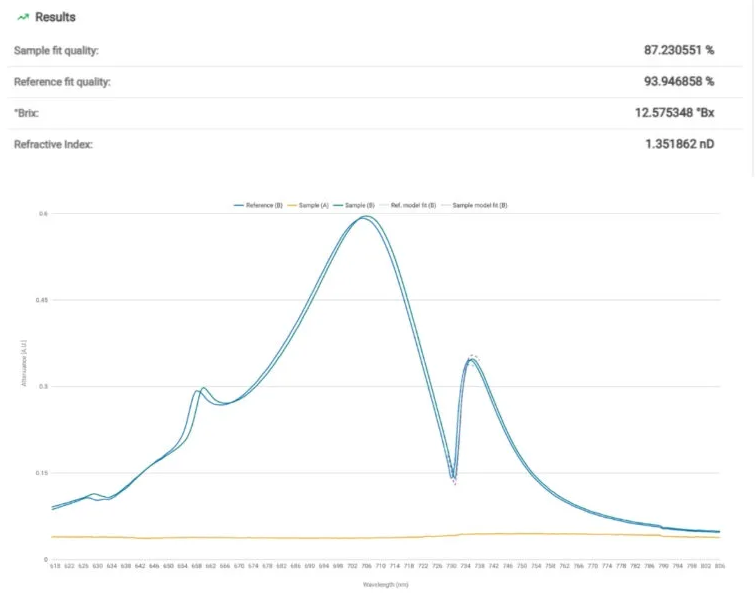
Figure 1. Brix value and refractive index analysis of sucrose solution 12.5 g/100 g water using the NanoIndex package. Image Credit: Edinburgh Analytical
Chromium (VI)
The DB30 is equipped with an integrated quantitation mode that facilitates concentration analysis. It measures standard solutions and automatically produces a calibration curve.
When analyzing samples of unknown concentration, the DB30 determines the sample concentration directly by referencing the measured absorbance against the previously established calibration curve. This functionality facilitates expeditious, precise, and dependable quantitative analysis while substantially reducing the user effort.
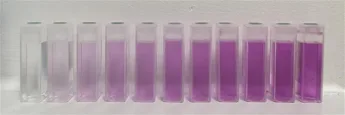
Figure 1. Standard Cr (VI) solutions from 0.0 mg/L to 1.0 mg/L (left to right). Image Credit: Edinburgh Analytical
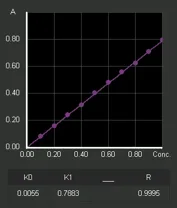
Figure 2. Cr (VI) standard calibration curve, taken from the DB30 touchscreen interface. Image Credit: Edinburgh Analytical
Download the Brochure for More Information
Specifications Table
Source: Edinburgh Analytical
| Parameter |
Description |
| Optics |
Czerny-Turner, dual-beam monochromator |
| Wavelength Range |
190–1100 nm |
| Spectral Bandwidth |
0.5 nm, 1 nm, 1.5 nm, 2 nm, and 4 nm |
| Stray Light |
≤0.10% T (220 nm NaI, 340 nm NaNO2) |
| Wavelength Accuracy |
±0.1 nm D2 peak 656.1 nm |
Wavelength
Repeatability |
±0.1 nm |
| Photometric Range |
Absorbance: -3.4 to +3.4, %T: 0 to 300, Concentration: 0,000 to 9,999 |
| Photometric Accuracy |
±0.002 Abs (0–0.5 Abs), ±0.004 Abs (0.5–1 Abs), ±0.008 Abs (1–2 Abs) ±0.3% T |
| Photometric Reproducibility |
±0.0003 Abs (0–0.5 Abs), ±0.0005 Abs (0.5–1 Abs), ±0.001 Abs (1–2 Abs) |
| Wavelength Scan Speed |
10, 100, 200, 400, 800, 1200, 2400, 3600, 6000 nm/minute |
| RMS Noise |
≤0.00003 Abs (0 Abs, 500nm) |
| Baseline Stability |
<0.0003 Abs/hour (500 nm, two-hour lamp warm-up period) |
| Baseline Flatness |
±0.0009 Abs (200–950 nm) |
| Light Source |
Tungsten-halogen and deuterium lamps |
| Light Source Switching |
Automatic switching selectable for 325–370 nm range |
| Detector |
Silicon photodiode |
| Display |
7” touchscreen |
| Software |
Touchscreen operation, PC-controlled software, or CFR-compliant PC-controlled software |
| Dimensions |
500 mm (W) × 475 mm (D) × 250 mm (H) |
| Net Weight |
20 kg (approx) |
| Power Supply |
100–240 V, 50/60 Hz, 150 VA |
| Ambient Temperature |
10–35 °C |
| Output Device |
USB flash drive, SD card |
| Interface |
USB PC interface |