With its high-frequency (HF) induction furnace and sophisticated detection, the G4 ICARUS Series 2 combustion analyzer raises the bar for quick and accurate carbon (C) and sulfur (S) measurement in inorganic materials.
Due to their influence on material characteristics, the demand for quick and reliable carbon and sulfur (CS) analysis extends beyond iron and steel to ferrous and non-ferrous metals, alloys, ceramics, ores, cement, limestone, and a wide range of other inorganic solids.
System Highlights
ZoneProtect™
The innovative combustion zone design employs a gas-extraction nozzle to ensure an adequate supply of oxygen to the sample, while liberated gases and dust particles are immediately purged through the nozzle.
The revolutionary, fully automated cleaning mechanism with brush-free dust removal cleans both the inline high-efficiency dust filter and the gas-extraction nozzle, while transferring collected dust to the crucible for disposal.
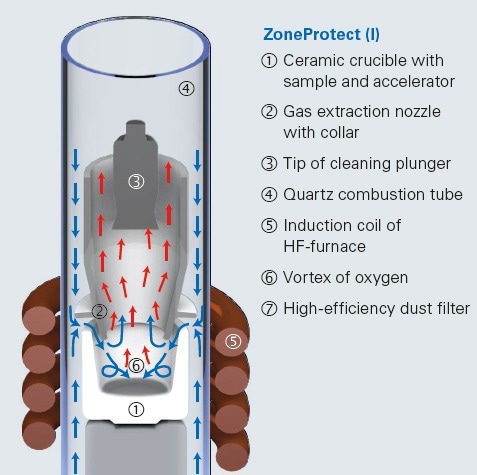
Image Credit: XRF Scientific
Detection
Recent advancements in high-performance light-emitting diodes (UV-LEDs) have enabled the development of an exceptional SO2 detector. This technique’s special benefits include the lowest detection limits and an ultra-wide linear dynamic range. All XRF Scientific detectors have no moving parts and are equipped with integrated reference-beam channels to prevent drift and ensure maximum baseline and calibration accuracy.
Three micrometer pore size: The high-efficiency dust filter’s 3 µm pore size ensures greater stability and a cleaner workplace.
Cycle time of less than 60 seconds, including cleaning cycle: ZoneProtect™ provides clean, rapid, and efficient combustion. The integrated automatic cleaning mechanism disposes of any dust in the crucible.
Ten times better signal-to-noise ratio: Advanced SO2 detection uses UV absorption, which is more efficient than IR absorption. This results in a 10-times-higher S/N ratio, a five-decade linear dynamic range, and maximum stability unaffected by temperature changes.
Why Combustion?
When the time taken to obtain results is critical, and accuracy must be guaranteed on the first attempt with minimal sample preparation, combustion analysis is unrivaled for studying light elements. These are difficult or impossible to quantify via direct spectroscopy, particularly when embedded in complex matrices.
For example, the G4 ICARUS Series 2 produces accurate findings even in gray cast iron, where carbon is irregularly dispersed in the form of graphite clusters, because it uses a volumetric approach to analyze the entire sample.
Applications
Iron (Fe), Steel, Cobalt (Co), and Nickel (Ni)
Carbon is the major interstitial alloying element in these materials, considerably influencing their properties. Sulfur can be regarded as a pollutant or a desirable addition, depending on the context. During metal manufacturing and alloying, high-accuracy carbon and sulfur analysis is critical for an optimal production process.
The G4 ICARUS Series 2 is designed to fulfill and surpass stringent process control requirements for both the end metal and its constituents, including ferroalloys and raw materials up to slag formation.
Ores and Minerals
The value of minerals and metal-bearing ores is defined by their desired metal content. The sulfur content in the ore concentrate is used to estimate the metal-in-concentrate and to determine the effectiveness of the concentration process.
Knowing the correct carbon and sulfur levels helps users optimize mining operations and mineral beneficiation. The G4 ICARUS Series 2 is a great complement to any mining laboratory due to its ultra-wide range and modern detectors.
Limestone, Lime, and Dolomite
Limestone and dolomite are sedimentary rocks with a wide range of uses. Limestone is used as a building material, aggregate, fluxing agent, and acid neutralizer. Dolomite is tougher than limestone, making it a better building material. The G4 combines ease of use with robustness to provide quick and precise carbon and sulfur readings for quality and process control in these raw materials.
Metal Processing
The G4 ICARUS Series 2 delivers exceptional analytical performance and versatility, backed by cutting-edge technology, for every demanding metal-processing task in aviation, space, automotive, biomedical, electronic, and similar industries. These materials include stainless steel, aluminum (Al), copper (Cu), nickel (Ni), titanium (Ti), zirconium (Zr), and other special metal compositions.
Case Hardening
Controlling the carbon potential during the carburization process is necessary for case hardening. The carbon potential is determined by direct furnace atmosphere analysis using the 'shim stock' method, which employs heat-treatment test foils placed inside the furnace. With its ease of operation and long-term stability, the G4 ICARUS is ideal for any parts manufacturer operating a heat treatment/hardening facility.
Glass and Ceramics
Refractory oxides, nitrides, and carbides are widely used in a variety of applications, including refractory materials in industry, high-performance ceramics in electronics, and metal cutting. The levels of carbon and sulfur present in the process or end product influence the distinctive qualities of glass and ceramics in various ways.
The G4 ICARUS Series 2 is a superb tool for the rapid examination of raw materials, intermediates, and final products, thanks to its strong HF furnace with ZoneProtect and wide detection range.
Cast Iron
Carbon is the primary alloying element in cast iron, typically present at levels above 2%. Even in difficult matrices such as gray cast iron, where carbon is irregularly dispersed in the form of graphite flakes, the G4 ICARUS Series 2 produces reliable results by using a volumetric approach to analyze the whole sample. The G4 ICARUS Series 2 also analyzes mold powders and fluxes.
Cement
Cement is a hydraulic binder and the primary component of fundamental building materials such as concrete and mortar. Quality and process control necessitate the rapid and precise analysis of elemental and phase compositions. The G4 offers a simple and quick way to adjust cement mixtures.
Specifications
Source: XRF Scientific
|
Specification |
Benefit |
| Sample Types |
Inorganic, dry, any form or shape |
Flexibility |
| Typical Samples |
Ferrous and nonferrous metals and their alloys, ores, cement, limestone, glass, ceramics, and soils |
Wide variety of sample materials |
| Sample carrier |
Ceramic crucibles (standard form) |
Usage of industry standard consumables, lower cost, security of supply |
| Sample weight |
0.1–1 g (typical 0.5 g) |
|
| Furnace |
High-frequency induction furnace, power adjustable with ZoneProtect™ |
More efficient, faster combustion with maximum productivity |
| Detectors: Carbon |
Dual-range NDIR detector with reference beam path |
Reliable, maintenance-free performance without drift |
| Detectors: Sulfur |
Advanced detector with reference beam path |
Unique wide range performance with unrivaled signal/noise without drift |
| Carrier Gas |
Oxygen 99.95% purity
(99.995% required for trace carbon)
3.5 bar (50 psi) minimum pressure |
Standard gas purity sufficient |
| Compressed air |
5 bar (72.5 psi) minimum pressure, oil-, water-, and particle-free |
|
| Analysis Time |
40 seconds (nominal) |
Fast, simultaneous analysis |
| Complete Cycle Time |
< 1 minute (typical) |
High productivity and throughput with waste disposal into a crucible |
| Noise Emission |
< 50 db |
Enjoy the silence |
| Calibration |
Single and multipoint calibration with solid standards |
|
| Reagents |
Magnesium perchlorate
Sodium hydroxide on support
Platinized silica |
|
| Power Supply |
230 VAC (± 10 %); L1 N; 50-60 Hz; 16 A; 2.7 kVA
208 VAC (± 10 %); L1 L2; 50-60 Hz; 16 A; 2.7 kVA |
Industry standard power and current configurations |