The BTC-130 and BTC-500 Battery Testing Calorimeters from H.E.L Group are adiabatic calorimeters designed to investigate the thermal stability and safety performance of battery cells under thermal, electrical and mechanical stress.
Both systems enable the determination of key safety parameters, including the onset of self-heating, adiabatic temperature rise and thermal runaway behaviour. The BTC-130 is designed for battery components and smaller cells, while the BTC-500 accommodates larger cells and small modules, with additional capabilities for electrical and mechanical abuse testing and thermal runaway propagation studies.
Features and Options
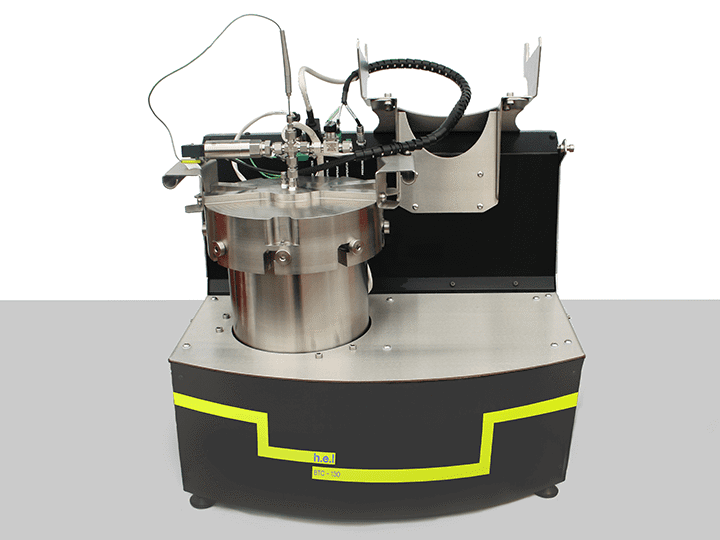
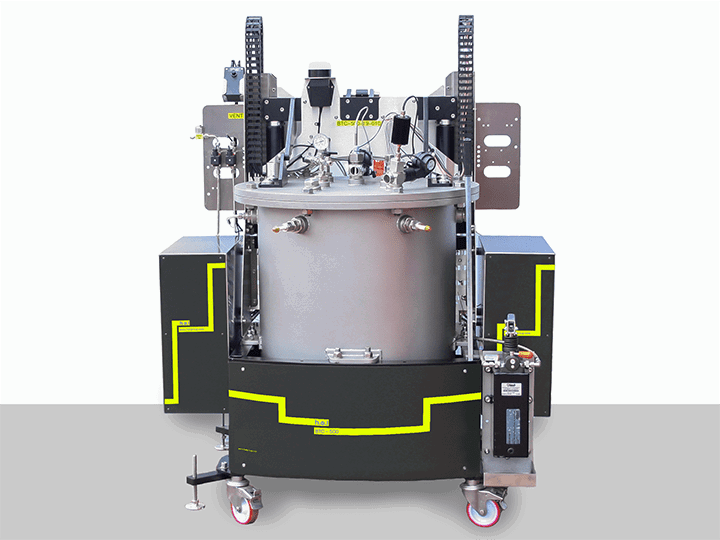
BTC-130 and BTC-500 Comparison:
 |
 |
| BTC-130 |
BTC-500 |
|
Feature
|
BTC-130
|
BTC-500
|
|
Configuration
|
Bench-top
|
Floor-standing
|
|
Test chamber
|
Ø130 × 200 mm
|
Ø500 × 500 mm
|
|
Temperature range
|
Ambient to 500°C
|
−40°C to 500°C*
|
|
Battery/sample size
|
Components, coin cells, small cylindrical and pouch cells
|
Cylindrical, prismatic and pouch cells, small modules
|
|
Electrical abuse testing
|
Optional
|
Optional
|
|
Mechanical abuse testing
|
Nail penetration option
|
Nail penetration and crush options
|
|
Thermal runaway camera
|
Not standard
|
Integrated
|
|
Thermal mapping
|
Configurable
|
Multipoint temperature measurement
|
|
Gas analysis integration
|
Configuration-dependent
|
Available
|
The following testing capabilities and features are available across the BTC range, depending on the instrument configuration
Type of Test:
- Thermal stress: Adiabatic testing to evaluate thermal stability, onset of self-heating, adiabatic temperature rise and thermal runaway.
- Electrical stress: Optional integration with charge-discharge equipment supports overcharge, over-discharge and cycling studies, with external short-circuit testing also available.
- Mechanical stress: Optional mechanical abuse testing enables investigation of damage-induced thermal runaway.
- Thermal runaway propagation: Investigation of heat transfer and failure propagation between cells in battery assemblies, supported by the BTC-500.
- Heat capacity measurement: Determination of battery heat capacity (MCp) to support thermal characterisation and energy calculations.
- Gas analysis: Optional integration with gas sampling and analysis equipment enables investigation of gases evolved during battery failure.
Temperature Control
- Heat-Wait-Search (HWS), temperature ramping and isothermal testing methods.
- Adiabatic temperature control minimises heat loss to the surroundings during self-heating measurements.
- Configurable test procedures for investigating different thermal conditions.
Intelligent Software Control and Analysis
- H.E.L's WinISO software enables automated test procedures, real-time data logging and parameter control.
- Measurement of temperature, self-heating rates and other experimental parameters during battery failure.
- Configurable data acquisition for monitoring rapid thermal runaway events.
Safety Features
- Automatic, user-configurable event detection and shutdown procedures.
- Hardware and software safety interlocks.
- Battery containment and provisions for safe venting during thermal runaway testing.
BTC-500 sub-ambient operation depends on system configuration.