The Park FX40 represents Park Systems’ newest advancement in atomic force microscopy (AFM), engineered for high-resolution imaging of small samples. Featuring an ultra-low noise floor, reduced thermal drift, and improved mechanical stability, the FX40 provides exceptional precision and dependable performance.
Consistent with all Park AFMs, the FX40 incorporates an orthogonal scan architecture and True Non-contact™ mode, allowing precise, high-resolution metrology on even the most sensitive and fragile samples.
The FX40 offers key capabilities such as automatic probe exchange, automatic laser beam alignment, and a sample-view camera – hallmark features of FX-series AFMs that simplify operation while substantially improving productivity. Powered by the advanced FX AFM controller, which includes an 8-channel lock-in amplifier and 5 MHz bandwidth for sophisticated signal processing, the FX40 enables a broad selection of advanced operating modes and options.
Designed to combine high precision with user-friendly operation, the FX40 provides an effective solution for nanoscale imaging and analytical applications.
Park FX40 Introduction | A Groundbreaking New Class of Atomic Force Microscope
Video Credit: Park Systems
Key Features
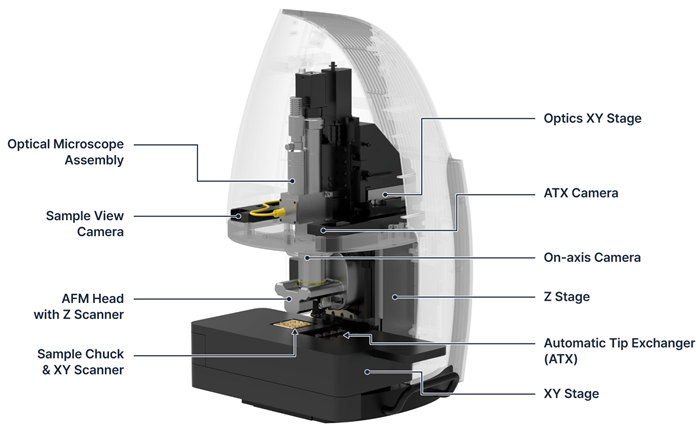
Image Credit: Park Systems
Superior FX Mechanical Design
The FX-series AFMs are engineered to minimize mechanical noise. The optical microscope is isolated from the Z stage, reducing its load and, in turn, decreasing sensitivity to mechanical vibrations. The Z stage is also reinforced with a high-stiffness cross-roller guide and dual bearing blocks to enhance structural stability.
By using materials with low thermal expansion coefficients to limit thermal drift, the FX40 maintains consistent and dependable performance over extended operating periods.
FX Laser Beam Path
The FX optics structure integrates a fiber-coupled superluminescent diode (SLD) into the optical microscope assembly. The laser beam is focused through the objective lens and remains fixed at the center of the optical field of view.
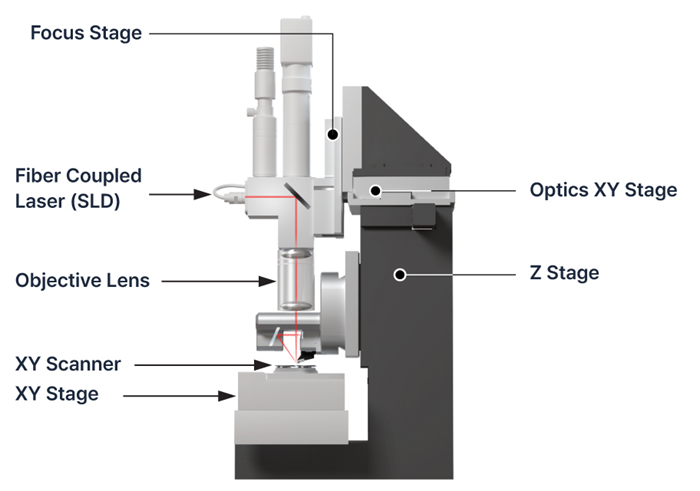
Image Credit: Park Systems
Automatic Laser Beam Alignment
The vision-guided alignment system identifies the cantilever’s shape and location, then automatically moves the optics XY stage to position the cantilever at the center of the field of view, where the laser beam is accurately focused. Two high-precision motors in the FX scan head subsequently fine-tune the steering mirror to center the laser beam on the position-sensitive photodetector (PSPD).
Automated laser beam alignment, combined with automatic PSPD centering, shortens setup time, delivers consistent alignment, and enables smooth operation for novice and experienced users.
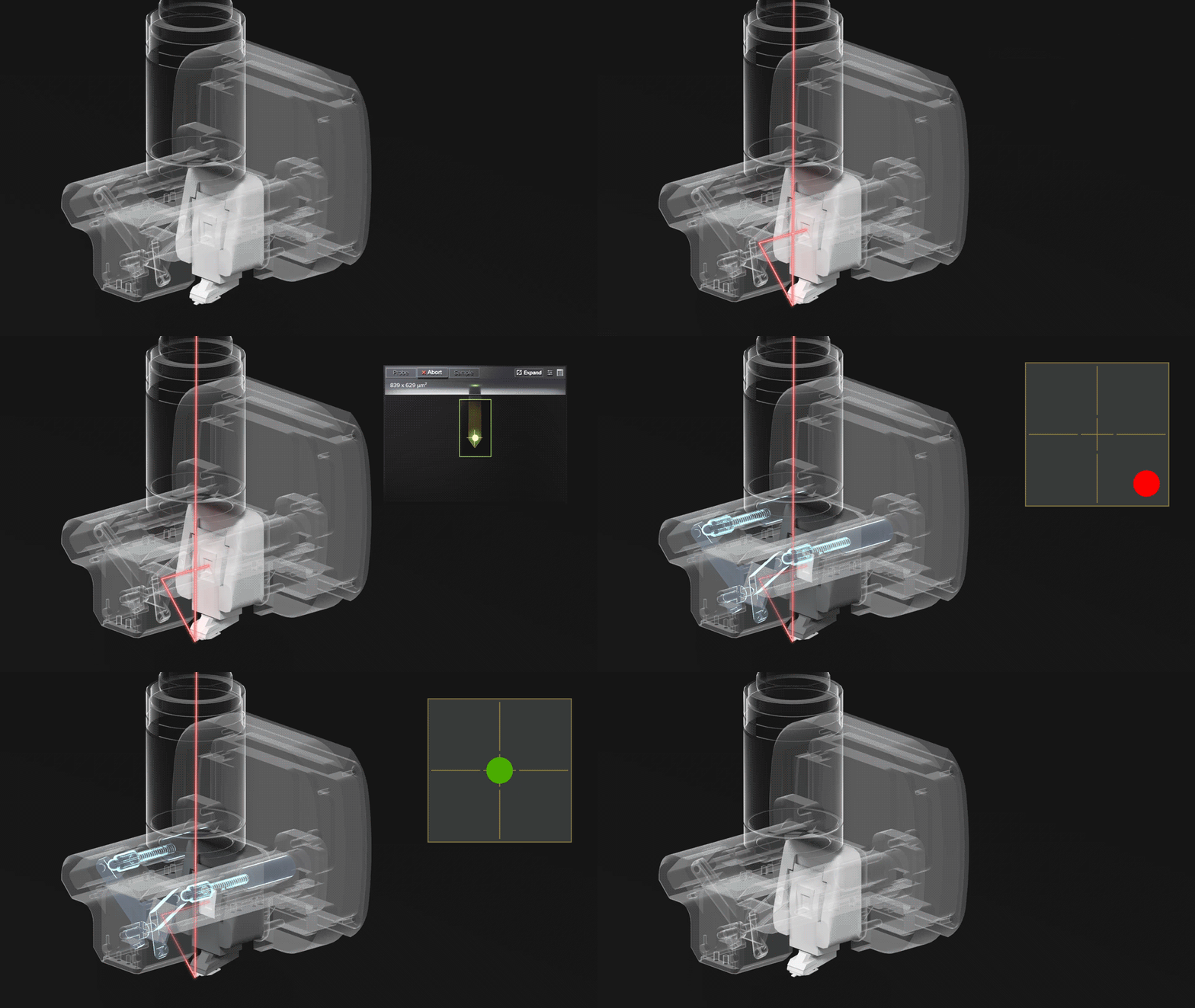
Image Credit: Park Systems
Automatic Probe Exchange
Replacing AFM probes can be difficult, even for skilled users, and often results in cantilever damage, increasing setup time and consumable costs.
Park AFMs overcome this challenge by using pre-aligned probe chip carriers with kinematic mounting points, ensuring reliable and repeatable tip positioning.
Each chip carrier is labeled with a QR code that stores detailed information, including the probe type, serial number, manufacturing date, and technical specifications.
The FX scan head’s Z scanner incorporates three precision ball seats for kinematic mounting, with magnets at the base providing secure, stable, and highly repeatable positioning.
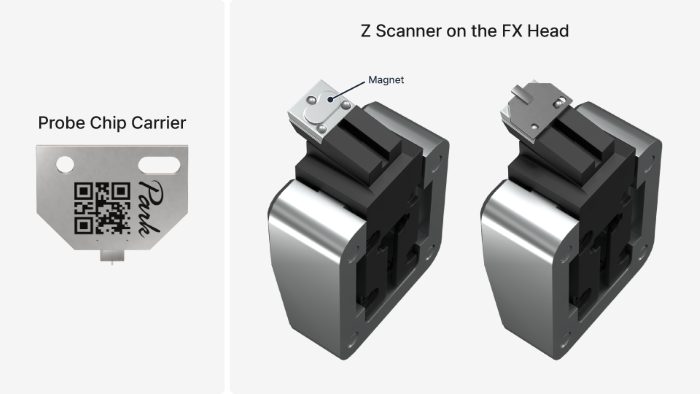
Image Credit: Park Systems
The automatic tip exchanger (ATX) module can hold up to eight pre-mounted probes. Once the ATX camera reads the QR codes on the probes, the SmartScan™ AFM control software displays detailed probe information for each slot, enabling users to identify occupied or empty positions and make selections with a simple mouse click.
After a slot is chosen, the AFM head moves downward to either retrieve a probe from the selected slot or return the currently mounted probe, guided by the position of the strong magnet beneath the slot.
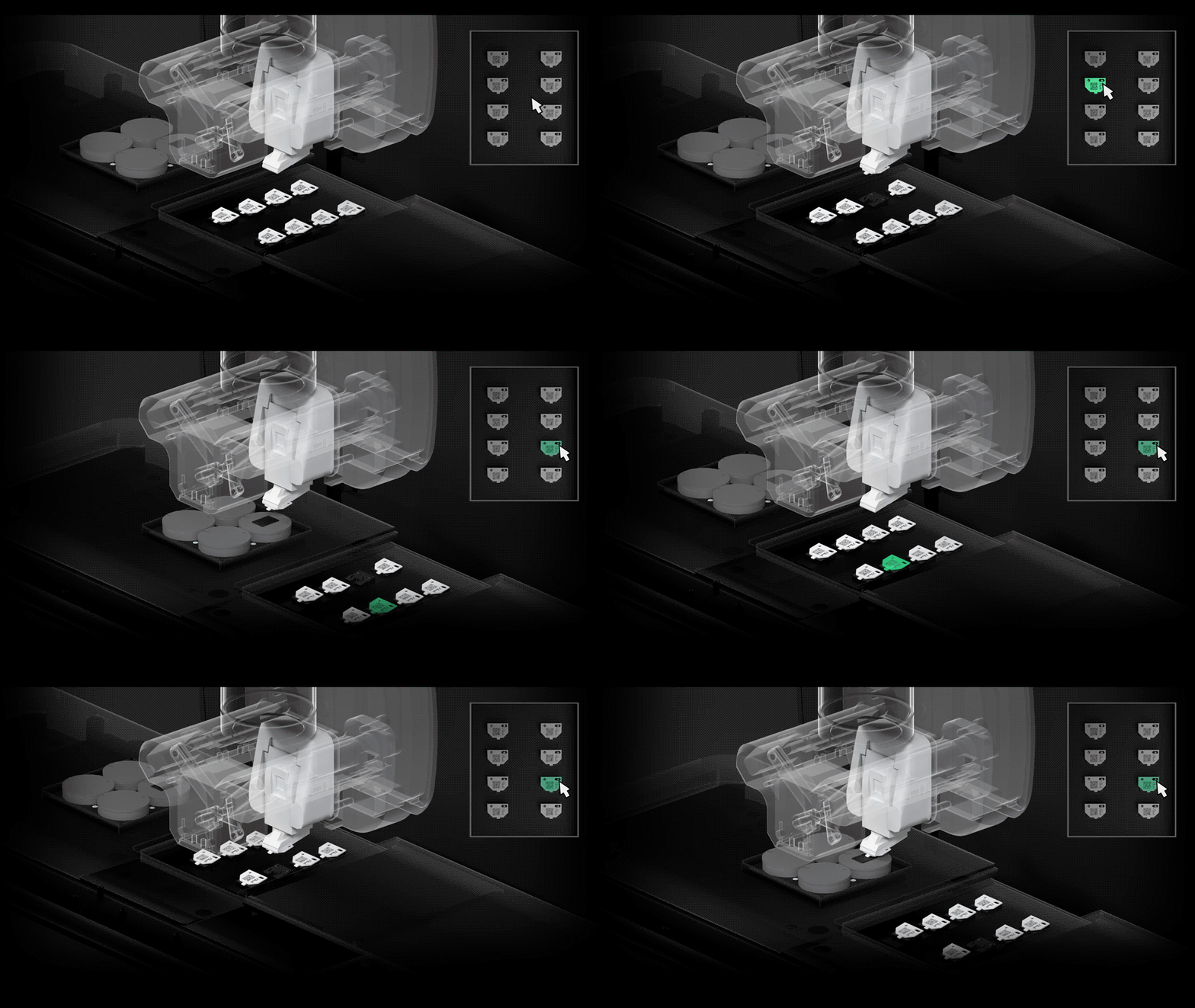
Image Credit: Park Systems
Sample-View Camera
The sample-view camera displays a live image of the sample, enabling users to move the XY stage with simple point-and-click control. This functionality allows easy navigation to regions of interest and quick return to previously selected locations.
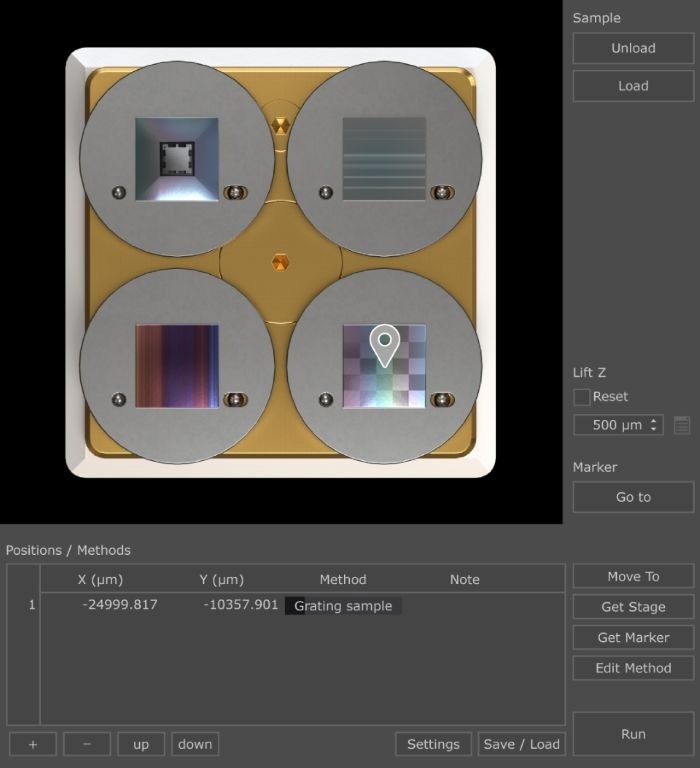
Image Credit: Park Systems
Improved On-Axis Optics
The unobstructed optical microscope provides a clear field of view and can resolve line widths as small as 0.87 μm.
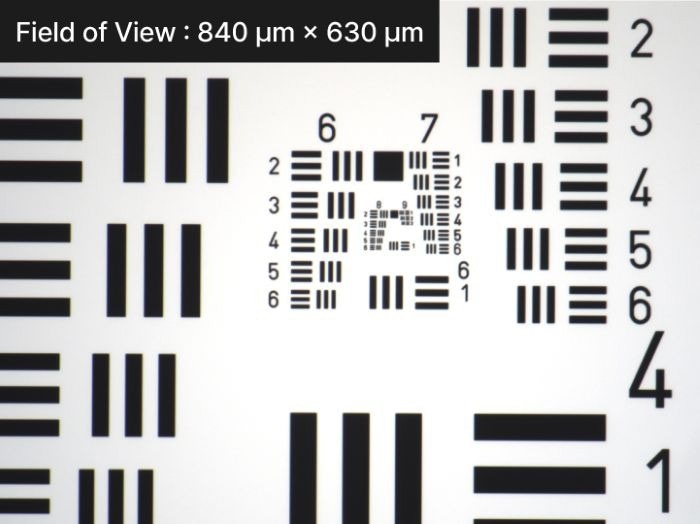
Image Credit: Park Systems
Park AFM Technology
Orthogonal Scan System
Conventional AFMs with tube scanners often exhibit out-of-plane movement and axis crosstalk, leading to image distortion, particularly during large-area scans. The FX40, like all Park AFMs, uses an advanced orthogonal scanning system based on a flexure-guided design: a 2D flexure scanner moves the sample in the XY plane, while a separate 1D flexure scanner independently manages motion along the Z axis.
This separated-scanner system enables highly orthogonal, linear scanning with minimal out-of-plane motion and strong dynamic performance.
Low-noise optical sensors provide closed-loop feedback for XY positioning, while an ultra-low-noise strain gauge sensor controls Z motion, allowing the servo control system to deliver accurate, stable, and repeatable scans across all axes.
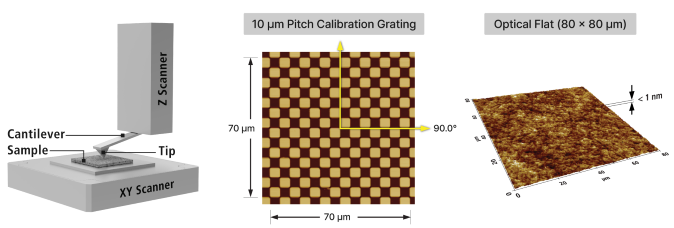
Image Credit: Park Systems
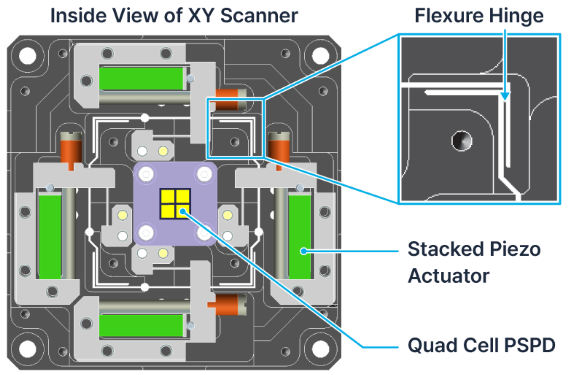
Image Credit: Park Systems
The XY scanner is engineered to deliver flat, strictly horizontal movement without vertical coupling via stacked piezo actuators and flexure-hinge mechanisms. A centrally positioned sensor provides direct positional feedback for servo control, reducing errors across the entire scan range. This configuration maintains high accuracy and stability, even during large-area scans.
Park AFM Technology
True Non-Contact™ Mode
The FX40 incorporates True Non-contact™ mode, a proprietary technology unique to Park Systems. This mode captures surface topography by sensing the attractive van der Waals forces between the AFM probe and the sample surface.
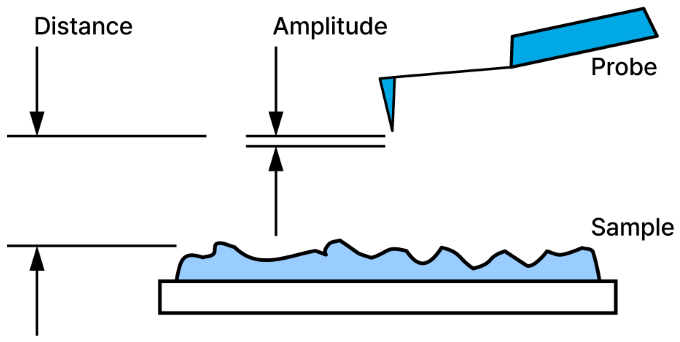
Image Credit: Park Systems
Softwares
Park SmartScan™
Park SmartScan™ is a sophisticated AFM control software with a clean, user-friendly interface and robust capabilities that support high-quality imaging and an improved overall user experience.
Image Credit: Park Systems
Park SmartAnalysis™
Park SmartAnalysis™ is a powerful AFM image analysis software designed for rapid image processing, in-depth data evaluation, and streamlined preparation of results for publication.

Image Credit: Park Systems
Applications
Conductive AFM
WTe2 on Au Electrode

Image Credit: Park Systems
True Non-Contact™ Mode
Block Copolymer

Image Credit: Park Systems
True Non-Contact™ Mode
Polymer Composite

Image Credit: Park Systems
Conductive AFM
tBG on hBN

Image Credit: Park Systems