The Aqualog®-Next A-TEEM™ Spectrometer is the fifth generation of the esteemed Aqualog® product line. Engineered to meet the most rigorous requirements of water research and environmental analysis while maintaining regulatory compliance, the Aqualog®-Next provides expedited, thorough, and quantifiable analytical results, enabling researchers to conduct more efficient and evidence-based assessments of this essential natural resource.
The HORIBA Aqualog series is recognized internationally as the preeminent standard in environmental water research for examining colored dissolved organic matter (CDOM).
The Future of Water Analysis is Here: Introducing the AQUALOG-NEXT from HORIBA
Video Credit: HORIBA
Experience the Power of A-TEEM™ Technology
The foundation of Aqualog®-Next comprises HORIBA's proprietary A-TEEM™ (Absorbance-Transmittance and fluorescence Excitation-Emission Matrix) spectroscopy technology. This innovative dual-purpose spectrometer simultaneously acquires absorbance measurements and fluorescence excitation-emission matrices (EEMs).
See the Full Picture: Obtain complete spectral information encompassing essential non-fluorescent absorption metrics, including specific ultraviolet absorbance (SUVA) measurements.
Ultra-Fast Performance: Featuring an advanced high-speed CCD detector, Aqualog®-Next delivers comprehensive A-TEEM fingerprint acquisition within seconds, representing a substantial advancement over conventional scanning PMT fluorometers.
Unrivaled Accuracy: Mitigate fluorescence inner filter effect (IFE) complications through real-time automated corrections, guaranteeing that the excitation-emission matrix (EEM) measurements maintain exceptional accuracy and dependability.
Intuitive Workflow with EzSpec™ Software
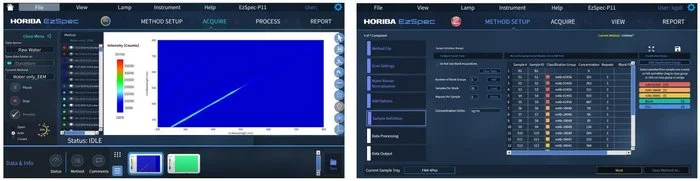
Image Credit: HORIBA
Preserving data integrity and enhancing user experience are HORIBA’s highest priorities. The Aqualog®-Next incorporates cutting-edge EzSpec™ software, engineered to facilitate an intuitive and efficient operational process throughout its entirety.
- Seamless Operation: Configure methodologies, retrieve information, analyze outcomes, and produce comprehensive documentation with minimal effort.
- Organized Data: Enhanced database connectivity facilitates straightforward categorization and retrieval of essential data repositories.
- Advanced Tools: Leverage sophisticated, integrated capabilities that include inner-filter effect correction, Rayleigh masking, RSU normalization, and 3D to 2D profiling.
- Easy Sharing: Create ASCII-formatted file exports and polished PDF documentation to facilitate collaborative scientific endeavors and streamline information distribution.
Environmental Research Topics for Color Dissolved Organic Matter (CDOM) and its Derivatives, DOM and NOM
Features
Featured Videos
Ep 8: Positive Current | SEARCH ON
Google “Positive Current | SEARCH ON” on YouTube. Video Credit: HORIBA
Global warming causing Canada's permafrost to release ancient bacteria
Global warming causing Canada's permafrost to release ancient bacteria. Video Credit: HORIBA
Transforming Water Research Applications
The Aqualog®-Next is an essential instrument for multiple significant water research and environmental initiatives:
Climate Change and NOM Analysis: Monitor worldwide patterns of colored dissolved organic matter (CDOM) to precisely evaluate carbon contributions within aquatic systems. The Aqualog was developed to address the requirements of environmental water researchers globally investigating CDOM through fluorescence spectroscopy, substantially accelerating the collection of fluorescence EEMs and guaranteeing quantitative dynamic range.
Harmful Algal Bloom (HAB) Monitoring: Identify preliminary signs of blooms and understand HAB species distributions and population dynamics using distinctive fluorescence characteristics.
Drinking Water Compliance: Enhance organic matter elimination and reduce disinfection byproduct (DBP) generation by monitoring NOM fluorescence signatures.
Membrane Fouling in Advanced Water Treatment: Examine how treatment methodologies and operational variables influence membrane functionality in drinking water (encompassing potable reuse) and wastewater.
Petroleum and Oil Spill Detection: Optically identify hydrocarbons at minimal concentrations and distinguish them from naturally occurring dissolved organic matter. This encompasses compliance with ASTM D8431 Standard Test Method for Detection of Water-soluble Petroleum Oils (BTEX) by A-TEEM optical spectroscopy and multivariate analysis.
Air Pollution Monitoring: Evaluate 'Brown Carbon' origins stemming from fossil fuel combustion.
Detecting Toxic Leachates: Recognize and measure toxic leachates originating from plastics, polymers, and tires.
Key Features for Unmatched Performance
- NIST Traceability: Fully aligned with National Institute of Standards and Technology (NIST) standard reference materials for both fluorescence and absorbance measurements, guaranteeing dependable and consistent data
- Multivariate Analysis Compatibility: Provides comprehensive support for PARAFAC, PCA, PLS, and other sophisticated machine-learning algorithms for advanced decomposition, classification, and regression analysis
- Optional A-TEEM™ Direktor Multivariate Analysis Suite: A structured workflow designed for fluorescence A-TEEM data analysis, incorporating predictive modeling capabilities
- DataStream Dashboard: A cloud-based platform for continuous water quality monitoring and analytical data processing
- HORIBA Multimodal Predictor (HMMP) Tool: A specialized add-in for Eigenvector Inc.'s Solo and PLS toolbox applications, enabling multivariate regression and discrimination modeling
- Fast-03 Autosampler Accessory Support: Enhance experimental efficiency through batch setup, priming, cleaning, and maintenance management controls
Specifications
Fluorescence Hardware. Source: HORIBA
| |
|
| Light source |
Extended UV: 150 W vertically mounted xenon arc lamp |
| Excitation range |
0–800 nm, 200–800 intensity corrected |
| Excitation bandpass |
5 nm |
| Excitation monochromator |
Subtractive double monochromator |
| Excitation gratings |
1200 gr/mm, 250 nm blaze |
| Excitation wavelength accuracy |
±1 nm |
| Emission range |
250–800 nm |
| Emission grating |
285 gr/mm; 350 nm blaze |
| Hardware pixel binning |
4.64, 2.32, 1.16, 0.58 nm/pixel |
| Emission bandpass |
5 nm |
| Emission spectrograph |
Fixed, aberration-corrected 140 mm focal length |
| Emission detector |
TE-cooled back-illuminated CCD |
| Emission integration time |
5 ms to 60 seconds |
| CCD gain options |
2.25 e-/cts in high gain, 4.5 e-/cts in medium gain, 9 e-/cts in low gain |
| Sensitivity |
Water-Raman SNR >20,000:1 (RMS method)(350 nm excitation, 30 second integration) |
| Sample Holder |
Rapid Peltier-controlled single-position sample holder |
| Weight |
32.72 kg (72 lbs) |
| Dimensions |
LWH (618 x 435 x 336 mm); (24" x 17" x 13") |
Absorbance Hardware. Source: HORIBA
| |
|
| Scanning range |
200–800 nm |
| Bandpass |
5 nm |
| Slew speed |
Maximum 500 nm/s |
| Optical system |
Corrected single-beam |
| Detector |
Si photodiode |
| Wavelength accuracy |
±1 nm |
| Wavelength repeatability |
+/-0.5 |
| Photometric accuracy |
+/-0.01 AU from 0 to 2 AU |
| Photometric stability |
<0.002 AU per hour |
| Photometric repeatability |
+/-0.002 AU (0 to 1 AU) |
| Stray light |
Measured with Kl, NaNO3, and Acetone |
| Performance validation tests |
NIST Fluorescence Standard Reference Materials for spectral calibration and correction (SRMs: 2940, 2942, 2943)
Starna® Standard Reference Material for Quinine Sulfate
Fluorescence Emission Spectral Correction (RM-QS00)
Water Raman Signal-to-Noise evaluation (RM-H20)
Spectrophotometry (RM-020610HLACKISN/CW/15-R)
US Pharmacopeia (USP) 857 compliant absorbance photometric accuracy/linearity tests with (Starna) NIST SRM 935a potassium dichromate; stray light tests with potassium iodide (KI), sodium nitrite (NaNO2), acetone |
Applications
Detecting Biochemical Oxygen Demand (BOD) Using A-TEEM Fluorescence Spectroscopy
In recent developments, A-TEEM (Absorbance–Transmittance Excitation–Emission Matrix) fluorescence spectroscopy has established itself as a swift and dependable option for BOD detection.
Trihalomethane Speciation Modeling in Drinking Water Using the A-TEEM Spectroscopic Technique and Multivariate Data Analysis
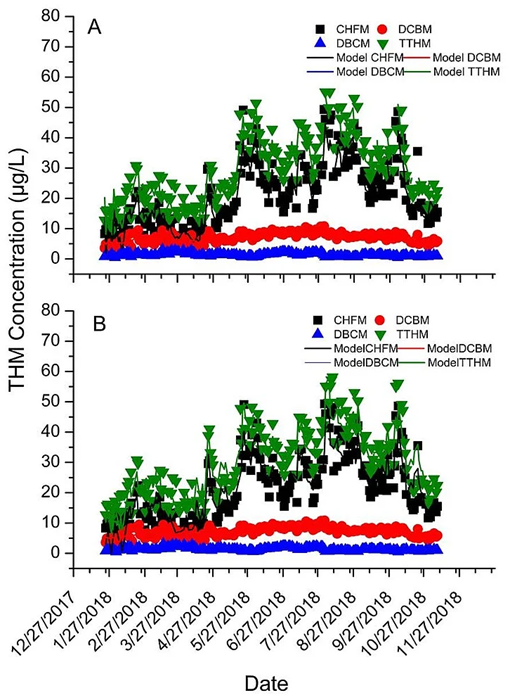
Image Credit: HORIBA
A swift, highly sensitive, non-destructive methodology predicts disinfection byproducts (DBPs) using proprietary simultaneous A-TEEM spectroscopy.
Monitoring Aquaculture Effluent Impact on Coastal Waters Using A-TEEM™ Absorption and Fluorescence Spectroscopy
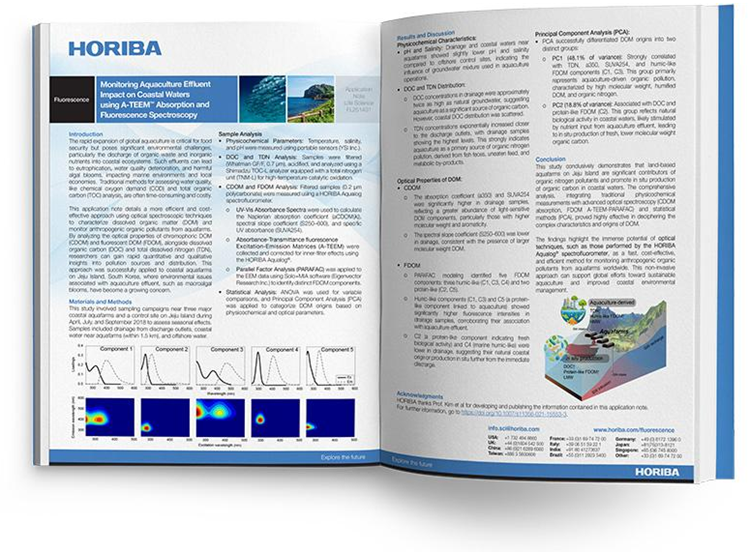
Image Credit: HORIBA
Conventional approaches to evaluating water quality, including chemical oxygen demand (COD) and total organic carbon (TOC) measurement, typically demand considerable time and financial resources. A substantially more streamlined and economically advantageous strategy employing optical spectroscopic methodologies assesses dissolved organic matter (DOM) and tracks anthropogenic organic contaminants originating from aquafarms.
Non-Invasive Analysis of Historical Chinese Textile Dyes Using EEM Fluorescence Spectroscopy
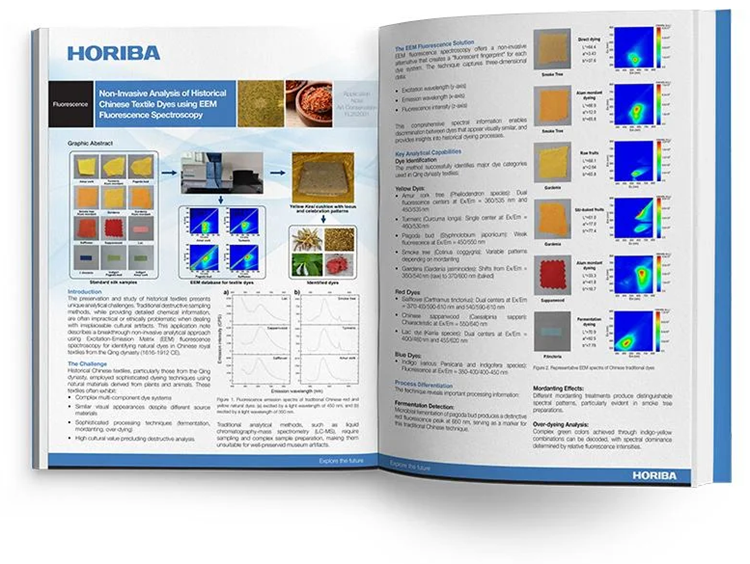
Image Credit: HORIBA
An innovative, minimally invasive analytical technique that uses excitation-emission matrix (EEM) fluorescence spectroscopy detects natural colorants in Chinese imperial textiles from the Qing Dynasty (1616–1912 CE).
Rapid Identification of Oil Contamination in Process Water Using Fluorescence Excitation Emission Matrix and Parallel Factor Analysis
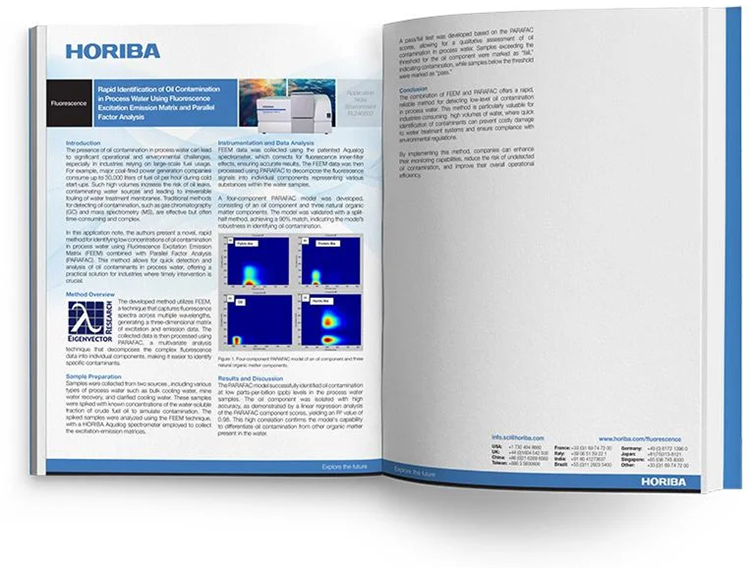
Image Credit: HORIBA
Scientists introduce an advanced, expeditious technique for detecting minimal concentrations of petroleum contamination in industrial process water by integrating fluorescence excitation emission matrix (EEM) with parallel factor analysis (PARAFAC). This technique facilitates the expedited identification and characterization of petroleum contaminants in process water, providing an effective solution for sectors where prompt action is indispensable.