Low Frequency (THz) Raman is a novel method of expanding Raman spectroscopy's already potent chemical monitoring capabilities into the spectral region. This region offers potent information on physical properties related to fine-tuning product physical properties or tracking phase transformation, drying, or crystallization processes.
Three fundamental parts make up a THz Raman analyzer:
- Light source (laser)
- Detection module (spectrometer)
- A THz Raman probe and accessories (interface)
Users can create a Raman system with many options for each of these components using the DIY THz Raman kits, which allow them to tailor the system to their unique application.
Ready to Design?
Try the pre-configured Low-frequency Raman DIY Kit, which includes:
- 785 nm L-type laser module
- Custom Professional Tier Exemplar T spectrometer
- THz Raman probe
This pre-configured Low-frequency Raman DIY kit offers an ideal starting point for low-frequency, or THz, Raman measurements.
Low Frequency Probe
The THz Raman probe features a specialized design that enables measurements as close as 5 cm−¹ to the laser line, allowing full access to the THz Raman spectral range.
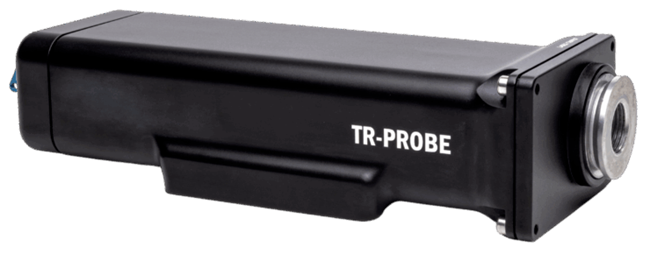
THz Raman probe showing its 38 mm Dovetail mount for accessories. Image Credit: B&W Tek
Applications for Low Frequency Raman
The physical properties of many compounds depend on variations in their physical state. Polymorphs are a clear example of this and are important in mineralogy, materials science, food and beverage, and pharmaceuticals.
Polymorphism refers to different physical forms of a material rather than changes in chemical structure.
Low-frequency (THz) Raman offers a direct, non-destructive method to measure these differences and support optimization and quality control of physical properties.
Polymorph Identification in Pharmaceuticals
Many active pharmaceutical ingredients (APIs) display polymorphism, where different forms or molecular arrangements of a compound can significantly influence the drug’s efficacy, stability, and bioavailability. These structural variations may arise during formulation, storage, packaging, or handling.
As a result, fast and reliable identification of polymorphs throughout development, manufacturing, and quality assurance is essential in pharmaceutical production.
THz Raman spectroscopy expands the capabilities of traditional Raman spectroscopy into the terahertz/low-frequency region, where distinctions between inter- and intramolecular structures can be clearly observed.
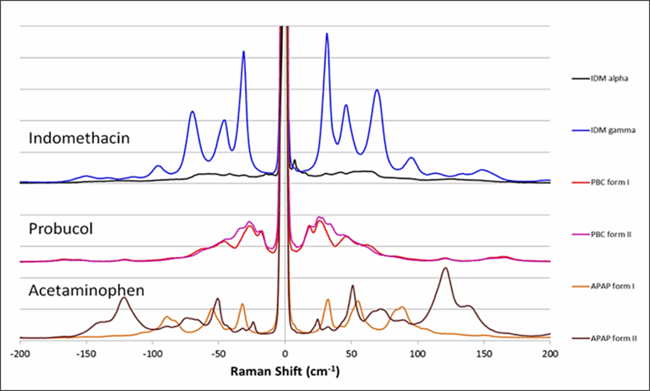
Differentiation of polymorphs for several active pharmaceutical ingredients (API). Image Credit: B&W Tek
DIY THz Raman systems enable rapid and unambiguous differentiation of polymorphs while preserving the full Raman “fingerprint region” for chemical identification.
Materials Science
Monitoring and controlling reactions, crystallization rates, and amorphous states is becoming increasingly important across the chemical, pharmaceutical, and electronics industries.
Clear and unambiguous determination of material structure (such as polymorphs), degree of crystallinity, and phase is essential for chemical process development, formulation, stability testing, and material characterization.
As materials transition from disordered to highly ordered states (e.g., amorphous to crystalline), the low-frequency bands shift and become more defined.
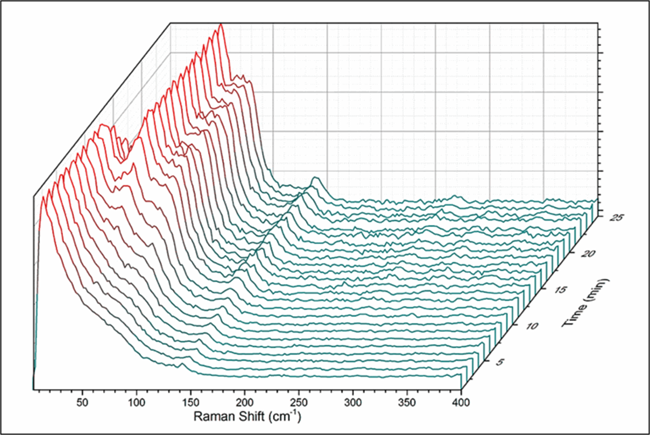
Monitoring crystallization of active ingredients in real time. Image Credit: B&W Tek
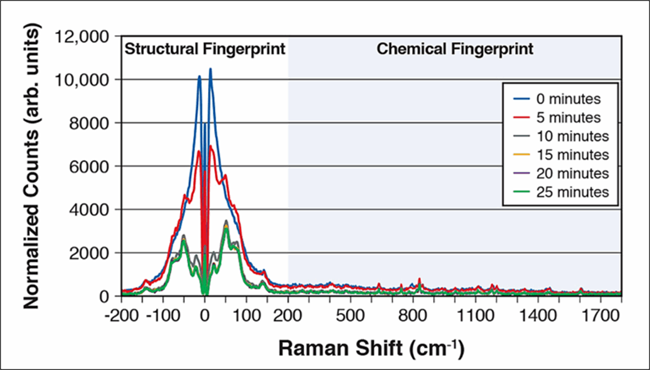
THz Raman spectra versus time showing dynamic crystallization. Image Credit: B&W Tek
With signals up to 10× stronger than conventional Raman, THz Raman systems enable rapid and unambiguous real-time measurement of crystallization and phase properties.
Explosives, Drugs, and HazMat
Today’s forward-deployed warfighters and security personnel must quickly and accurately identify compounds or residues encountered in the field to distinguish inert materials from homemade explosive (HME) substances.
Forensic specialists require information on ingredient sources, contaminants, and manufacturing methods, along with insights into formulation and storage conditions, which can provide clues about origin and production processes.
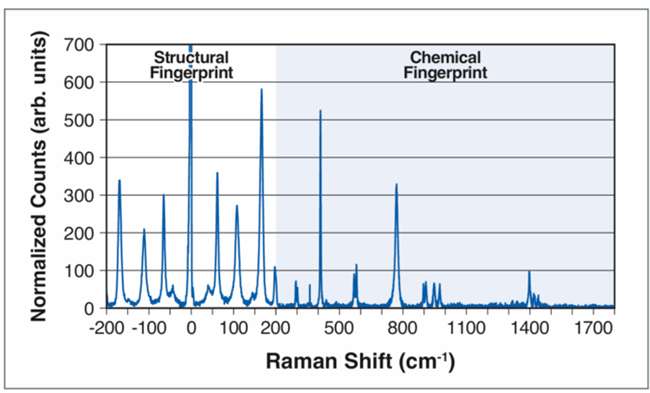
Enhanced sensitivity of THz spectra for the explosive HMTD. Image Credit: B&W Tek
Low-frequency/THz Raman analysis can detect and distinguish synthetic pathways, ingredients, and formulations, while also revealing changes related to environmental and storage conditions (e.g., heat, humidity).
These factors leave characteristic “signatures” or “fingerprints” in the molecular structure, helping forensic specialists narrow and accelerate their search for clues.