The Extended Range Raman system overcomes the usual range/resolution trade-off seen when using conventional dispersive 1064 nm Raman systems by using an 860 nm/1064 nm dual-wavelength laser combination.
Extended Range / Concatenated Raman System
- A research-grade Sol HT 1.4 spectrometer with a resolution of 10 cm-1 and expanded Raman coverage from 200 to 4600 cm-1
- A Raman probe that may be configured to operate at two different wavelengths within a single probe body
- A turn-key laser system with two wavelengths
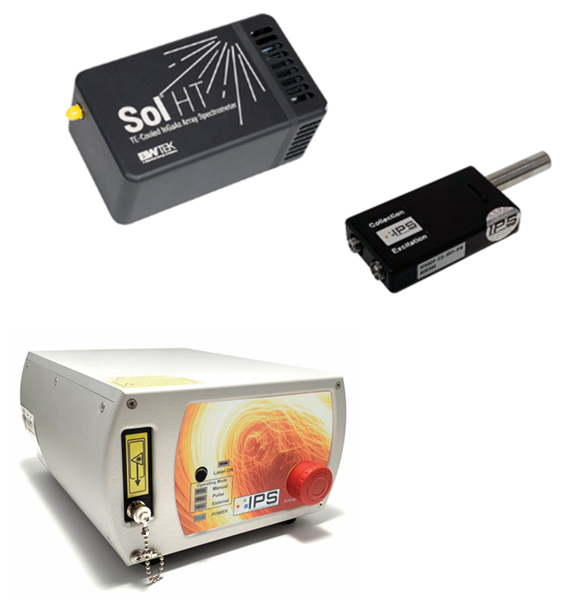
Image Credit: B&W Tek
Applications for Raman Concatenation
Raman concatenation makes it possible to shift the fingerprint excitation laser to longer wavelengths - even 1064 nm - while still measuring the Raman stretch region with an 860 nm laser when samples exhibit strong fluorescence.
This allows for the measurement of differences in aliphatic and aromatic C–H stretches, compounds exhibiting N–H stretches, and even the difficult-to-detect water O–H stretch, which extends beyond 3600 nm.
Food and Beverage
To avoid microbial development and spoiling, the USDA mandates that jerky maintain a moisture-to-protein ratio (MPR) below 0.75:1 and a water activity (aW) below 0.60.
Concatenated Raman spectroscopy is well suited for this application, as its dual-laser configuration captures protein peaks in the fingerprint region, along with O–H and C–H stretch peaks in the high Raman shift region, enabling rapid, non-destructive monitoring of both moisture and protein levels.
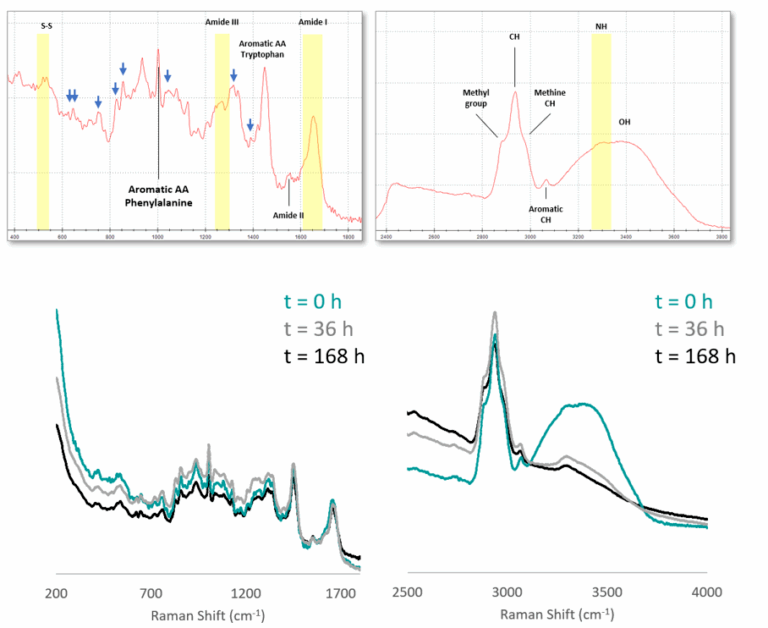
Monitoring moisture-to-protein ratio and water activity in beef jerky production. Image Credit: B&W Tek
Polymers
During the curing process, amine and epoxy groups create polymer networks, causing Raman signals to change as bonds are broken and new structures form.
Although they are more noticeable in the stretch region, these alterations can be seen in both the fingerprint and stretch regions. Concatenated Raman is an effective method for tracking and improving polymerization since the N-H peak may also be employed for Amine Value Prediction.
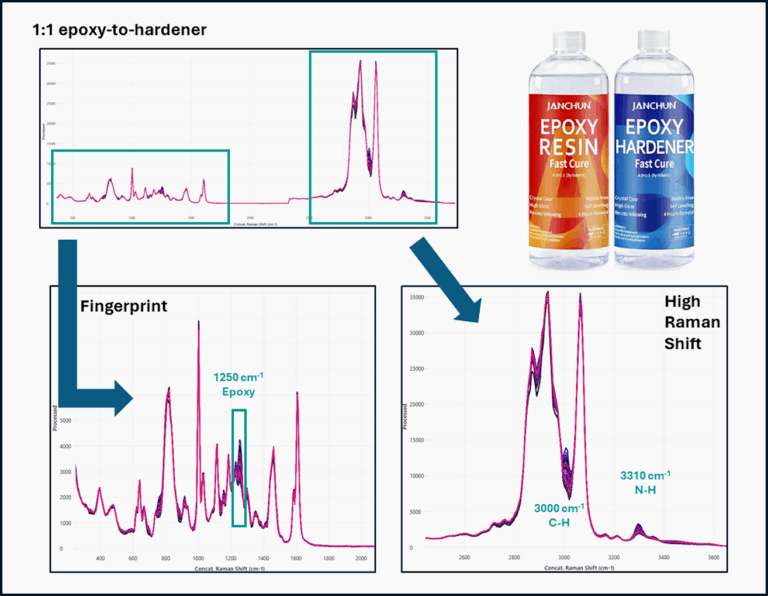
Monitoring the epoxy curing process. Image Credit: B&W Tek
Plant Health
In plant-based monitoring, the Stretch Region enables simultaneous monitoring of water content and plant stress, while the Fingerprint Region offers information on structural chemicals and carotenoids. An illustration of a typical plant sample spectrum can be found below.
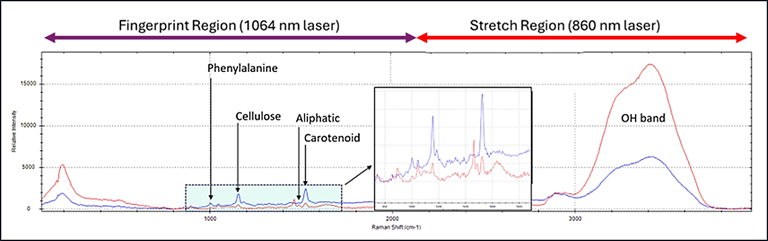
Image Credit: B&W Tek
Chemical Production
Soda ash (Na2CO3), widely used in glass manufacturing, detergents, and water softening, is mainly produced via the Solvay process, where monitoring ammonia-based chemistries is essential.
With extended spectral coverage reaching 4600 cm-1, concatenated Raman spectroscopy enables detection of N–H bonds (~3300 cm-1), offering an effective approach for real-time process monitoring and enhanced efficiency in soda ash production.
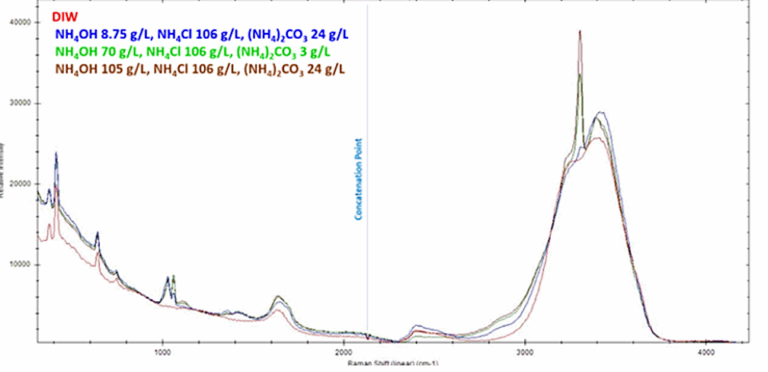
Raman spectra of critical reactants, intermediates, and products in the Solvay process. Image Credit: B&W Tek