Raman spectroscopy is a robust analytical technique used in quality control, industrial process monitoring, research and development, and routine identification of hazardous compounds, pharmaceuticals, and illegal narcotics.
These do-it-yourself kits offer the freedom to set up a Raman system with several choices for every part, allowing optimization for particular uses.
Three main parts make up the Raman analyzer:
- Laser
- Detector (spectrometer)
- Sample interface (probe)
Getting Started
These DIY Raman systems come in three common wavelengths, with bespoke wavelengths available upon request.
532 nm
Why Choose 532?
- Enhanced Raman signals
- Broader Raman spectral range
The 532-nanometer laser is ideal for inorganic materials because it provides the most excitation energy to the sample, increasing fluorescence.
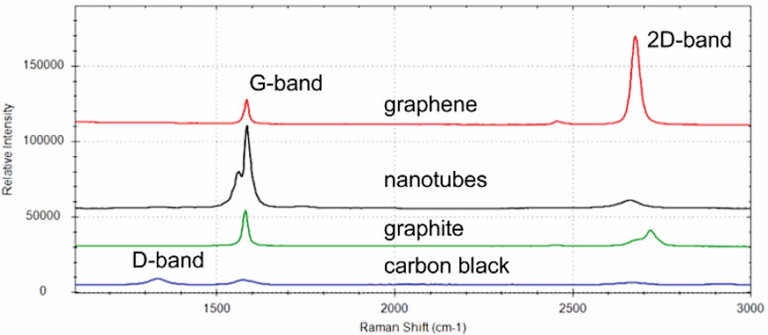
Image Credit: B&W Tek
785 nm
Why Choose 785?
- Reduced fluorescence
- High spectral resolution
The most commonly used wavelength for dispersive Raman measurements is a 785-nanometer laser because it provides an efficient balance between signal intensity, reduced fluorescence, and spectral range.
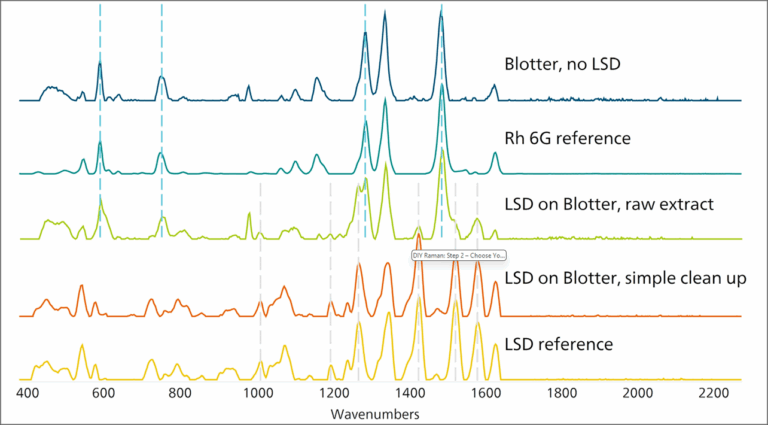
Image Credit: B&W Tek
1064 nm
Why Choose 1064?
- Minimal fluorescence
- Suitable for analyzing the widest range of samples
Darker illicit drug samples, botanicals, and highly colored substances like paints and inks are best analyzed with a 1064 nm laser since these materials typically exhibit intense fluorescence when excited at 532 nm or 785 nm.
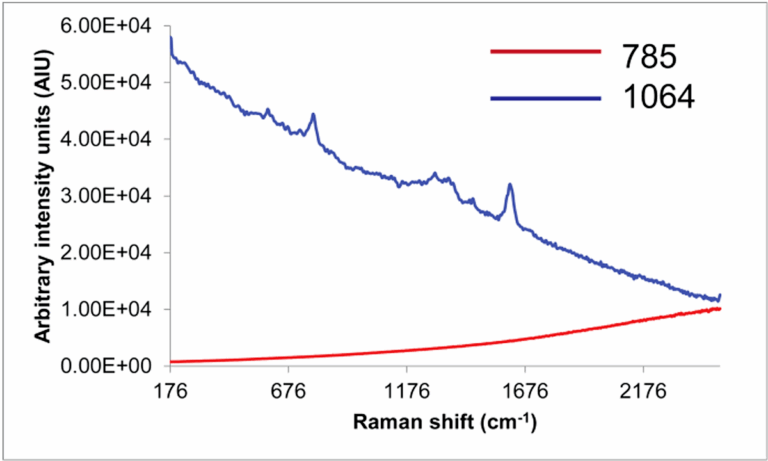
Image Credit: B&W Tek