The ZEM-3 series simultaneously measures the Seebeck coefficient and electric conductivity of thermoelectric materials.
This system incorporates a user-friendly, high-precision measurement method that responds to requests from both domestic and foreign academic groups and clients.
It complies with JIS standards for equipment used to measure the Seebeck coefficient of thermoelectric materials.
Applications
It can be used to analyze the thermoelectric characteristics of several different materials, such as metals, ceramics, and semiconductors.
Features
- Dark electromotive force is eliminated, and automatic measurements are made possible by the computer-controlled measurements, which can be carried out at predetermined temperatures on each temperature differential.
- A micro-heater for temperature differential control and an Infrared Gold Image Furnace with superior temperature control
- Ohmic contact automatic check function (V-I plot) as a standard function
- Measurement of a thin film using the original adapter
- Adaptable to high resistance
Specifications
Source: Orton Ceramic Foundation
| Model |
ZEM-3L |
ZEM-3LW |
ZEM-3M8 |
ZEM-3M10 |
| Temperature range |
-80 °C to
100 °C |
-100 °C to
200 °C |
RT, 50 °C to
800 °C |
RT, 50 °C to
1000 °C |
| Measurement properties |
Seebeck coefficient, electric resistivity |
| Sample size |
2 to 4 mm square or φ x 5 to 22 mm length |
| Measurement atmosphere |
Low-pressure He gas |
| Optional |
Cooling water circulator
Thermoelectric generation simulation software
Thin film attachment
Measurements in various atmospheres (negotiable) |
Measurement Principle
In the heating furnace, a prism or cylindrical sample is positioned vertically between the upper and lower blocks. The heater in the lower block provides a temperature gradient while the sample is heated and maintained at a predetermined temperature.
The thermocouples are pressed against the side of the sample to measure the upper and lower temperatures (T1 and T2). Then, the thermal electromotive force (dE) between identical wires on one side of the thermocouple is measured to get the Seebeck coefficient.
The dc four-terminal method is used to measure electric resistance. This method involves applying a constant current (I) to both ends of the sample to measure and calculate the voltage drop (dV) between the identical thermocouple wires by deducting the thermoelectromotive force between leads.
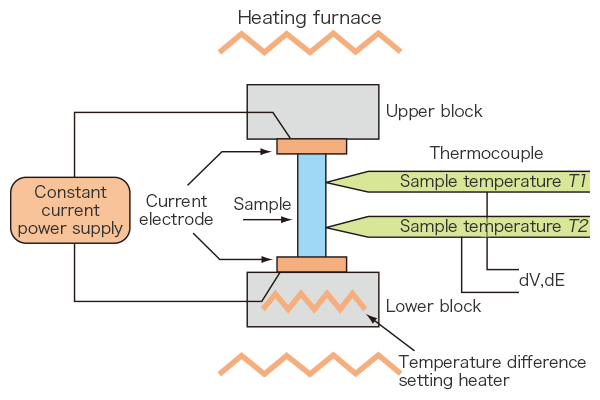
Image Credit: Orton Ceramic Foundation
Measurement Example of P Type Si80Ge20 Sintered Compact
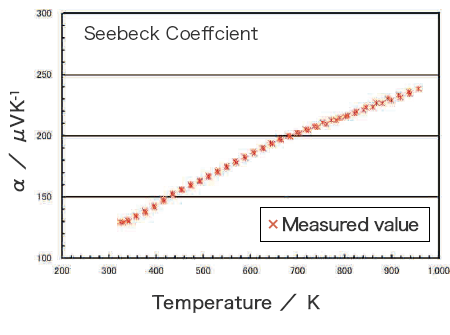
Image Credit: Orton Ceramic Foundation
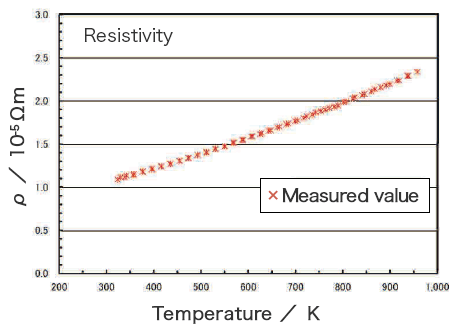
Image Credit: Orton Ceramic Foundation