The Mini-PEM can be used to calculate the thermoelectric conversion efficiency for a single thermoelectric material and a pair of thermoelectric materials.
This system has the ability to assess the thermoelectric module's conversion efficiency and power generation. A heat flow meter is used to measure heat flow, and the four-probe method assesses the current dependence of power generation; from these, the conversion efficiency is calculated.
The low-temperature half is cooled by water flow, while the high-temperature segment can reach up to 500 °C (standard specifications).
Applications
- Power generation and heat flow are used to compute the module conversion efficiency
- Evaluation of heat flow and power generation only using thermoelectric materials
- Thermoelectric module performance and lifetime evaluation
Features
- Able to assess the output characteristics of a small module that measures 2 to 10 mm (square) and 1 to 20 mm (height)
- Measures power generation and heat flow data before calculating conversion efficiency
- The high-temperature component can reach up to 500 °C
- Easy operation with control software
Specifications
Source: Orton Ceramic Foundation
| . |
. |
| Measurement properties |
Power generation amount, heat flow, conversion efficiency |
Temperature range on
high-temperature part |
50 ℃ to 500 ℃ |
| Sample size |
2 to 10 mm (square) x 1 to 20* mm (height) *maximum |
| Atmosphere |
In vacuum |
Sample System Chart
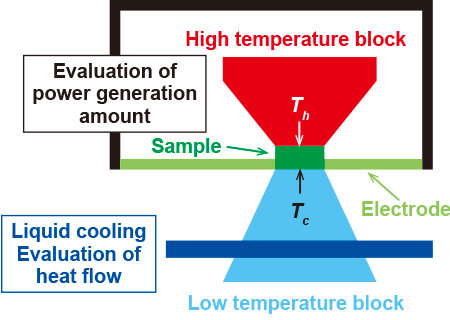
Image Credit: Orton Ceramic Foundation
Temperature Difference of Samples
Tc: Sample temperature on the low-temperature part
Th: Sample temperature on the high-temperature part
Examples of Measurement Data (Measurement of Module with a Commercially Available 8 mm Square)
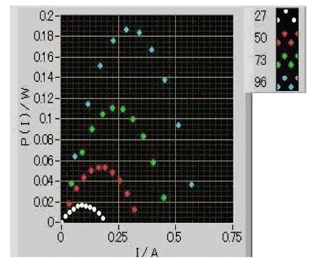
Power generation amount. Image Credit: Orton Ceramic Foundation
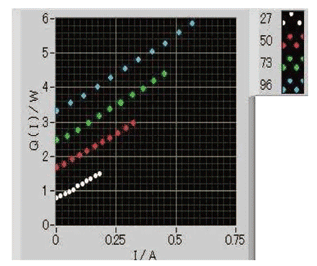
Heat flow. Image Credit: Orton Ceramic Foundation
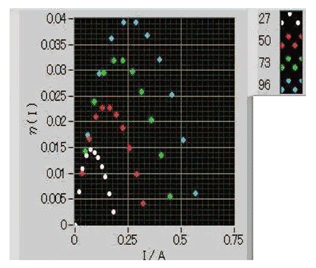
Conversion efficiency. Image Credit: Orton Ceramic Foundation