The Hot Disk TPS technique is a rapid and straightforward approach for calculating a material's thermal conductivity and diffusivity from a single test, as well as its volumetric heat capacity based on the connection between these thermal characteristics.
Method
- The Hot Disk Thermal Constants Analyzer employs the Transient Plane Source (TPS) approach, which involves a transiently heated plane sensor (Nickel double spiral) laminated between two thin sheets of an insulating material (Kapton, Mica, etc.).
- The system guarantees excellent contact when the sensor is inserted between two identical samples of a material. The sample's flat surface faces the sensor, facilitating easy use. The remaining sample geometry is less crucial (one of the numerous advantages of the Hot Disk)
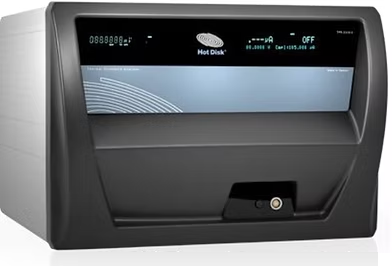
Hot Disk Thermal Constants Analyzer. Image Credit: Orton Ceramic Foundation
Range of Materials, Thermal Conductivity, and Temperatures
- The materials tested using the technique can be solids, powders, pastes, liquids, and thin films (thickness from 20 to 600 microns). The Hot Disk Thermal Constants Analyzer has been used to analyze a wide range of materials, including metals, alloys, minerals, ceramics, glasses, powders, plastics, building materials, biomaterials, and liquids.
- Thermal conductivity could be measured in the range of a few mW/m/K to around 1800 W/m/K.
- Measurements can be made between –250 °C and 1000 °C. Mica sensors should be leveraged at higher temperatures, whereas Kapton sensors can be used from cryogenic temperatures to 300 °C. Teflon sensors are also available for use in harsh or corrosive environments
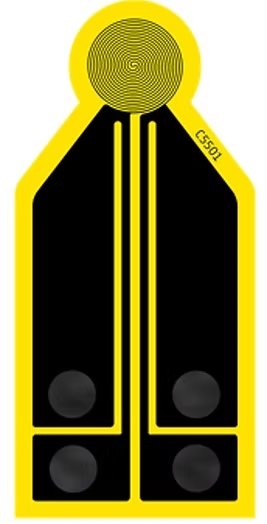
Hot Disk Kapton sensor. Image Credit: Orton Ceramic Foundation
Sensors and Sample Dimensions
- The sample’s smallest dimension, such as thickness, shouldn't be less than the sensor's radius. There is a wide range of sensor sizes available, with radii from less than 1 mm (for extremely tiny samples) to around 30 mm. Whenever feasible, it is advised to use bigger samples with the larger sensor.
Additional Capabilities
Anisotropy
The TPS features a unique module that differentiates between axial (through-thickness) and radial (in-plane of the sensor) thermal conductivities, and it can test both isotropic and anisotropic materials.
One-Dimensional Measurement
When the sample geometry or dimensions are limited to a small diameter or cross-section, but sufficient in the axial direction (rod-shaped samples), thermal conductivity and diffusivity can be evaluated along this axis using a unique one-dimensional module.
Single-Sided Testing
Single-sided testing can be employed in cases where only one sample is available for measurement: this involves supporting the sensor with an insulating material. The thermal conductivity of an insulating material should be about an order of magnitude lower than the predicted conductivity of the tested sample.
Direct Heat Capacity Characterization
A specially designed heat capacity sample holder, together with the Heat Capacity module, facilitates direct assessment of material heat capacity.