The Orton Gradient Furnace uses a single heating chamber to fire a series of samples at various known temperatures. To investigate how temperature affects the relevant ceramic qualities, each sample is measured. For R&D research and QC comparisons against established norms, this method is perfect.
Put a glazed substrate, a row of pressed discs or pieces, a trough of granular raw material, or an extruded column of green ceramic on the D-tube hearth and into the Orton Gradient Furnace. After setting the controller for a particular thermal cycle, users can either manually or automatically record the temperature of the thermal gradient while it is firing.
Once the furnace has cooled, remove the samples and note their positions on the D-tube hearth. Users can quickly observe how the range of firing temperatures influenced the shrinkage, color, porosity, particle size, degree of vitrification, and other temperature-dependent ceramic characteristics since one end of the row of materials was colder than the other. As seen in the graph, users can measure the samples' characteristics and plot their value versus temperature.
The Orton Gradient Furnace is a specifically made horizontal tube furnace that has thermocouples spaced two inches apart along a 12-inch monitoring zone. To determine the temperature conditions for each sample, samples are positioned directly beneath the monitoring thermocouples on the D-tube hearth.
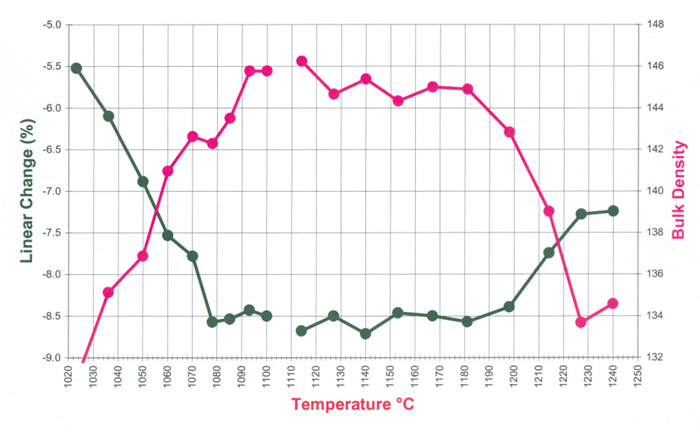
Image Credit: Orton Ceramic Foundation
Orton Model GTF-MD-16 Gradient Furnace
Observe, measure, or investigate the effects of temperature throughout a temperature range in ONE firing. The Orton Model GTF-MD-16 system provides a consistent, linear temperature gradient over a monitored zone of 12” or 16”. At 1,600 °C, the usual soak gradient is around 10 °C per inch (up to 20 °C per inch is available). Each system consists of four major components:
- The furnace is a rectangular metal shell with refractory fiber insulation and four molybdenum disilicide heating elements around one end of the 2.875" ID ceramic heating chamber tube. The samples for firing are put on the 2.5" wide high alumina D-tube hearth, which sits on the bottom of the ceramic heating chamber tube. Type "S" thermocouples are positioned at 2” centers along the monitored zone and extend vertically into the top of the heating chamber tube. The concept design on the right depicts the sample and thermocouple positions, as well as a temperature gradient. Two uniquely formed IFB end plugs are provided to cover both ends of the furnace
- The Universal Temperature Control Console (UTC) controls the furnace temperature. The UTC connects to the main power supply and meters power to heating elements. The UTC includes a programmable multi-segment PID controller, phase-angle-fired SCR solid-state power module, ammeter, ON/OFF power switch, and necessary electrical receptacles. The PID controller employs a thermocouple at the furnace's hot end to adjust the temperature, causing the monitored gradient to decrease from the control point
- The power from the UTC is routed through a step-down transformer (not seen in photos) to the molybdenum disilicide heating elements
- The Temperature Display Cabinet uses a digital panel display, rotary selector switch, and electrical receptacles to show the temperatures of thermocouples along the monitored zone. The user manually records the monitoring thermocouples' temperatures over time
Real Time Data Logging Option: An optional computer interface can be installed to show the temperatures of all monitoring thermocouples on the user’s PC during the run and preserve the data for post-firing analysis.
The GTF-MD-16 system requires 240 VAC, 30 amps, and 50 or 60 Hz input power. The temperature display cabinet requires 120 VAC and 1/2 amp power. Please inform Orton about the local power supply so that the power control system can be adjusted accordingly.
Model GTF-16 Gradient Furnace System Typical Specifications
Source: Orton Ceramic Foundation
|
GTF-MD-1612 |
GTF-MD-1616 |
| Maximum Temperature |
1,600 °C |
1,600 °C |
| Heating Chamber Tube |
High Alumina |
High Alumina |
| Monitored Zone Length |
12” |
16” |
| Monitoring T/C’s (Type “S”) |
6 |
8 |
| Control T/C (Type “S”) |
1 |
1 |
| D-tube Hearth Length” |
17” |
23” |
| APPROXIMATE Gradient in the Monitored Zone (after reaching equilibrium at 1,600 °C) |
| Average °C/inch (± 2 °C/inch) |
10 °C/inch |
10 °C/inch |
| Approximate Temperature Span |
120 °C |
160 °C |
Note: Gradient increases slightly as the equilibrium temperature decreases
Source: Orton Ceramic Foundation
| Power Requirements |
| UTC |
240 VAC, 30 Amps, 50/60 hertz |
| Temperature Display Cabinet |
120 VAC, 0.5 Amps, 50/60 hertz |
Source: Orton Ceramic Foundation
| Approximate Dimensions & Weight |
Dimensions |
Weight |
| GTF-MD-1612 Furnace |
25” long x 15” W x 18” T |
70 pounds |
| GTF-MD-1616 Furnace |
32” long x 15” W x 18” T |
85 pounds |
| UTC Console |
17” W x 14” D x 5.5” T |
17 pounds |
| Step-down Transformer |
15” long x 9” W x 10” T |
68 pounds |
| Temperature Display Cabinet |
10” W x 8” D x 4.5” T |
5 pounds |
Gradient Furnaces
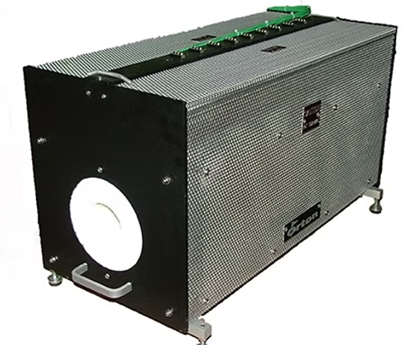
Image Credit: Orton Ceramic Foundation
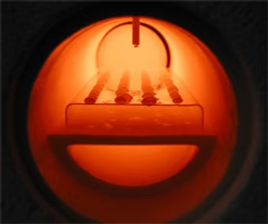
Image Credit: Orton Ceramic Foundation
Gradient Furnace (1600 °C Model)
The Orton GTF-MD-16 Series (1600 °C maximum) Furnace is a horizontal tube furnace with regulated, reproducible linear thermal gradients of around 10–12 °C per inch. Available in 12” and 16” monitored zones, with a maximum firing temperature of 1600 °C.
Thermocouples on 2” centers monitor temperatures throughout the gradient zone, allowing the material's temperature to be determined at any point along the Sample D-tube hearth. Visual or post-firing studies of sections cut from the fired material at any place can be quantified, recorded, and examined as a function of temperature.
The furnace is a rectangular metal shell construction that contains refractory fiber insulation and four molybdenum disilicide heating components that encircle one end of the ceramic heating chamber tube with a diameter of 2 7/8”. The samples to be burned are put on top of the 2.5” wide high alumina D-tube hearth, which is mounted on the bottom of the ceramic heating chamber tube.
Type “S” thermocouples are placed 2” apart along the monitored zone and run vertically into the top of the heating chamber tube. Two IFB end plugs are provided to shut both ends of the furnace.
Liquidus Furnace
A liquidus furnace is important for identifying the highest temperature at which crystallization occurs in a glass, as well as the minimum temperature at which a glass can be stored for long periods of time without crystal formation and development.
Samples of glass, frit, or cullet are put onto a platinum tray and placed in the hot Orton Liquidus Furnace for 1 to 24 hours. The Orton Liquidus Furnace is a particularly built horizontal tube furnace with a regulated, repeatable, linear thermal gradient of around 120 °C throughout a 12” long monitored zone; the glass temperature in the tray is proportional to its position along that 12" zone.
The tray is withdrawn when hot and allowed to cool, freezing the glass in the state it evolved within the furnace. Visual or microscopic inspection reveals the crystal boundary plane (the Liquidus Point), and the temperature of that plane is interpolated from the known gradient's temperature/position connection.
Gradient Furnace (1200 °C Model)
Furnaces constructed with reduced temperature needs are less expensive. Furnaces with a maximum temperature of 1200 °C have the same design features as higher temperature units, but they can employ lower-cost insulation packages, heating elements, power controllers, and thermocouple sensors.
If the application requires a maximum temperature of 1200 °C or below, contact Orton for a custom quote to match the gradient furnace requirements.
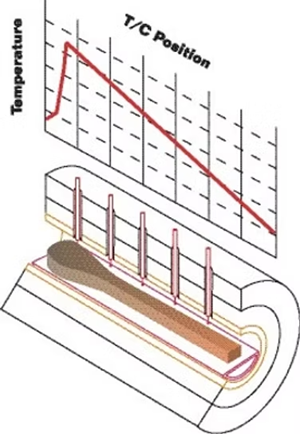
Image Credit: Orton Ceramic Foundation